



Pat Brown arrives with his team after the session has begun.
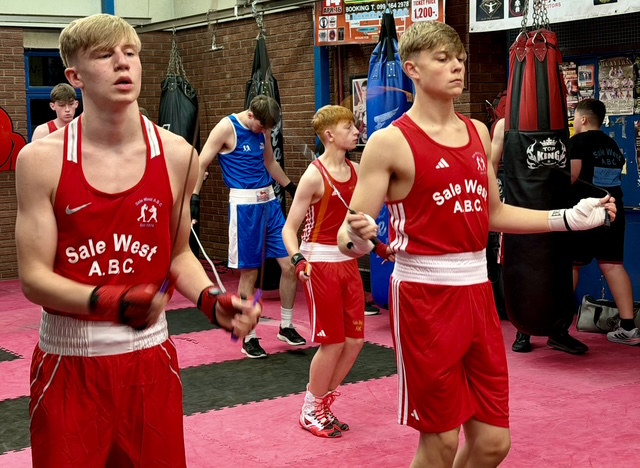
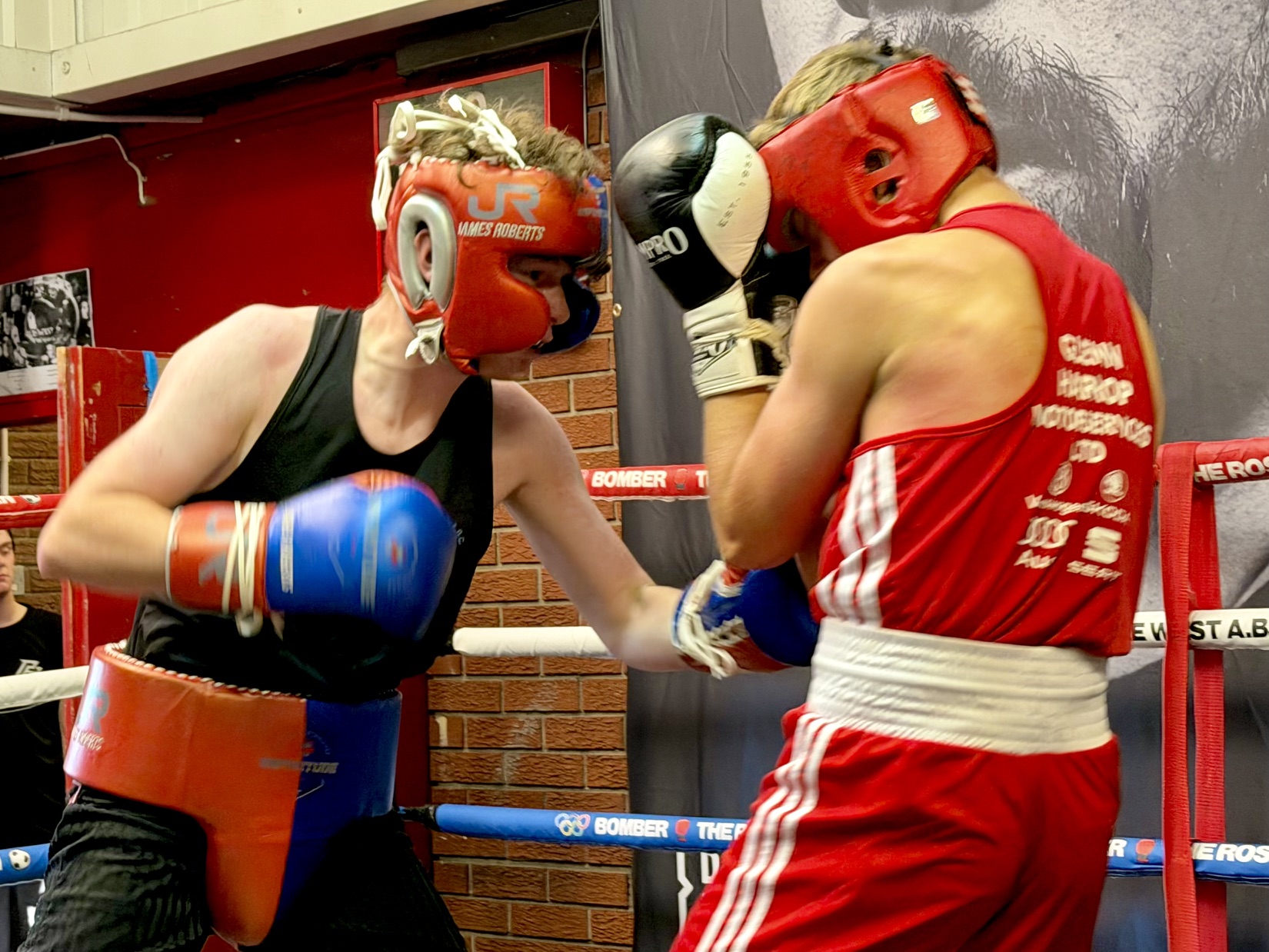
By then, the bags are already swinging inside Sale West Amateur Boxing Club. Young fighters are moving around the pink-and-black floor. Two boxers are sparring in the ring. Coaches are holding pads, calling instructions and watching the feet.
Pat’s father, Mike, is here. So is his younger brother Dan, already coaching. Ben, the youngest of the three Brown brothers, is among the teenagers training.
Then Pat walks in: the Olympian, the unbeaten professional, the local boy whose photograph now appears beside those of the champions who once inspired him.
There's excitement, of course. Pat Brown is becoming a significant figure in British boxing. Six professional fights have brought six stoppage victories. He holds the WBA International and IBF Intercontinental cruiserweight titles. On 19 September, he will headline at Manchester’s Co-op Live against the undefeated John Hedges for the British and Commonwealth titles.
But inside this building, the superstar is also Mike’s eldest lad.
Pat talks to the young boxers. He watches them work. He works with them on technique. Around him, Dan continues coaching and Ben continues training.
The scene contains the whole story of Sale West ABC: a father, three sons and an inheritance being passed around a crowded room.
.jpeg)
Sale West doesn't look like an elite sporting laboratory. It looks better than that.
The gym sits inside Sale West Community Centre on Newbury Avenue. Its brick walls are covered with photographs, posters and the accumulated memory of nearly half a century. Bags hang from steel frames beneath fluorescent lights. The ropes are worn. The floor is patched together in pink and black mats. Every available surface appears to have been pressed into service.
Nothing's decorative. Everything has been used.
On one wall, Ricky Hatton is frozen in the act of landing a punch. Hatton trained at Sale West before becoming a world champion and one of Manchester’s most loved fighters. His image remains part of the room, not as distant sporting mythology, but as evidence that extraordinary journeys can begin here.
The club was founded by Paul Dunne - Mr Dunne to Mike, in 1976 and celebrates its 50th anniversary this year. Its stated purpose isn't only to develop fighters, but to create a safe and inclusive environment in which people can build confidence, discipline and belonging.
That language can sound familiar on a website. Inside this gym, it becomes immediately visible.
Pat first came through its doors as a hyperactive seven-year-old. At first, Mike says, it was somewhere for his son to play and exhaust some of his almost limitless energy.
“He was a very energetic kid and, when he came, he loved it,” he remembers. “At first, it was just a bit of playing for him because he was very young.
“Then, probably as the months went on, we started showing him bits because you could see the interest. He was just like a sponge, sucking it in, even at a young age.”
Pat remembers that the club gave him something far more consequential than the ability to throw a punch.
“People think it taught me boxing,” he says. “Of course it taught me boxing. But the main things it taught me were my morals, my respect, my manners - looking out for the vulnerable at school and stuff like that.
“It teaches you not to be a bully. They’re the main fundamentals that boxing can teach you, especially in a place like this.”
It's an arresting corrective to the image some people still hold of boxing gyms: rooms in which aggression is cultivated and the strongest child prevails.
Pat describes the opposite. Sale West taught him that strength carries obligations.
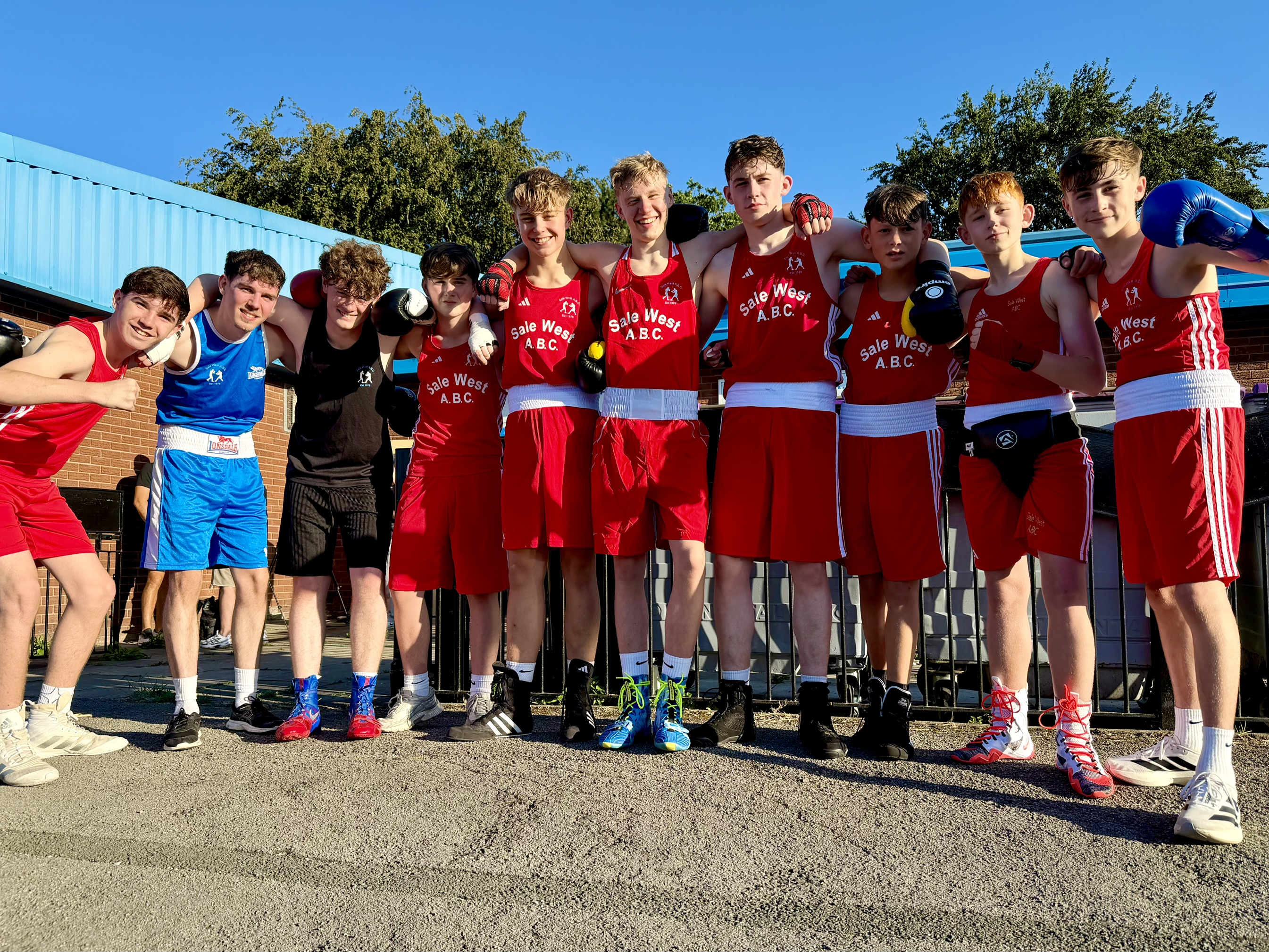
The young boxers training around him are mainly 15 and 16. They are confident, funny and remarkably attentive. They meet an unfamiliar adult’s eye. They answer questions politely. They listen to one another.
Not one is scrolling through a phone.
Asked how they feel when they walk out after training, the answers come quickly.
“Recharged.”
“Tired.”
“Happy.”
“Relieved.”
“Accomplished.”
One of them struggles to describe the apparent contradiction of physical exhaustion and mental renewal.
“Refreshed,” he says. “It’s a weird feeling. Even though you’re sweaty, you’re still refreshed.”
Pat recognises himself in them.
“These are all hungry kids wanting to do well in the sport of boxing - and just in life in general,” he says.
The habits required in the gym, he believes, travel out into the rest of their lives: into exams, revision and eventually job interviews.
“What boxing instils into you mentally, you take that into everyday life,” he says. “When I’m seeing these kids in here, I see hungry little lions like I once was.”
Nine of the boys raise their hands when asked who wants to become a boxer. Ben Brown is among them.
After watching his eldest brother, he's asked whether he wants to follow him.
“I hope I’m better than him,” Ben replies.
That, he knows, will annoy Pat. Becoming bigger than him would be satisfying too.
The laugh carries the familiar sound of brothers competing, but Ben’s answer also reveals what Pat represents to these young people.
“Just the fact that he’s from around here,” another young boxer says, “shows us that people from around here, who live around here, can do it as well.”
Pat doesn't arrive at Sale West as an inaccessible celebrity performing inspiration for a convenient photograph. He's the material proof of possibility.
He began where they're beginning.
Competition didn't begin in the gym for the Brown brothers.
“All my life, me and my dad have always been in competition,” Pat tells me. “We’ve always had a laugh. He’s always play-fighting with me. He’s always raced me against my brothers to the bin.
“He’ll say, ‘First one to get to the bin, put that in the bin and get back wins.’
“Everything’s a competition in my house. I’ve got two brothers, they’re both younger - and my dad, he may as well be a child as well.”
At home, Mike was Dad. In the gym, the distinction became more complicated.
“When you’re a dad and a coach, and you’re coaching your sons, all the kids are like your kids,” Mike says. “I used to always say to them: ‘You’re no different from any other kid here.’
“So I was probably harder on my own kids compared to the other kids, because I wasn’t letting everyone think, ‘Oh, he lets his kids get away with this.’”
Pat eventually understood that, for his boxing to progress without consuming their relationship, he needed to leave Sale West. At 20, after 13 years at the club, he moved to Moss Side Fire Station Boxing Club and later into the GB system.
“For me personally, with my dad, we’re so alike and we’re so passionate with each other - and we love each other so much - that can only take you so far before you start losing your father-son relationship and boxing takes over,” Pat says.
“We’ve got it where it’s just perfect now.”
Away from the gym, the old domestic roles return. Pat sits in Mike’s chair. Mike tells him to get out of it. The competition resumes.
“We’re very close-knit,” Pat says. “We love each other dearly. We’re a big family unit. He’s always Dad to me.”

The Brown family’s boxing story would be simpler if it consisted only of Pat’s ascent.
But Sale West isn't a place of simple sporting narratives.
Dan, the middle brother, was an elite amateur. He competed among fighters who progressed into the GB system. He won some contests against them; they won others against him.
Around 18 months ago, he told his dad that he was finished with boxing.
Mike found that difficult.
“I felt bad because his brother’s made it,” he says. “His younger brother Ben is a three-time North West champion, and our Dan was very good and elite, but he just wanted something else.”
Yet Dan hasn't disappeared from the gym. On this evening, before Pat arrives, he's already coaching.
One brother has become the headline fighter. Another is passing on what he learned. The youngest remains among the teenagers, still testing the limits of his own ability.
All three journeys matter.
Pat wants his success to show his brothers what commitment can achieve.
“Success to me really is just making my dad proud, making my family proud, showing my brothers that if you do put your mind to something, you can get there,” he says.
He's careful not to rewrite his early career as an uninterrupted march towards greatness.
“I was an amateur kid. I would win, lose, win, lose when I was younger. I lost a good handful of times. Then, when I started growing into the youth and growing into a senior, that’s when I started performing well.”
The professional record might now read six victories and six stoppages, but the deeper inheritance isn't invincibility. It's returning after losing.
Mike knows that most of the kids who walk into Sale West will not become professional fighters.
Some have a genuine chance. Others will eventually discover that their future lies somewhere else. A responsible coach must nurture belief without allowing a young person to be damaged by a dream that has passed beyond reach.
Mike has twice had to tell boxers he had coached for years that it was time to stop.
“As a coach, you don’t want them to keep getting hurt and getting headshots,” he says. “As a good coach, you’ve got to tell them - even though that night you’ll go home and, as a man, you’ll cry.
“Because you’ve been with them for seven, eight, nine years.”
It's maybe the most revealing description of coaching offered all night.
The duty isn't to extract one more contest from a fighter. It's to know when protecting them matters more than winning.
“More than anything, apart from the winning and the losing, you’re making men and young women out of them,” Mike says. “You’re giving them a way of life.
“I know they get a way of life at home with the parents. But sometimes, you know what it’s like - they don’t always listen to Mum and Dad, but they’ll listen to a coach.”
The transformation can begin with the smallest things.
“When they first walk through the door, they can’t even skip or throw a punch properly,” Mike says. “At the end of it, when they can, it’s still an achievement.
“You don’t need medals for them to be proud of themselves. The medals are a bonus. If you can make someone happy and proud, and give them discipline - good people, that’s it.”
Good people.
Not just winning fighters.

One of the teenage boxers says Sale West has taught him how to look after himself - but also when not to use what he knows.
“You don’t only learn how to fight,” he says. “You learn how to use it properly, without getting into too much trouble and causing trouble. Overall, it teaches more good than bad.”
Others describe losing weight, gaining fitness and acquiring the confidence to walk in front of a crowd.
“Do you all feel much more confident than when you started?” I ask.
“Yeah,” comes the collective reply. “One hundred per cent.”
One coach tells the story of a boy who arrived unable to make eye contact or mix easily with the other children. After several weeks, he was encouraged to perform a demonstration in front of the group.
The boy didn't think he could do it.
He did.
He's now a central part of the club and, in the words of the coach, growing into a fine young man.
Another parent talks about a mother bringing her son, who has ADHD, to Sale West for the first time. He loved it.
The message from the staff was immediate: “We’re your family now too.”
Pat understands why the boy might have arrived nervously.
“People have this anticipation that if you walk into a boxing gym, it’s this big, scary place,” he says. “It’s really not.
“If anything, it’s the safest place you can possibly be. People are all respectful. They look after you.”
He has seen people carry the confidence acquired here into universities, crowded rooms and situations that once caused anxiety.
“They think to themselves: ‘I’ve walked into a boxing gym with people who can fight. What’s there to be scared of?’”
Sale West is closed at Christmas and during Manchester Marathon weekend. Otherwise, it is there.
That continuity is crucial.
“Some of the kids have real stuff going on at home,” one parent explains. “They’ll never get away on holiday or anything like that, so the club is a constant.”
A constant is different from a project.
It's not a six-week intervention created to satisfy a funding criterion. It doesn't ask a child to transform according to an administrative timetable. It's a door that remains where it was, a coach who remembers your name and a place where your absence is noticed.
Mike remembers a time when the wider youth centre was alive with football, netball, karate, Thai boxing and trips for children whose families couldn't otherwise afford them.
“They used to send them by the coachload for days out to Blackpool,” he says. “And it was all funded. Those days have gone now.”
He believes the decline of youth provision is a profound national mistake.
“Bring back youth centres,” he says. “That’s not just the boxing - Thai boxing, football, cricket, basketball, judo, karate, whatever sport’s going.
“Even the youth clubs for some of the kids to hang about in during the winter, so they’re not on the street. You’ll get better kids out of it all. You’ll get more kids who aren’t going down the wrong path and going to prison.
“I can promise you that. I really can.”
Mike points to young men from the club’s earlier years who might otherwise have ended up in prison, but whom Paul Dunne and Sale West helped to keep “on the straight and narrow”.
He also makes the basic public-health argument. If government is concerned about childhood inactivity and obesity, investing in places where young people learn how to train and what to eat should be obvious.
“It’s a win-win,” he says.
Yet the club must continually find money for boxing affiliation, insurance, its minibus and the ordinary costs of keeping young people safe. Sale West charges only £3 per child.
“It really is hard,” Mike says.
He's emphatic about the importance of Amey, his employer, and Trafford Council, which he describes as crucial partners in the club’s survival.
Community institutions don't remain open through affection alone. They need organisations willing to recognise their value before they disappear.
For Pat, Sale West was the beginning rather than the limit.
Moving to Moss Side gave him a new environment and renewed hunger. Entering the GB system exposed him to relentless competition with the country’s finest amateur boxers.
“I’d never been in such competition every single day,” he says. “You’re against the best of the best. I qualified for the Olympics and was always getting pushed by unbelievable athletes alongside myself.
“These environments just made me grow and grow and grow.”
Now another new environment waits.
On 19 September, Pat will face John Hedges. Both men are undefeated. The British and Commonwealth cruiserweight titles will be on the line.
It will be only Pat’s seventh professional contest and his third as a headline fighter.
“This sort of pressure, I’m rolling with it,” he says. “It either makes you or breaks you. If I want to get to the top, there’s going to be a hell of a lot more pressure than this.”
Fighting in Manchester means thousands of his own supporters can attend, but Pat insists the location does not alter the essential task.
“A ring’s a ring.”
His concern is that the people who have followed him enjoy the occasion.
“As long as they have a good night, I’m not really bothered,” he says. “As long as they’re happy.”
.jpeg)
When Pat is asked who will own a tiny piece of the British title if he wins it, he doesn't hesitate.
“The whole of this gym,” he says. “Sale West means everything to me. I love this gym.
“This is where I was born and bred. My dad still runs the gym. My brothers are here. One of my brothers is coaching now; the other one’s still fighting.
“This will always have a place in my heart, forever.”
Around Sale West, the area is known as the Racecourse. Pat wants the people there to see something of themselves in whatever happens next.
“If they can take any positivity from it,” he says, “then it makes me really happy.”
At the end of the evening, everyone gathers for a photograph.
There are young children, teenage fighters, coaches, parents and volunteers. Mike stands at one side. Dan is among the adults. Ben remains with the young boxers. Pat is at the back, taller than almost everyone, unmistakable but not separate.
It's not a photograph of a star visiting a community project.
It's a family portrait.
In September, the lights at Co-op Live will find Pat Brown. His name will fill the screens. The belts will be held aloft and the cameras will tell the story of two unbeaten fighters meeting in a Manchester arena.
Sale West will understand the longer story.
Afterwards, whatever the result, somebody will return to Newbury Avenue and unlock the community centre. The bags will begin to swing. A child will step through the door unable to skip, throw a punch or meet another person’s eyes.
Perhaps that child will become a champion.
Perhaps they'll become a coach.
Perhaps they'll simply become happier, prouder and more certain that they have a place in the world.
You don't need a medal for that.





