



Outside Live Theatre on Newcastle's Quayside on Friday night, before anybody had taken a seat, the question had already escaped the stage.
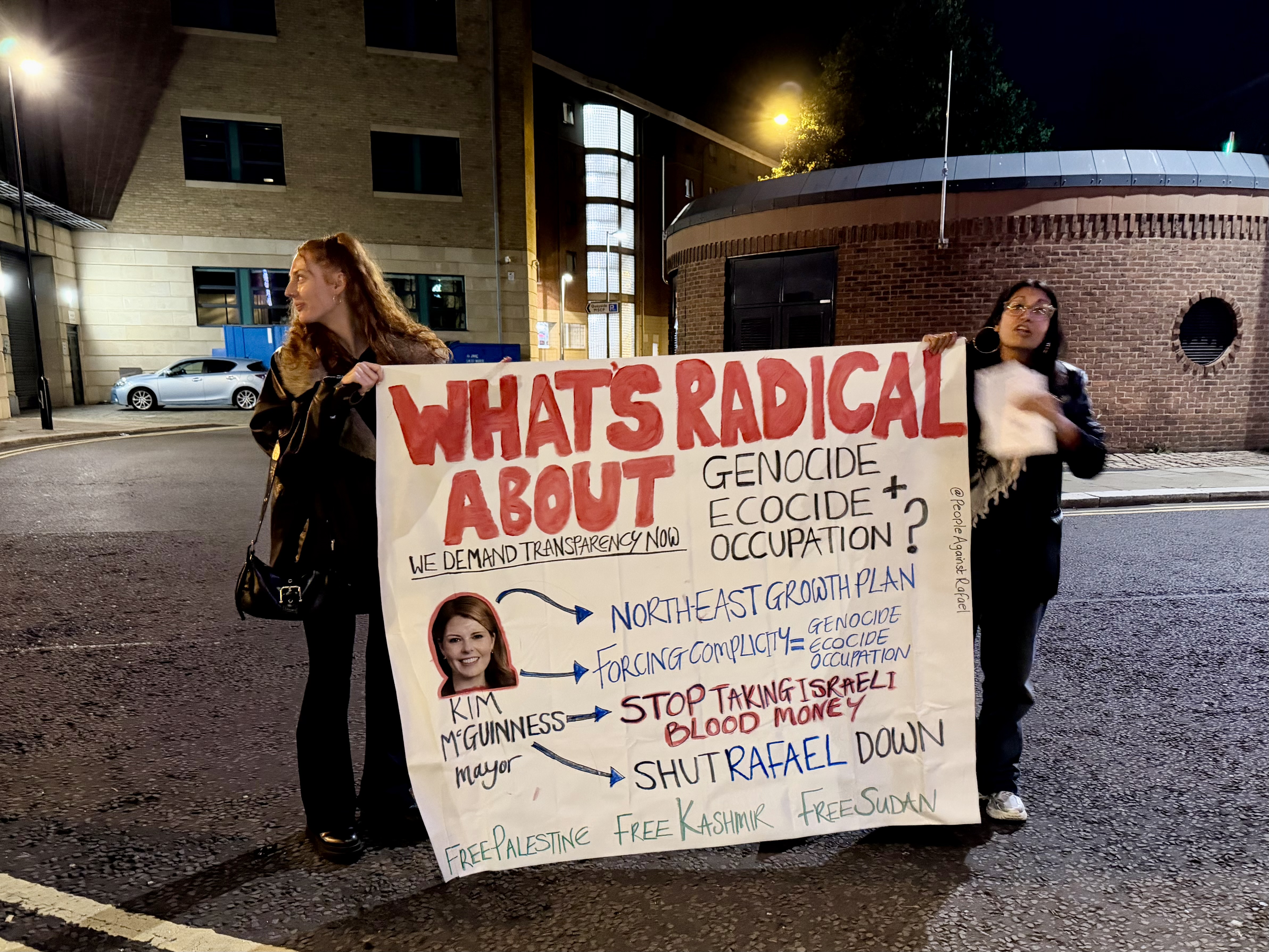
A small group of protesters stood on Broad Chare with leaflets about Rafael Advanced Defense Systems, Pearson Engineering and North East Mayor Kim McGuinness. Their presence was justified and pointed. The evening had been billed as an urgent discussion about the political and cultural place of the North East: whether this was finally the region’s moment, and what “truly radical” change might require. The protesters had arrived with a less abstract version of that inquiry. What does radicalism mean when jobs, investment, public power and war become entangled? What is a political promise worth when people ask you to choose?
All around it, Newcastle had kicked-off Great North Run weekend. Barriers were appearing, runners and families were arriving, and the city was readying itself for Sunday’s great collective movement from Newcastle to South Shields. Some 63,000 people were expected to take part. McGuinness herself was due to be among them.
The juxtaposition was difficult to resist. Outside, a region was preparing to move together. Inside, an audience was asking whether the North East itself could move - and whether those with power were prepared to set the pace, surrender control or carry people with them.
The atmosphere initially held something warmer: expectancy, humour and the familiar closeness of a theatre in which ideas rarely remain safely theoretical.
Live Theatre’s artistic director, Jack McNamara, welcomed an audience gathered on what he called “the most inconvenient evening of the year”, with the Great North Run imminent. Artists, he joked, supported running “from a safe distance”. The one house rule was kindness. Political passions were welcome, but people should disagree without abandoning each other. Anyone failing the test risked a rendition of Big River.
It was witty, hopeful and precisely judged. It also established a standard against which the evening would later be measured.
McNamara located the discussion in Live Theatre’s own history. Founded 53 years ago without a permanent building or much money, it took work into working men’s clubs and shopping centres, determined to bring theatre to people who had been told - directly or otherwise - that art was not for them. Radicalism here wasn't a branding exercise. It meant changing who could enter the room, whose life was represented and where culture happened.
That inheritance framed The Radical North East: Is This Our Moment?, presented with the New Statesman and prompted by Live Theatre’s forthcoming stage return to Peter Flannery’s Our Friends in the North. The advertised chair, New Statesman editor-in-chief Tom McTague, was unable to attend. Journalist Kevin Maguire stepped in at short notice - an experienced, lively replacement who handled a crowded stage and an increasingly charged room with generosity.
But McTague’s absence was difficult to regard as wholly incidental to the meaning of the night. Here was an event co-presented by a London-based national political magazine, convened to ask whether the North East might at last control its own story, without that magazine’s advertised editor-in-chief in the room. There may have been an entirely unavoidable reason; none was offered to the audience beyond the programme change. Still, in a discussion repeatedly returning to distance, attention and the tendency of national institutions to discover the North selectively, the empty chair acquired an awkward symbolism of its own. The North East was again debating whether it mattered - while one of the people invited to help frame that national conversation was somewhere else.
Onstage were North East Mayor Kim McGuinness, Newcastle Central and West MP Dame Chi Onwurah, Middlesbrough playwright Ishy Din and writer Alex Niven, joined on the night by Newcastle Green councillor Nick Hartley.
Before them came theatre - and theatre did something the panel would spend the next 90 minutes attempting in political language.
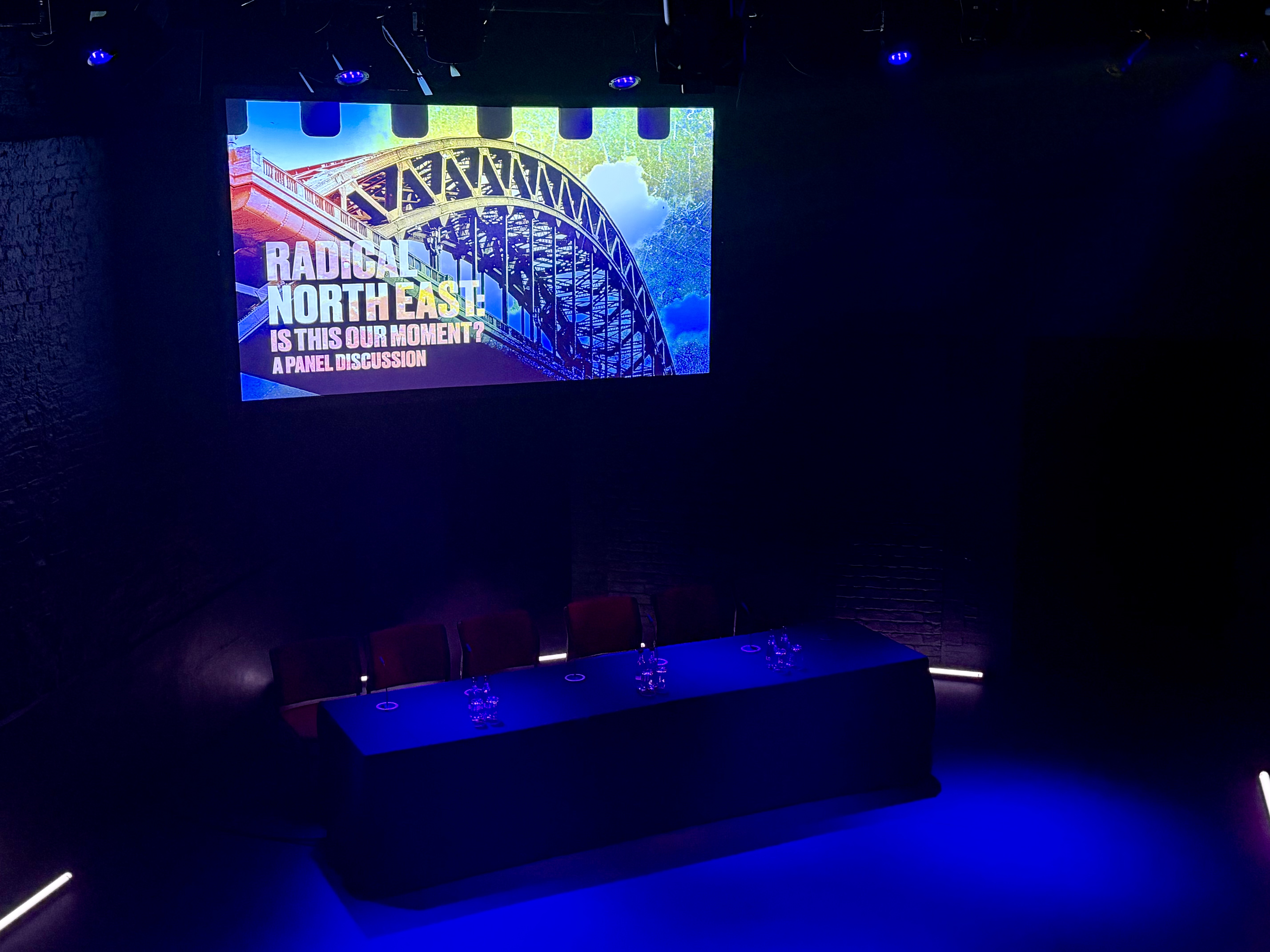
Trevor Fox and Ryan Nolan offered a preview of the opening of Our Friends in the North: The Thatcher Years. It was funny, but its humour carried grief. “Remember,” the piece asked, a time when politics was not a career or a contract, but a way of changing lives for the better; when people were promised dreams rather than merely protection from nightmares.
The reading compressed the loss of industrial confidence, organised labour and collective expectation into something felt rather than itemised. Decisions made elsewhere arrive here as closed works, broken communities and altered lives. The point was not that the past was innocent. It was that politics once dared to describe a future.
Then Vici Wreford-Sinnott delivered what was introduced as a love letter to the radicals.
“Imagine a North East where no child is hungry - and it isn’t called radical.”
Her monologue moved down the A19, away from the lazy assumption that Newcastle can stand for the whole region: red-brick back streets, coal dust, slag heaps, women holding everything together, men outside working men’s clubs, and children capable of imagining otherwise. It refused both shame and the sanitised North East sold back to itself as heritage. This wasn't nostalgia “safely behind glass”, but a region “alive, messy, angry, funny”.
Its defining question was simple: “Are we still asking who gets to tell the story?”
By the end, the official version was being metaphorically set on fire so that something else might be built. It was stirring because it described radicalism not as a regional personality trait, but as a practice: speak up, disturb the approved account, enlarge the story and redistribute the authority to tell it.
Then the panel began, and the distance between radicalism as inheritance and radicalism as government opened up.
Parochial. Provincial. Left-behind. Angry. Different.
Those were the old descriptions moving beneath the new language. Some had been imposed from outside; some had been half-reclaimed as proof that the region wouldn't be absorbed into somebody else’s England. “Radical” might be a route beyond them. It might also become a more flattering label for the same old distance from power.
Alex Niven called radicalism the North East’s “birthright” and “inheritance”. His argument began in the region’s repeated experience of being first and last: an edge of empire; then a workshop of industrial modernity; later a place found near the bottom of measures of income, health and opportunity. England, he suggested, has repeatedly failed to work for this region. A desire for a different country follows.
Ishy Din was less interested in romance than necessity. Deep-rooted problems can't be repaired with patches, he argued; simple answers to damage accumulated over half a century are fantasies. Radical change is required precisely because the alternatives have already been tried.
Onwurah found the region’s radical tradition in solidarity and collective institutions: trade unions, co-operation, feminism, engineering and the expectation that working people could organise power rather than merely appeal to it. Her recollection of leaving Newcastle for an engineering job in London - and asking where she should go to join the union - drew laughter. The alarm with which the question was received became, for her, a lesson in how different the political common sense of two parts of England could be.
Hartley pushed devolution further downwards. A mayoral settlement can still reproduce distance if power stops at the combined authority. A genuinely radical politics, he argued, would give communities meaningful control and dismantle the notion of a sealed professional political class.
McGuinness was emphatic: “It is absolutely our moment.” For her, devolution was the central instrument - an end to decisions about the region being made by officials and politicians in Whitehall who neither live with their consequences nor understand the places affected. The North East now had a louder voice and a greater opportunity to decide its own future.
There was broad agreement that England is grotesquely centralised. But agreement isn't the same as an answer. Devolving responsibility without devolving sufficient money can make local leaders the administrators of scarcity. Niven warned that decentralisation has to be matched by national reconstruction: reform at Westminster, public institutions working across regions, and a settlement capable of redistributing power and wealth rather than simply relocating blame.
McGuinness supplied one of the night’s clearest demands: a strategic period of overinvestment in the North - in transport, skills, housing and infrastructure - not another formula that gives deprived places a slightly larger share of an inadequate pot. Asked whether that might upset the South, she was untroubled. The present arrangement already concentrates investment and economic power in one corner of England. Fairness will feel unfair to those accustomed to priority.
That was radical language. The unanswered question was whether the institutions represented onstage possess, or will fight to obtain, the power required to turn it into a material programme.
Housing brought the discussion closest to the daily meaning of power. Hartley described Newcastle’s housing crisis as a “crying shame” and placed council housing and an end to homelessness at the top of any radical programme.
The argument mattered because “security” is frequently invoked by governments to describe borders, policing and defence. Here it meant something more intimate: knowing where you will live; knowing what you will earn next week; knowing that work will provide a pension; being able to plan a life.
Din punctured a familiar piece of industrial nostalgia. His father had worked very hard - and hated the job. What people miss is not necessarily the pit or shipyard, but the stability around them: regular pay, collective organisation, a recognised place in the economic life of the region and the knowledge that the work led somewhere.
That distinction should shape any honest account of reindustrialisation. Nobody needs another museum of masculine hardship. The task is to recover security, dignity and shared prosperity without recovering danger, exclusion and environmental destruction.
The panel identified culture, screen production, green energy, advanced manufacturing and technology as parts of that future. McGuinness argued that cultural and creative businesses are routinely required to jump through hoops that wouldn't be placed before a conventional manufacturer, despite their economic and civic importance. Din insisted that cultural investment can't end with the shiny end of television production while community programmes and working-class routes into the sector remain precarious.
Sam Fender became the useful contradiction. His success demonstrates the scale of northern talent, McGuinness said, but also the narrowing of opportunity: he is an example and an anomaly. Music, theatre and television become socially narrower when only those able to survive unpaid development, insecure work and expensive training can enter them.
A radical cultural policy would therefore do more than celebrate the stars who escape. It would change the conditions deciding who gets to begin.
The most consequential exchange of the evening began with Sunderland’s National Glass Centre and the limits of public authority over private institutions. It then moved to the defence industry - and to the protest waiting beyond the theatre doors.
A young woman in the audience, who introduced herself as Fisa, spoke with urgency about Pearson Engineering, its ownership by Israel’s state-owned Rafael, and references to defence firms in regional growth material. Her question was not a request for a general expression of concern about Gaza. It was a challenge to the moral basis of an economic strategy: if regional leaders speak about values, devolution and people-powered politics, what will they actually do when communities ask them to oppose a company they believe is implicated in the destruction of Palestinian lives?
Her voice carried anger and grief. At points, people around the auditorium shushed her. She persisted.
That response was patronising and ugly. It also exposed the contradiction at the heart of the evening more sharply than any prepared question could have done. A room had applauded Wreford-Sinnott’s call to speak up, speak out and challenge the official story. When a young woman did exactly that - without the composure or compression demanded by a cultural event - some of us appeared to decide that her testimony was taking too long.
Kindness can't mean that power is protected from discomfort. Civility can't become a condition imposed most strictly on the distressed. If a radical room has space for Palestinian pain only while it remains orderly, brief and easily answered, then its welcome has limits.
“We haven’t invested in those businesses,” McGuinness replied. She said that, “in direct response to what people said", the companies had been removed from the investment plan, and that the authority had stated publicly that it would not invest in anybody complicit in genocide. Fisa pressed her on transparency: why, if the document had changed, had the change not been made more visible?
McGuinness then drew a line which exposed the political difficulty rather than resolving it. Britain, she argued, still had to invest in defence at a time of heightened threat. She said she could stand both against genocide and in favour of the North East playing a major role in the future defence of the country - including the jobs created by that industry.
Onwurah spoke about the frustration of watching the killing in Gaza and the occupied West Bank while possessing so little direct power to stop it. She defended the Government’s move against goods from illegal settlements as a meaningful, if insufficient, change. Protest mattered, she suggested, but radicalism ultimately had to be judged by whether it altered events.
Din went further. Britain could not describe the machinery it sells simply as “defence” while refusing to confront what that machinery does to human bodies. A radical country, he argued, would have to reconsider what kind of country it wanted to be, what it was prepared to manufacture and export, and which values took precedence when jobs and human lives were set against one another.
Those claims require careful distinction. Pearson Engineering states that it supplies equipment and manufacturing capability for armoured military vehicles. Rafael, an Israeli state-owned defence company, acquired Pearson in 2022. Campaigners argue that this makes the Newcastle operation part of an arms economy connected to Israel’s assault on Gaza; Pearson has publicly rejected allegations that equipment made at its Newcastle site is supplied to the IDF. The moral and political dispute is real. So is the need to report precisely what is known, what is alleged and what each party denies.
Hartley returned to the democratic issue. “This is about people who are saying, ‘Look, this is not right to have this in our community.’" It wasn't enough, he argued, for political leaders to say the matter was too difficult or outside their immediate powers. He asked McGuinness and Onwurah to use the forums available to them to raise it with the Prime Minister and to ensure that growth is governed by publicly stated ethics.
This was where the word “radical” acquired a cost. Regional power is easy to demand in opposition to Whitehall. It becomes harder when the region must decide what kind of investment it will refuse, what forms of employment it will replace, and which communities it will stand beside when doing so brings institutional or economic consequences.
Fisa wasn't a device inserted into somebody else’s political argument, but a citizen demanding an answer from people exercising power in her region. Her intervention deserves to be followed, not merely remembered as the moment the atmosphere changed.
Partly.
It described many components of a genuinely radical North East: power reaching below Westminster and below the mayoralty; large-scale public investment allocated according to need; council housing; secure employment; restored collective institutions; green reindustrialisation; public control of essential systems; cultural opportunity not rationed by class; and a region confident enough to face its history without embalming it.
There was also an important refusal of decline as identity. The North East doesn't have to choose between sentimentalising vanished industries and accepting an economy of low pay, insecure services and outward migration. It can make things again. It can lead in clean energy, culture and technology. It can decide that its children are entitled to more than resilience.
But a list of aspirations isn't yet radicalism. Radicalism begins where competing goods can no longer be held together by rhetoric: jobs and demilitarisation; growth and ethics; local autonomy and national redistribution; industrial pride and ecological limits; cultural celebration and the redistribution of cultural power.
The event didn't resolve those conflicts. Perhaps no 90-minute panel could. What it did - sometimes intentionally, sometimes not - was reveal them.
Its most persuasive answer came before the formal discussion, in a theatre built to take art beyond the people already authorised to receive it. It came in Fox and Nolan’s reminder that politics once promised dreams. It came in Wreford-Sinnott’s insistence that the official version must be unsettled. And it came, painfully, from the audience, when a young woman refused to allow Palestine to be reduced to a footnote in somebody else’s vision of regional growth.
Is this the North East’s moment?
It may be. Devolution has opened a door. Political attention has shifted northwards. Institutions are speaking a language of investment, power and possibility that would have sounded implausible not long ago.
On Sunday morning, McGuinness will join the river of runners carrying itself from city to sea. The Great North Run is one of the region’s most persuasive demonstrations of collective endeavour: thousands of private struggles made public, supported by strangers, no one reaching South Shields without the infrastructure and encouragement surrounding them. Political change isn't a half-marathon, and government isn't an endurance slogan. But the contrast remains. A region can move together when the route is visible, the destination understood and participation genuinely open.
But a genuinely radical North East won't be measured by how often its leaders invoke the region’s inheritance. It will be measured by houses built, lives lengthened, childhood poverty reduced, secure work created, cultural doors opened and power surrendered. It will also be measured by what happens when somebody speaks from the edge of the room and makes everyone uncomfortable.
The test isn't whether the North East can tell a radical story about itself.
The test is whether those with power are prepared to be changed by the people who interrupt it.





