



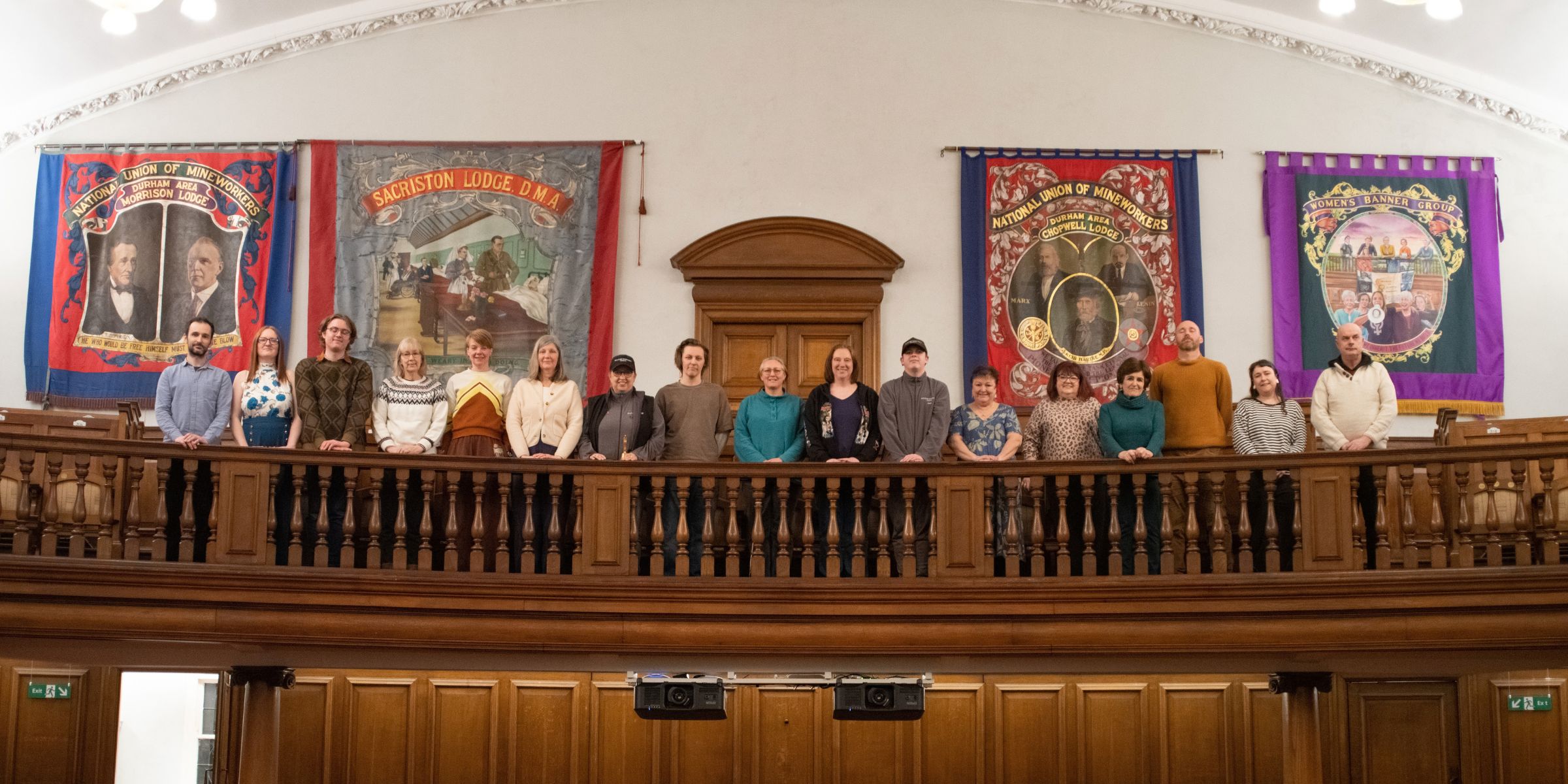
For generations, miners across the Durham coalfield did not simply vote for change. They organised,contributed, elected representatives and built institutions, creating systems of welfare decadesbefore the modern welfare state.
For more than 40 years, my family has kept a small engraved plaque.
It is not valuable, but it is one of those family possessions whose significance grows with time.
The inscription reads:
“CLIPSTONE COLLIERY N.U.M. striking miners and families would like to thank MR CHALLENOR CHADWICK for your support during the 1984-5 Miners Strike.”
Then, while I was writing this article, my mum went into the attic.
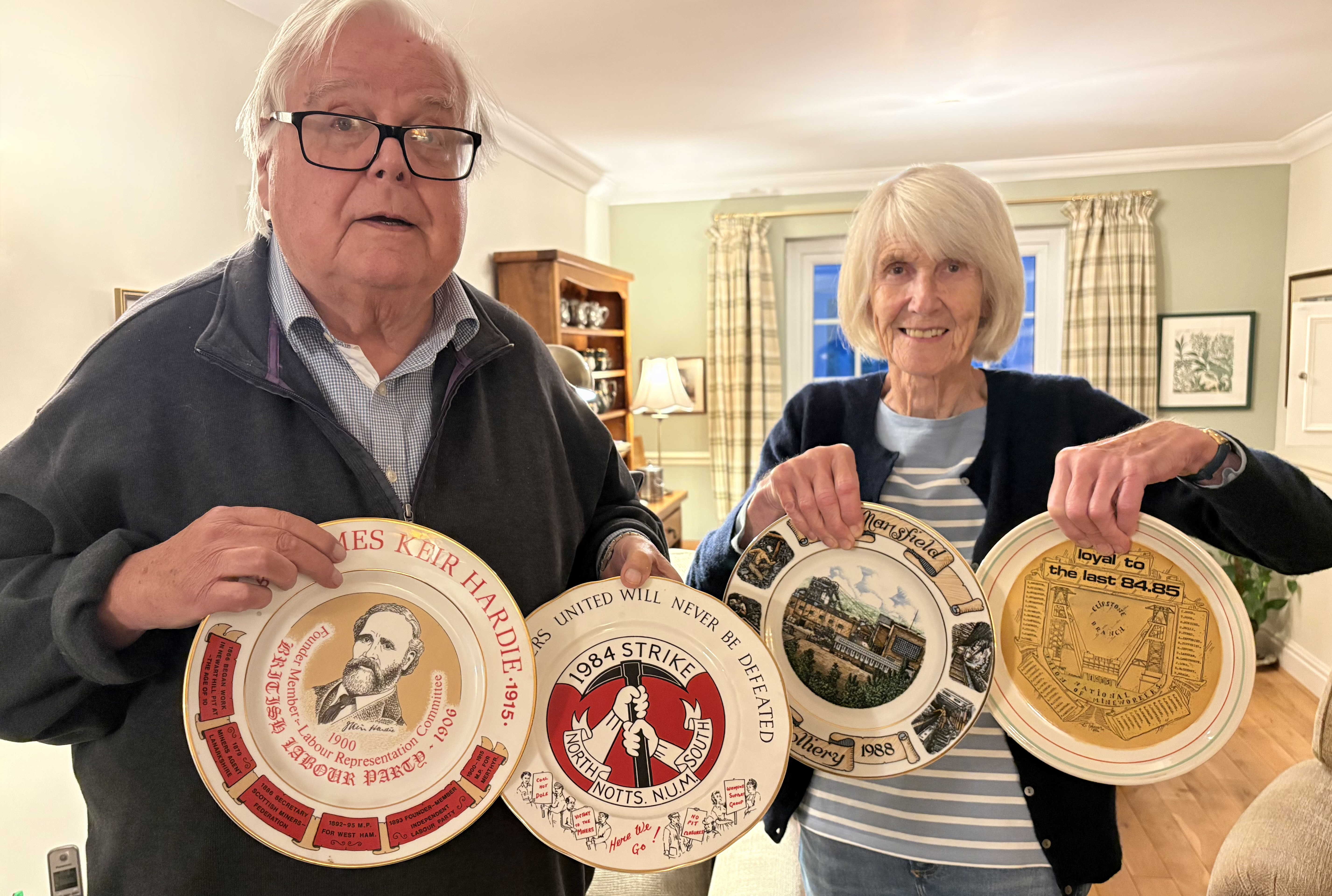
She came back down with four miners’ plates – more gifts given to my family as tokens of thanks.
One commemorates James Keir Hardie, miners’ leader and founding figure of the Labour Party.
Another carries the words “THE MINERS UNITED WILL NEVER BE DEFEATED” around an image commemorating the 1984 strike. A third depicts Mansfield Colliery, 1904–1988.
But it was the fourth that stopped me.

“Loyal to the last 84:85.”
At its centre are the headstocks of Clipstone Colliery. Around them are the names of miners.
These are not valuable family heirlooms in the conventional sense. They are pieces of working-class history that ended up in our attic.
And they take me straight back to being an 11-year-old child during the miners’ strike.
I do not remember the politics. I remember the people.
My family ran a hotel, and my grandparents and parents supported striking miners and their families at Clipstone Colliery in Nottinghamshire.
My father remembers buying food wholesale from Booker Cash & Carry and my grandfather driving it to the striking miners. Police tried on several occasions to divert him but never succeeded.
Towards the end of the strike, my family paid for a coach to bring around 30 miners and their families to our hotel for Lancashire hotpot and a free bar.
I remember collecting the glasses.
It is a tiny childhood memory of an enormous national event: empty glasses, plates, conversation and people gathered around tables.
The miners’ strike divided Britain, and there was a price for taking sides. Once my family’s support became known, some regular customers stopped coming to the hotel.
When the strike was over, a delegation of miners came to thank my grandparents and parents. They brought the plaque and commemorative plates that my family has kept ever since.
Four decades later, another miners’ inheritance survives in Durham: Redhills, the remarkable home of the Durham Miners’ Association and its famous Pitman’s Parliament.
Its story poses a question that feels increasingly relevant today:
What does it mean for ordinary people to have power?
Redhills opened in 1915 as the purpose-built headquarters of the Durham Miners’ Association. At its heart was a debating chamber, called The Pitman’s Parliament, where elected delegates from lodges across the coalfield gathered to represent their communities.
There is something wonderfully audacious about The Pitman’s Parliament.
They came not as petitioners waiting for somebody else to solve their problems, but as representatives of organised communities. The miners themselves paid levies to build their parliament.
A miner did not need to travel to Westminster to have a political voice. His voice travelled through a representative he knew, from a community they shared, into a chamber built with miners’ money.
And what happened there mattered far beyond the chamber.
The miners did not simply use democracy to demand things.
They used it to build things.
Long before Britain created its national welfare state, Durham’s mining communities had developed an extensive system of collective provision.
Miners’ contributions helped provide medical care, sick pay, unemployment support, education and homes for retired mine workers. Across the coalfield, they also created halls, libraries, sports facilities, allotments and bowling greens, a flourishing cultural life.
These were not gifts bestowed upon them. They were built collectively, through subscriptions, democratic decision-making and solidarity.
That history belongs within the wider story of the development of Britain’s welfare state and NHS.
It would be too simplistic to say that the NHS began at Redhills. The health service established in 1948 had many political and social antecedents, including the mutual healthcare traditions of the South Wales coalfield associated with Aneurin Bevan.
But Durham demonstrated the same powerful principle long before universal healthcare became national policy: people could pool resources so that medical care and economic support were available collectively, rather than determined solely by an individual’s ability to pay.
The debates at Redhills therefore had tangible consequences. Illness, unemployment, old age and education were not merely subjects for political discussion; communities organised practical responses to them.
Democracy became something people could experience in their everyday lives.

On 2 and 3 October 2026, people gathered at Redhills for an Assembly on Rebuilding Our Coalfield Common Wealth.
Among those presenting was Adam Cooper, founder of Threads in the Ground, whose work focuses on former mining communities.
He describes democracy as an inheritance – something handed down by generations who fought to create it, and which we have a responsibility to pass on.
“No matter how you might feel about politics and the state of the world right now, you should know that living in this country we’ve inherited an incredible and delicate gift from our ancestors – our democracy,” he says.
“Maybe you read ‘democracy’ and picture something grand in London run by unreachable people with titles. Redhills teaches us that our democracy, our power to shape the world and the land around us, was built right here.
“It teaches us that our democracy was built by communities putting in hundreds of years of graft and sacrifice to build power for themselves and for us. And that it’s our turn to think about what we want to build and to pass on.”
The Assembly gave a name to what generations of miners created: the Coalfield Common Wealth.
It describes a whole system of collective life through which communities educated themselves, cared for one another, created culture, provided security and organised politically.
Physical traces remain throughout former coalfield communities: miners’ halls, aged miners’ homes, playing fields, bowling greens, parks and allotments.
But a community asset continuing to exist is not necessarily the same as a community continuing to own and control it.
The miners’ democracy was not confined to elections. Crucially, communities also possessed the institutions through which they could act – lodges, unions, co-operatives, welfare halls, clubs and associations capable of retaining resources, knowledge and power beyond any single campaign or individual.
Coalfield communities should not be sentimentalised. Mining was dangerous, dirty and physically punishing.
But when the pits disappeared, we also lost something less visible: some of the social infrastructure that enabled communities to organise and act collectively.
Before the restoration of Durham Miners’ Hall, people across the coalfield were asked what they wanted Redhills to become.
They did not want simply a museum or “a monument to a vanished industry”.
They wanted its history put back to work.
The ambition was expressed simply: “We don’t simply want our communities to have a voice. We want them to have power.”
That distinction is important.
Being asked what you think is not the same as determining what happens. Being consulted about a community asset is not the same as owning it. Receiving a service is not the same as having a stake in the institution that provides it.
And that feels particularly relevant now.
-(r)%20Alix%20Collingwood%2C%20Fiona%20Dyer%2C%20Gemma%20Franklin.jpg)
England is entering a new phase of devolution, with regional mayors gaining greater responsibility over areas including planning, infrastructure and economic development. The Government has even announced a new No. 10 presence in Manchester – another symbolic shift in the geography of political power.
It would be too neat to draw a direct line between the Pitman’s Parliament and today’s mayoral authorities. They are fundamentally different institutions.
But underneath them lies a remarkably similar question:
The miners who organised through Redhills had their own answer.
Individual miners organised through lodges. Lodges sent representatives to the Durham Miners’ Association. Resources and knowledge were pooled while communities retained their local organisation.
Power moved upwards from the community, rather than simply downwards from the state.
That history poses an interesting question as decision-making is devolved from Westminster today:
Moving power from Whitehall to a regional mayor brings decision-making geographically closer to communities.
But does power stop at the mayor’s office?
Or can communities themselves own assets, build institutions, pool resources and acquire greater control over the places in which they live?
Modern devolution concerns formal governmental authority. The miners’ model was different: it grew through membership, contribution, representation and ownership from below.
Yet both invite us to think again about the relationship between people, place and power.
Bringing power north is one thing.
Bringing power all the way back to communities may be the more radical challenge.
As an 11-year-old collecting glasses, I did not understand that I was witnessing a tiny act within a much bigger story about class, community, power and solidarity.
I certainly did not understand why customers might stop using our family business because my grandfather had driven food to striking miners.
My grandma and grandad are no longer here, but I know their working-class politics drove them.
People needed help, so my family helped them.
And when the strike was over, those miners came back to say thank you.
The pits have not survived but Redhills and the Pitman’s Parliament has.
So too have around 60 banner groups across the coalfield, alongside brass bands, choirs, artists and storytellers carrying forward a culture that is not simply historical re-enactment, but something living.
An old miners’ banner motto seems almost written for this moment:
“The Past We Inherit. The Future We Build.”
And that brings me back to the four plates my mum found in the attic.
The plates will soon leave my parents’ house. They are giving them to their grandson, Rafe, for his 21st birthday.
He is studying politics at the University of York. He never knew his great-grandfather, and the miners whose names appear on those plates belong to a world that disappeared before he was born.
But perhaps that is precisely why he should have them.
They were given by one generation to another as an act of thanks. Now, more than 40 years later, they will pass to another generation again.
Not because they are valuable, but because of what they represent.
They are a reminder that democracy is an inheritance, but never a finished one. Previous generations fought for a voice, organised that voice and used it to build institutions that made people’s lives better. What the next generation chooses to build with the democracy it inherits is now up to them.
When my parents give Rafe those miners’ plates on his 21st birthday, they will be passing on more than pieces of our family history.
In a small and symbolic way, they will be passing on something that those miners understood profoundly: the past is ours to inherit, but the future is ours to build.
Header image: The Pitman's Parliament - Redhills
For more information on photographer and filmmaker Andy Martin's COALFACE project CLICK HERE





