



When Thomas James Butler was 13 or 14, somebody cut down the tree.
It stood on the green at Scriven, close to Knaresborough, where Butler had spent years playing and climbing beneath its branches. The Scriven Oak belonged not only to the landscape but to the collective geography of childhood: a landmark around which memories accumulated, quietly and without anybody realising they might one day need protecting.
The explanation was that the tree was diseased.
Then, two months later, a newspaper report suggested otherwise.
“My dad was irate,” Butler remembers. “There was nothing wrong with the tree.”
He never discovered precisely why it was felled. He suspects money changed hands somewhere. What he does know is that its removal altered something in him.
“I think that’s the first time I really felt something for nature,” he says. “The destruction - and how people can treat it.”
More than three decades later, part of the Scriven Oak remains.
Butler’s father retained a piece of its wood and carved a small face from it. The carving appears briefly in a new film made by Butler and photographer Robin Clewley, created to accompany Thank You, Sorry, and Congratulations, Butler’s solo exhibition at RedHouse Originals in Harrogate.
It could easily be missed. But then, that's partly the point. We've become skilled at missing what is directly in front of us.
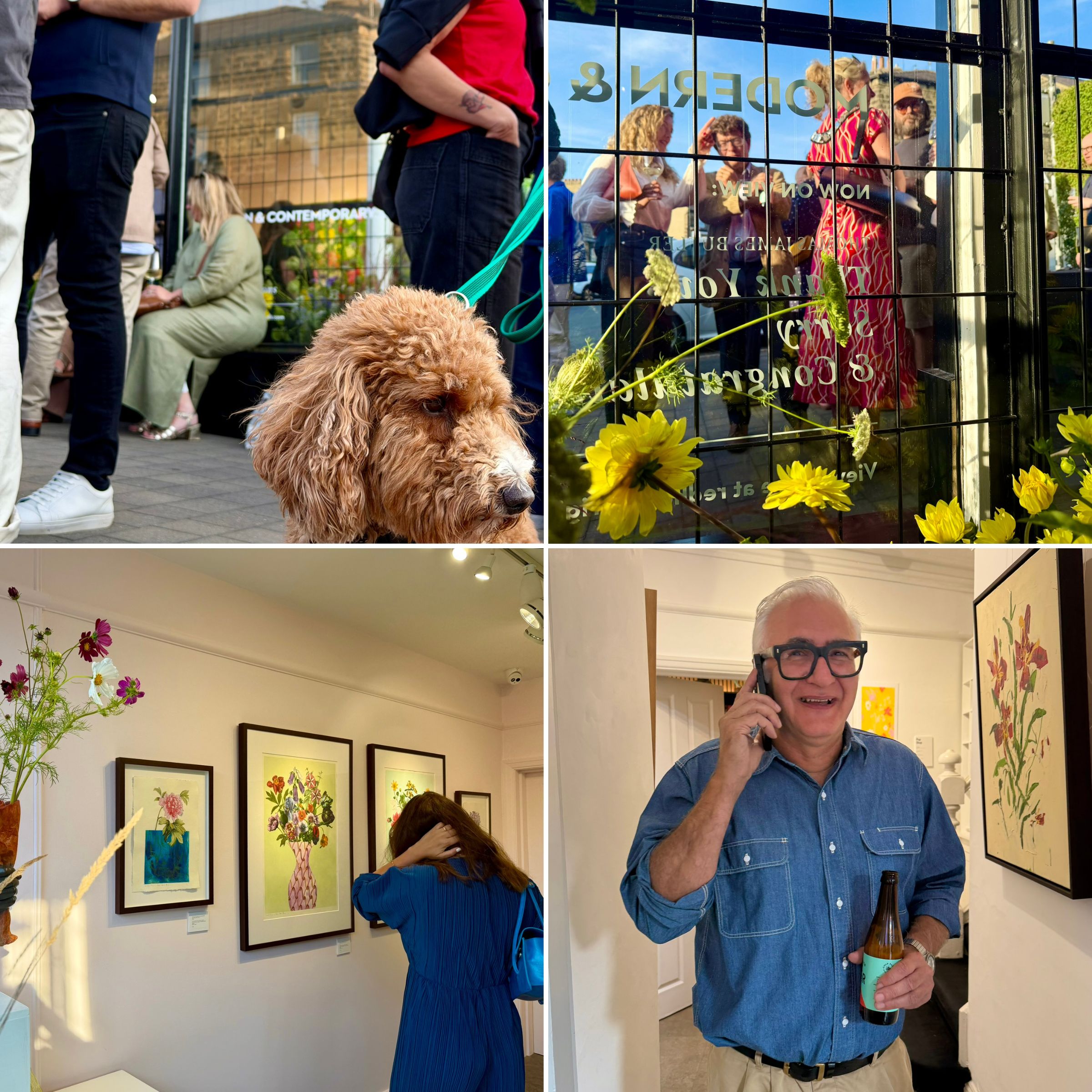
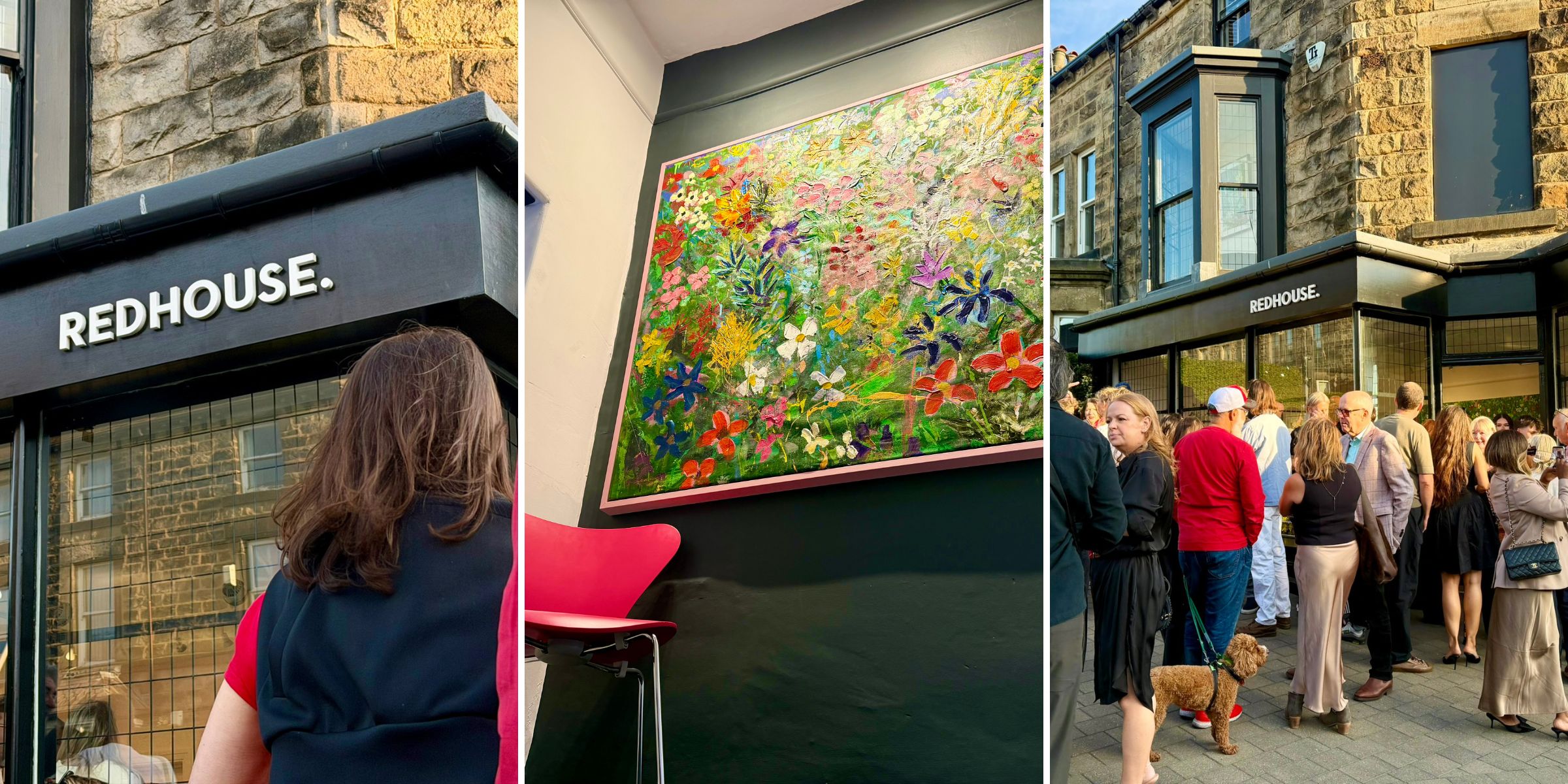
On a warm Friday evening in Harrogate, the pavement outside RedHouse is crowded. People gather beneath the evening sun with glasses in their hands while flowers press against the gallery windows from within.
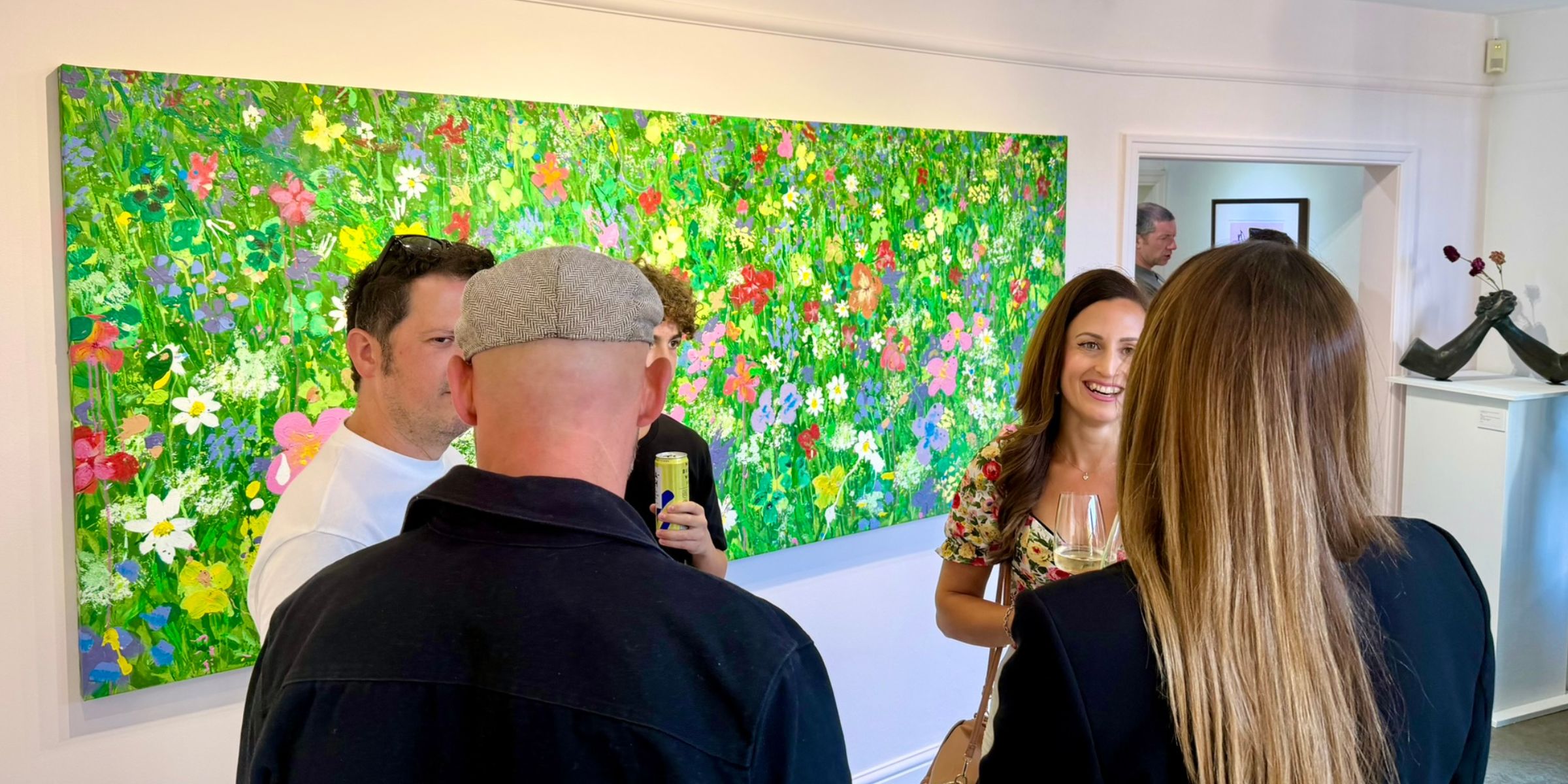
Inside, nature has taken over the building.
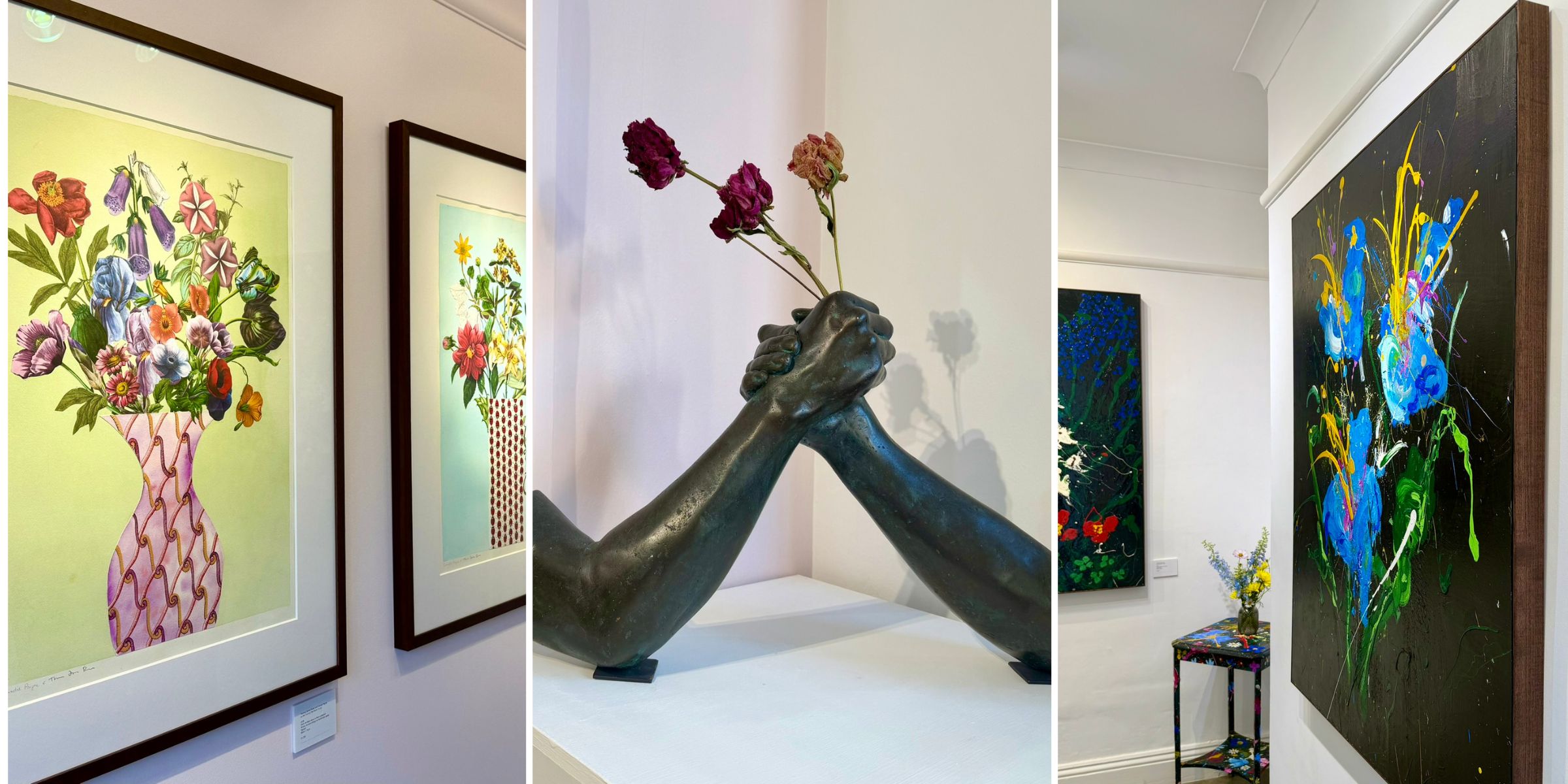
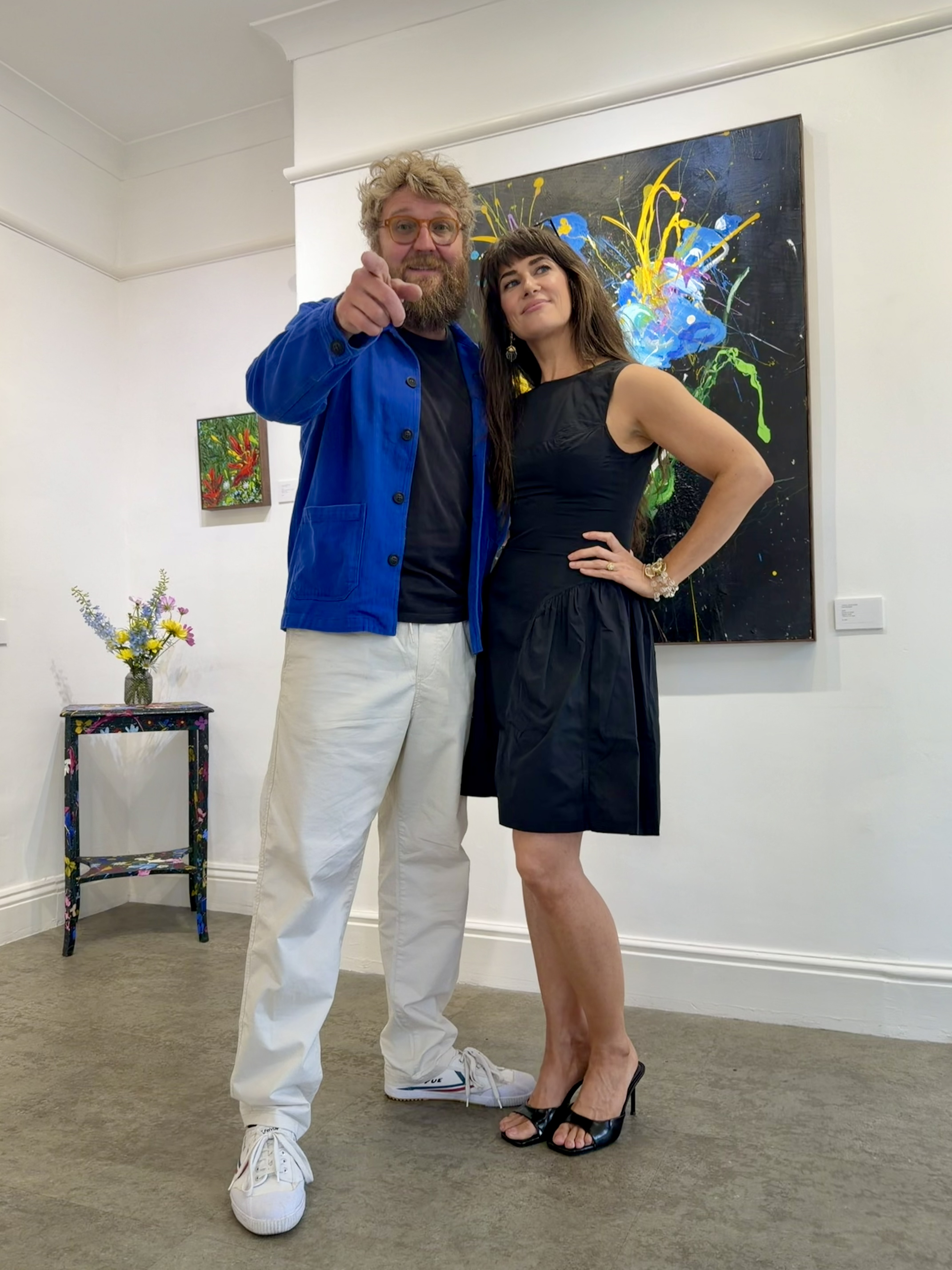
It appears in great, exuberant paintings alive with greens, pinks, yellows and blues; in flowers on the verge of decay; in sculpted arms holding bouquets; in arrangements grown and cut from the same Hampshire field Butler painted two years earlier.
One huge work rises above a pink chair in the stairwell, too abundant to be absorbed in a single glance. Elsewhere, flowers emerge from deep black grounds, their stems flung upwards in loops, splashes and sudden movements. They don't sit politely in vases. They appear to be growing, colliding, reaching and refusing containment.
Upstairs, however, the mood changes.
The accompanying film draws inspiration from Philip Larkin’s 1972 poem Going, Going, a bleak anticipation of the loss of England’s green spaces to commerce, concrete and development.
For Butler, its argument is no abstraction. Some of the construction footage in the film was recorded at the end of his own road, on what had been an open field.
“We used to walk across it at night,” he says. “We’d seen roe deer on there, badgers on there. And all of a sudden, they’re building.
“It’s happening everywhere.”
But the film isn't only concerned with what's being lost. It journeys back to where Butler’s relationship with the natural world began: Scriven Green, his grandmother’s cottage and the places where he played as a child.
His father appears. So does his 11-year-old son, Travis, who reads part of the narration.
When Clewley sent him an early edit, Butler heard his son say the words “when I was a kid”.
“I burst into tears,” he says. “Because it was me, back again on the green.”
Clewley describes the film as semi-biographical: a portrait of Butler told through landscape, family and the places that formed him.
“Tom’s son reads a poem. Tom reads a poem. Tom’s dad features in it as well,” he tells me. “It’s a real biographical piece, but it’s also about nature.
“The Larkin poem is quite gritty and a bit bleak, but we tried to make the film hopeful. As Tom described it, it’s a love letter to nature.
“It’s a bit of a warning as well. We all know what is going on with the environment and that we need to treat it better. But there is a lot of hope in there too.”
The film hadn't originally been part of Butler’s plans.
The paintings were to lead the exhibition. Then RedHouse told him that if he wanted to occupy the whole gallery, he needed to create something more.
His response, in essence, was: then I’m making a film.
The apparent limitation became a gift.
Butler had already been trying to work out what to do with two pieces of music by the band Modern Nature. Music has long been central to his visual life, but it presented a particular problem.
“If I’m inspired by nature, I can paint the colours,” he says. “If I’m inspired by a poem, by words, music or sound - that’s difficult. How do I put it down?
“How can I paint music when I can’t? So I had to make a film.”
He took the idea to Clewley, who accepted immediately. Butler wrote and storyboarded; some of the material was filmed on his phone; Clewley brought his own footage and shaped the pieces into a coherent whole.
“Robin just reached inside my head and took it out,” Butler says. “‘Okay, there it is.’”
It's a phrase that recurs when Butler talks about the creative people around him.
The exhibition’s sculptural work began in a similar way. Butler imagined an isolated arm holding a bunch of flowers, but lacked the technical means to make it. He approached artist Christopher Kelly and, within a week, they were in the studio casting Butler’s arm.
“I am surrounded by creative people,” Butler says. “I am so lucky.
“I can go, ‘Look, I’ve got this idea.’ A lot of people would say, ‘That’s a bad idea.’ These people go, ‘Okay, yeah - let’s make that happen.’”
The result is an exhibition bearing one artist’s name but sustained by a web of collaboration: Clewley’s film and photography; Kelly’s sculptural skill; Modern Nature’s music; Travis’s voice; Butler’s father and the surviving fragment of the oak; the flowers brought to Harrogate by Hannah from Minnow and Wolf in Hampshire.
The flowers came from the same field in which Butler created The Field, the large painting you will be mesmerised by, when you head to RedHouse.
The subject has stepped out of the canvas and arrived in the room.
The exhibition’s title began with a stranger leaving a garage in Oslo.
Butler was taking part in a group exhibition there when he saw a man walking away with his head bowed and a bunch of flowers in his hands.
He began wondering why the flowers had been bought.
Was the man apologising? Offering thanks? Celebrating something?
The moment led Butler towards floriography - the symbolic language of flowers that reached its cultural height in Victorian Britain, when the choice, colour and arrangement of a bouquet could communicate what social convention prevented people from expressing directly.
“I started thinking about how we use flowers to speak,” Butler says.
The title holds two meanings simultaneously.
Thank You, Sorry, and Congratulations refers to the messages human beings ask flowers to carry on our behalf. But the three phrases are also addressed to nature itself.
“I’m thanking nature,” Butler explains. “I’m apologising to nature and congratulating nature.”
The apology is necessary because the relationship has become dangerously unequal. We accept everything the natural world supplies while treating it as inexhaustible, ornamental or inconvenient when placed in the path of development.
Yet Butler doesn't want the exhibition to become a sermon.
“I don’t want to use the word ‘protest’,” he says. “But it is a piece saying: please look at this.
“I’d like to think the work makes people go, ‘Oh wow - we do have that on our doorstep.’”
His request is surprisingly modest.
Look up.
“People don’t look at the stars. People don’t look at the trees. Everyone’s head is down - looking at screens, or driving.
“Not enough people are going out and looking and going, ‘Fucking hell, look at the sunset. That’s amazing.’”
Thom Butler tells me he remains astonished by the moon.
“I genuinely am. I still see it and think, ‘Oh my God, that’s the moon.’
“It makes me realise how small everything is, but how big everything is as well. We’re so lucky. We just don’t know it.”
Butler’s route to these great abstract flowers was neither direct nor planned.
He attended art college for six months and hated it.
“I didn’t want to be told anything,” he says. “I didn’t want to be shown how to do anything. I just didn’t know what I wanted to do.”
For anumber of years he largely stopped making art. The return began when he discovered the work of British-German collage artist John Stezaker, whose precisely placed combinations of film stills, publicity portraits and postcards transform familiar faces into something strange and psychologically charged.
Butler saw that two existing images, placed together, could create an entirely new idea.
“I thought, if someone can make something so profound, incredible and moving from that, I can do that.”
He began cutting and assembling. Flowers entered the work almost accidentally, laid across a portrait and suddenly revealing a possibility he had not consciously sought.
Paint followed.
Initially it sat on top of the collage. Then, gradually, it occupied more space. The collaged elements became smaller while the painted marks grew.
Butler compares the process to Billy Connolly’s journey from folk musician to comedian. Connolly initially played songs and told stories between them. The stories grew longer; the music diminished. Eventually, the banjo was left at home.
“That’s what it was like with me and painting,” Butler says. “I hadn’t brought my collage stuff. It was just part of my painting now.”
The work became physical. Butler found himself drawn towards Hans Hofmann, John Hoyland and the freedom of abstract painting.
“I wanted to be covered in paint,” he says. “I know it sounds daft, but that’s what I wanted - to really feel what I was doing.”
He doesn't sketch beforehand. The marks preserve individual moments: a movement of the arm, an instinctive decision, paint thrown, dragged or allowed to fall.
Nothing is pre-mapped.
He begins - and discovers the painting through the act of making it.
There is a persistent belief that important art must emerge from torment.
Happiness is treated with suspicion. Joy risks being mistaken for shallowness; beauty for an avoidance of serious thought.
Butler has little patience with the idea.
Flowers entered his work because painting them made him happy. That doesn't make the work less rigorous or the ideas behind it less urgent.
“I think there are too many artists trying to be too profound,” he says.
The artists he admires most didn't wait for an intellectual justification to create. Van Gogh painted because he had to. David Hockney continued drawing and painting across a lifetime because looking and making are fundamental to who he was.
“They just painted,” Butler says. “No matter what, they had to paint.”
Butler’s joy isn't ignorant of pain. The exhibition contains loss: the oak, the disappearing field, the flowers already fading in the sculptures and Larkin’s fearful vision of a landscape sold and built over.
But joy, here, is not denial. It is a reason to care.
Asked to select one work from the exhibition and give it to somebody as a message, Butler pauses.
Then he rejects the premise and chooses the film.
At first, he considers giving it to someone with power: Andy Burnham, perhaps, or a world leader capable of influencing what happens next.
He abandons the idea almost immediately.
“No one in power wants to hear anymore,” he says. “Greed’s taken over.”
Instead, he would give the film to children.
“I’d put it in schools. That’s what I’d do.
“I think it’s the lack of education about nature. I know schools do, ‘Oh, let’s have a nature day.’ But it’s not taught properly. What is actually happening?”
It is the most hopeful answer he could have given.
Children don't hold the power that has allowed green fields to become speculative assets. They didn't construct the systems in which the immediate financial value of land repeatedly outweighs its ecological, emotional and communal worth.
But they might still be taught to look.
The film ends with a small intervention in Larkin’s title. After Going, Going, Butler and Clewley add a knock at the door.
Knock, knock.
It is still there.
The field, the tree, the flower, the moon; the possibility of acting before disappearance becomes memory. Nature hasn't entirely left the room.
For now.
And in a crowded gallery in Harrogate, Thomas James Butler is asking us to raise our heads, pay attention and find the words while there is still something here to receive them.
Thank you.
Sorry.
And congratulations.
Thomas James Butler: Thank You, Sorry, and Congratulations continues at RedHouse Originals, 15 Cheltenham Mount, Harrogate, until 19 September 2026





