



.jpg)
On a Sunday evening in York, something important is happening in one of the city's pubs.
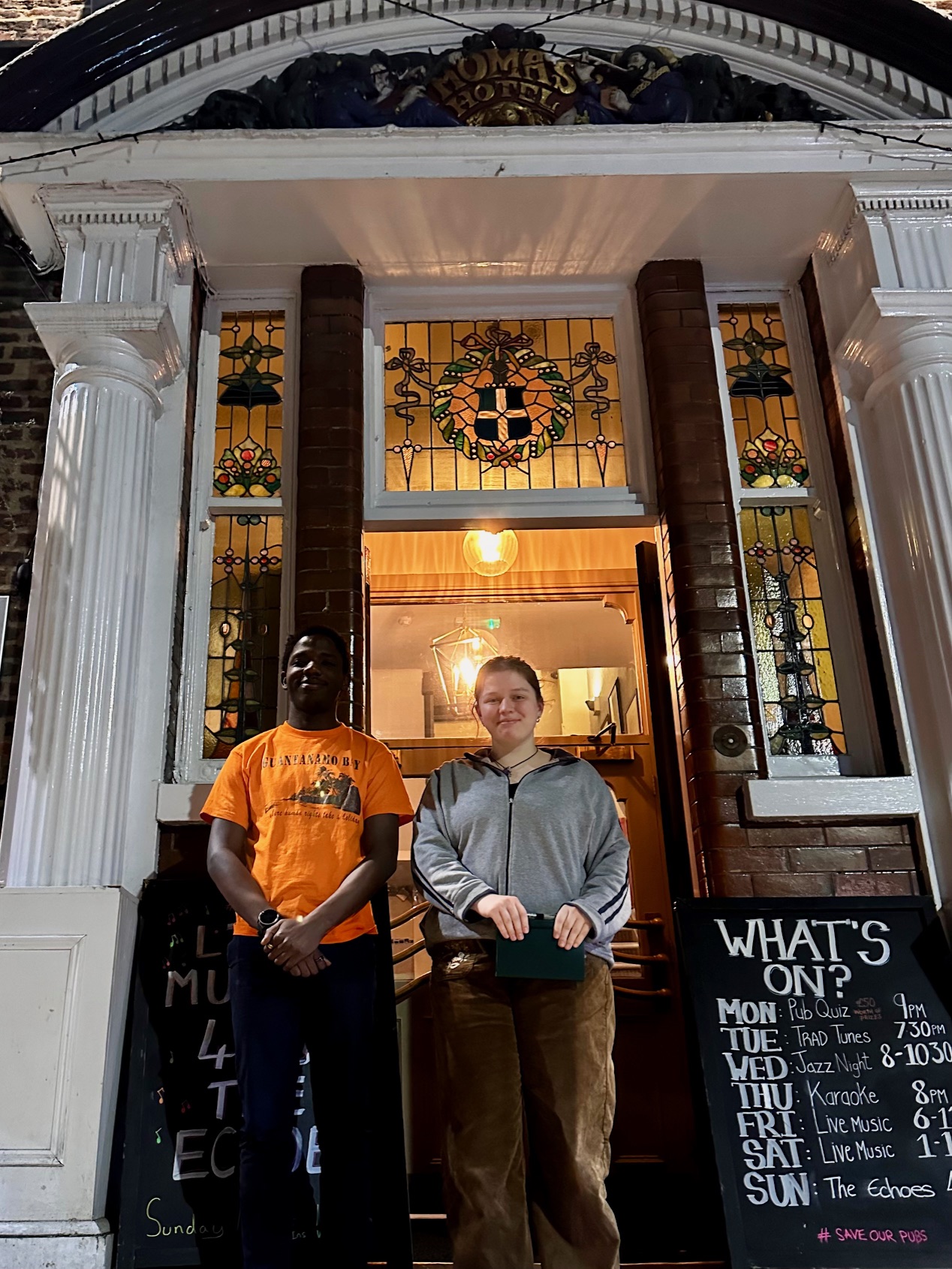
Inside the pub, there is nothing remarkable about the table. No banner. No sign-up sheet. No clipboard. Just two young people (one in a bright orange T-shirt) and an empty chair deliberately pulled back from the table.
For fifteen minutes, nobody comes.
Sophie and Ano had agreed they would stay for two hours regardless. Even if it was just the two of them.
Then the door opens. Two strangers - and a dog - step in.
By the end of the night, ten people have sat down.
That is how Empty Chairs works.
Empty Chairs began with grief.
Its founder, Dean, lost a close friend to suicide. In the months afterwards, he kept going to the pub - but now the seat opposite him remained unoccupied. One evening, instead of letting that chair symbolise absence, he posted online: if you’re struggling, lonely, new to town or simply don’t want to sit alone, join me.
The empty chair became an invitation.
It was never intended as therapy. The website makes that clear, signposting support services such as Samaritans for those in crisis. What it offers is simpler than counselling, but more radical than it first appears: visible, low-pressure human presence. Now the model is spreading across the UK - including here in York.
Ano first came across Empty Chairs on Instagram. “I told myself I would host one,” he says. A week later, sitting in the same pub where Sophie works behind the bar, they made it official.
The first event drew ten people. Students. Locals. A couple who had seen a Facebook post shared in a York group. Conversations ran until nearly 11pm.
At the second gathering, a young man we’ll call Daniel hovered outside before going in. “I’m very shy and socially anxious,” he says. “I sat there thinking, ‘Shall I go in? Shall I go in?’”
It had been a difficult week. He had just been told he was losing his tenancy and hadn’t secured somewhere new to live. “I thought - I need to do something good. Even if it’s just an hour. Just get out and say, this is what I’ve done.”
Inside, he found a table where nobody expected anything from him.
“You just have to exist,” Sophie explains. “You can talk as much or as little as you want.”
Ano puts it more plainly: “You don’t have to live alone. You don’t have to be on your own. Just come out and meet people.”

Loneliness is often framed as a problem of old age - the isolated pensioner, the quiet neighbour. But the data across the North tells a more complex story.
Office for National Statistics surveys consistently show that young adults aged 16–29 report the highest levels of loneliness in England, higher than over-70s. In the North East, around one in four adults report feeling lonely often or always, among the highest regional rates in the country. Yorkshire and the Humber has similarly elevated figures compared to the national average.
University cities - including York and Leeds - sit at a particular crossroads: high student turnover, rising private rents, precarious employment and increasing housing insecurity. Social networks are transient. Friendship groups form and dissolve quickly.
Daniel describes it succinctly: “There’s either rowdy drinking or very specific interest groups. I never found anything I fitted into.”
Loneliness, increasingly, is not about physical isolation. It is about misalignment - about not quite slotting into the spaces available.
Young adults are the most affected
Office for National Statistics data shows 16–29-year-olds consistently report the highest levels of loneliness in England, challenging assumptions that the issue primarily affects older people.
North East: Among the highest rates nationally
Around 1 in 4 adults in the North East report feeling lonely often or always, placing the region among the highest in England.
Yorkshire and the Humber above national average
Regional surveys show rates of frequent loneliness sitting above the England average, particularly among working-age adults.
Students and private renters at higher risk
Research links elevated loneliness levels in university cities to:
Loneliness is subjective
ONS defines loneliness as a personal, subjective feeling - meaning a person can feel lonely even when surrounded by others.
Seasonal pressures
Charities such as Samaritans report increased contact during darker winter months, when reduced daylight and social withdrawal compound existing pressures.
There is something quietly defiant about sitting alone in public. Sophie remembers feeling, when she was younger, that she always had to be seen with someone. “Now I’ll come to the pub and read a book,” she says. “You’ve got to do what’s good for you, with or without whoever is there.”
Empty Chairs reframes solitude as neutral - and companionship as accessible.
The hosts wear orange so newcomers can spot them immediately. It removes the paralysing moment of scanning a crowded room.
“I’ve been to meet-ups before where you can’t find them,” Daniel says. “If you don’t have the courage to go up to somebody, you just go home again.”
Even the hosts admit they feel the pull of staying in. “Even today I was thinking - I don’t want to go out,” Sophie says. “But I’ve got to host this space. I’ve got to do it for myself too.”
This is not charity from the socially confident to the socially anxious. It is peers holding space for peers.
Empty Chairs now lists multiple venues across the UK, including gatherings in Leeds, Middlesbrough, Manchester and Newcastle, with more Northern hosts signing up each month. The model is intentionally simple: choose a venue, wear orange, leave a chair empty.
“We express our want for connection through our phones,” Daniel reflects. “But this is an actual solution.”
The scale of loneliness across the North cannot be solved by pub tables alone. But policy shifts take time. An empty chair is immediate.
There are no speeches here. No icebreakers. No forced vulnerability. Just conversation.
There will be nights when ten people come. There may be nights when no one does. The point is that the chair remains.
Because for someone sitting outside debating whether to go in, knowing there will be a seat - and someone waiting - can be enough.
On a dark Northern evening, that matters. The chair is empty. Until it isn’t.
Loneliness has increasingly entered policy conversations across the North - from combined authority wellbeing strategies to NHS mental health planning and local council community funding reviews. Yet while regional leaders debate long-term solutions, many grassroots responses remain small, unfunded and largely invisible.
Projects like Empty Chairs do not replace statutory services. They do not claim to. But they highlight something policymakers are increasingly acknowledging: that loneliness is not solely a clinical issue, nor only a matter of individual resilience. It is shaped by housing insecurity, economic precarity, transport access, youth service provision and the design of public space.
Across Northern towns and cities - particularly those with high student turnover, shifting rental markets and stretched local authority budgets - the question of how we rebuild everyday social infrastructure is becoming more urgent.
An empty chair in a pub will not solve structural inequality.
But it may signal where solutions begin.





