



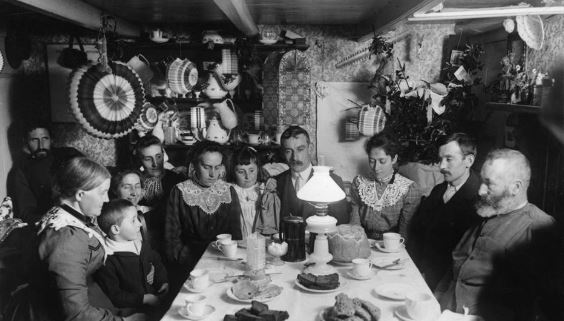
Every December, the cultural machinery of the UK recalibrates to sell us a singular, highly romanticised ideal: the warm, chaotic, multi-generational Northern household. It's an image woven deeply into our regional identity - the open-door terrace house, the crowded local pub on Christmas Eve, the fierce collective resilience that finds its ultimate expression around a crammed dining table.
But for thousands across the North of England, this festive iconography doesn’t inspire comfort. It's triggering a cold, somatic dread.
While seasonal domestic awareness campaigns rightly spike during the holidays, they almost exclusively target partner-to-partner violence. Society remains functionally blind to a different, but equally devastating kind of quiet war: the grinding, non-partner hostility occurring between adult children, parents, siblings, and extended kin.
To describe these dynamics, the internet offers us the sleek, pop-psychology buzzword "toxic." But human geography and sociology offer us something far more rigorous, useful, and urgent. In a landmark study published via the Northumbria University Research Portal, researchers John Clayton, Catherine Donovan, and Stephen J. Macdonald reframed these domestic dynamics not as personal drama, but as a structural reality: they are "hate relationships" defined by "geographies of entrapment" and the "temporalities of routinisation" (Clayton, Donovan and Macdonald, 2020).
As winter closes in, these academic frameworks cease to be mere theory. For those locked in hostile families or homes, Christmas actively weaponises the geography and socio-economics of the North of England against them, turning the family sanctuary into an inescapable space of siege.
To understand why key calendar dates evoke such profound anxiety, we must look at how a troubled and controlling family member effectively holds an entire household to ransom. In sociological literature, this is understood through the lens of coercive control and asymmetric emotional dependency. Within a closed family system, a singular volatile or manipulative individual operates as the emotional regulator of the environment; their mood dictates the safety of the room.
This dynamic creates what the Stress-Strain-Coping-Support (SSCS) model identifies as a systemic pressure cooker. Because the controlling relative’s behavior is radically unpredictable, other family members are forced into an unwritten pact of appeasement. They become active participants in managing the perpetrator's triggers, sacrificing their own boundaries to maintain a fragile, temporary peace.
Consequently, significant calendar milestones cease to be markers of celebration and instead become periods of acute threat. In the academic backdrop of "temporalities of routinisation," key dates are explicitly dreaded because they enforce proximity [Northumbria University Research Portal]. The controlling individual inherently understands that holidays matter to the collective; therefore, these dates provide maximum leverage. By threatening to ruin a shared milestone - through an orchestrated outburst, an unwelcome intervention, a calculated depressive withdrawal, or financial manipulation - the hostile relative demands total compliance. The family is held hostage by the threat of a ruined memory.
Popular media tells us that a harmful relationship is defined by cinematic explosions - screaming matches, broken plates, dramatic midnight departures. Threats - often followed by promises. But the Northumbria University research flips this script, tracking the profound psychological weathering caused by these low-level, relentless patterns.
Within a hostile family, trauma is an exercise in daily attrition. It is the calculated silence when you walk into a room. It is the micro-aggression disguised as a festive joke. It is the ambient unpredictability that forces everyone to permanently "walk on eggshells."
Because this hostility usually flies entirely under the radar of external interventions like social services or the police, it transforms the domestic space. Home stops being a refuge and becomes what sociologists term an "everyday space of siege."
During the holidays,or on key dates, this siege intensifies. The festive calendar enforces a hyper-surveillance of shared spaces. Victims are forced into complex logistical calculations just to survive the day: parsing the kitchen layout to avoid a volatile parent or sibling, altering sleep cycles to minimise contact, and decoding micro-expressions over a Christmas dinner. The Northumbria paper highlights how this cumulative, daily erosion of boundaries results in genuine "geotrauma" - a psychological state where the physical layout of the home itself becomes a site of chronic nervous system stress.
When secular self-help culture addresses family hostility, its advice is uniformly middle-class and Southern-centric: Set boundaries. Extract yourself. Just don’t get involved.
In the North of England, Clayton, Donovan, and Macdonald’s concept of "geographies of entrapment" reveals that cutting contact is not a simple psychological choice; it can be an economic privilege. Even then, when dealing with an individual displaying long-term sociopathic behaviours - stepping back can be virtually impossible.
The ability to escape a hostile familial space or member requires structural escape routes that the North’s current economic climate actively denies. Consider the specific material realities facing a young adult or vulnerable relative in a Northern town this December:
When the sun sets at 4:00 PM on Boxing Day in a freezing Northern town, the physical landscape reinforces the trap. The cold and darkness pull people back indoors, forcing the geographically entrapped back into the immediate vicinity of the familiar actor causing them harm.
The trap isn't just economic; it's deeply cultural. Parts of the North of England prides themselves on "ecological relatedness" - the tightly knit, interdependent family structures where extended networks live in close geographical proximity [British Psychological Society / Journal of Personality and Social Psychology]. We value grit, family loyalty, and the communal expectation to "just get on with it" for the sake of the collective.
But as British Psychological Society studies into family proximity note, this intense interdependence can blur healthy psychological boundaries [British Psychological Society / Journal of Personality and Social Psychology]. In a dysfunctional family, these celebrated regional traits are easily weaponised by the person holding the family to ransom.
To refuse to visit, to sit in silence at the table, or to declare estrangement during "the most wonderful time of the year" is frequently framed by hostile relatives not as a self-preservation tactic, but as a class, familial and cultural betrayal. The victim is made to feel they are rejecting the very core of community solidarity.

If we are to meaningfully support those living through the winter siege, our regional dialogue has to change. We must stop treating family dysfunction as a private, psychological flaw to be cured by self-help books and Instagram infographics.
As the Northumbria University researchers advocate, we must recognise that non-partner domestic hostility requires structural, institutional solutions. It requires local authorities to understand that housing immobility and underfunded public transport are safety issues. It requires regional mental health services to acknowledge the unique "geotrauma" of non-partner coercive control.
This winter, as we celebrate the warmth of the Northern hearth, we must also extend our solidarity to those hiding in plain sight within it - those sinking into the wallpaper, waiting out the season, surviving the siege.
⚠️ IMPORTANT: Digital Safety Warning
If you are reading this article online or on a device that a controlling family member has access to, please take a moment to protect your digital footprint. Your safety is paramount.
Where to Find Support Over the Coming Weeks
If you are navigating familial hostility, controlling behavior, or a space of siege at home this winter, you do not have to carry it alone. The following confidential services are operating throughout the festive period:
Emergency Services & Law Enforcement
Local Authority Social Services
If a vulnerable adult or a child is living in a hostile or unsafe environment, Local Authority Social Services departments have legal duties to provide emergency safeguarding, housing assessments, and intervention.
Regional Northern Support Charities
National Helplines (24/7)


