



.jpg)
There's a moment, not long after arriving at Drew Colson’s home in Bilton-in-Ainsty, when an interview about a new amplifier business threatens to become something else entirely.
Two handmade cabinets are standing in the room. They're beautifully proportioned, their fronts rising at an angle rather than obeying the familiar geometry of the black, rectangular guitar amp. Warmly figured hardwood surrounds traditional woven speaker cloth. Small variations in grain, colour and shape distinguish one from another.
They look less like equipment than furniture. Or sculpture. They look like objects someone might be nervous to touch.
But when Drew connects a guitar, the room changes. And that's the point.
“I’ve spent years chasing that feeling you get when an amplifier really responds,” he says. “As a player, I wanted something that worked naturally with pedals, felt alive under my fingers and had a real presence in the room.”
These are the first completed amplifiers from Colson of York, the small business Drew has established at his home on the rural western edge of York. He calls the series The Three Sisters of Ainsty: Maria, Charlotte and Emily.
Only three have been made. Only three ever will be.
Each combines an analogue amplification platform, an individually matched speaker and a cabinet constructed from Yorkshire sycamore and sapele. They have shared material origins and recognisably belong together, but differ in their proportions, markings and voice.
One, Emily, has already left home. The man who bought her arrived with his guitar, played all three and struggled to choose. Emily’s timber contained a particularly characterful burr, which Drew believes gives the cabinet a slightly more aggressive edge.
There was another connection too. Emily had been the name of the buyer’s grandmother. Stories attach themselves to things. It's clear that's something Drew understands instinctively.
.jpg)
Colson of York didn't begin with a business plan. It began with irritation.
Drew has played guitar for decades and performs regularly around York as the singer and guitarist with indie, rock and punk covers band The Cover Culprits. The band’s repertoire travels from the Sex Pistols, The Clash and The Cure to Blur, Oasis, Kasabian and The Killers.
They play pubs, weddings, private events and charity festivals. Drew also hosts musicians’ nights, placing him in regular contact with players who understand the strange and sometimes infuriating relationship between a guitar, its pedals and the equipment expected to make it heard.
“A lot of amps actually fight the pedals,” he explains.
“The amp is trying to get its own sound out, and you’re trying to manipulate that sound by putting pedals into it to get your sound. A lot of the time, it’s just really frustrating.”
Around three years ago, tired of searching for the right equipment, he built his first valve amplifier.
“I just got absolutely sick of trying to find the right sound for my guitar,” he says. “That’s why I started building - to make something that sounds great on its own, but once you start putting pedals into it, still sounds great as well.”
It wasn't his first attempt to make rather than purchase what he wanted.
He's repaired motorcycles and assembled cars. He's modified and rebuilt guitars, installed their electronics and even replaced their frets. Several years ago, after spotting a chair he liked in a magazine, he responded not by ordering one but by deciding he could make it himself. “A normal person would probably think, ‘That’s a really cool chair. I might buy it,’” he says. “I thought, ‘That’s a really cool chair. I could make that.’”
There's no bravado in this. Drew isn't claiming mastery of every discipline he encounters. He's simply fascinated by how things work - and sufficiently stubborn to find out.
“I’m really interested in electrics and electronics,” he says. “And with wood and carpentry, I’m intrigued by how you can shape something from a block. It sounds daft, but there’s something hidden in there that you can release.”
Music, electronics, cabinetmaking and design gradually began to converge. The result was an amplifier that worked, followed by another prototype that Drew sold to an enthusiastic musician in 2025.
The buyer’s response stayed with him. “He was absolutely in awe of it,” Drew recalls. “He said, ‘This is amazing. I love it.’ He offered to write me a review, and I said no because I wasn’t doing anything with it. I just told him to enjoy it.
“But then my mind started ticking away. I thought: there might be something I can do here.”
The word analogue has become an increasingly broad cultural shorthand. It can mean warm, authentic, nostalgic, imperfect or simply old.
For Drew Colson, it begins with something more particular: response.
A guitar creates an electrical signal. In an analogue system, that signal travels through the circuitry to the speaker without first being converted into data and processed by an onboard computer.
Digital modelling amplifiers can reproduce an enormous range of tones and simulate celebrated equipment. They can be convenient, lightweight and dependable. Drew's owned and used them. He's not interested in dismissing useful technology simply to make a romantic argument for the past.
But he feels a difference. “The main thing is the immediacy,” he explains. “With analogue gear, because it isn’t having to be processed by a computer, as soon as you strum, it is there.
“Even things like your fingers dragging on the strings - you hear that instantaneously. You can roll the volume back on the guitar and clean the sound up. It is about the conversation you are having with the amplifier while you play.”
The delays involved in digital processing may be measured in milliseconds, but musicians can experience them as a subtle distance between action and response.
Digital equipment, Drew says, can feel “mathematically perfect”.
“But because of that mathematical perfection, it can be like talking to a robot rather than talking to something alive.”
His preferred comparison is the difference between hearing a violin played in the room and listening to a recording of a violin. “It still sounds like a violin. But you don’t get that same sound of the wood and the strings.”
The Three Sisters do not use valve amplification. Instead, Drew has selected and modified an existing solid-state analogue platform, matching it to the individual cabinets and speakers. He's careful to be transparent about this: he hasn't designed every electronic component from first principles, nor does he claim to have done so.
His earlier prototype was constructed from scratch around valves. They can produce a glorious sound, but they also generate heat, deteriorate and become less reliable.
The Sisters use established analogue technology as their starting point, which Drew then adapts, installs and voices as part of the whole amplifier.
The important thing, for him, is that cabinet, speaker and electronics aren't treated as unrelated components. They're one system.
.jpg)
The Yorkshire sycamore used in the first Colson amplifiers had been waiting for this purpose long before Drew knew what that purpose might be.
He found it around a decade ago while searching for local timber for new kitchen worktops. At a farm somewhere between Harrogate and Thirsk, he met a man selling rough-hewn sycamore taken from the surrounding estate. The timber had already been naturally drying for several years.
Drew bought enough for his kitchen and bathroom, then retained three or four large planks. For almost a decade, they remained with him - first beneath a tarpaulin outside and later in the roof of his garage - continuing their slow seasoning.
Some of the wood was spalted by hand. Drew encouraged cultures within the timber to create dark, meandering zone lines: markings formed as fungi occupy and defend territories within the wood.
The process, he explains with some delight, involved yoghurt. "When I bought the planks, the chap said, ‘I really wish I’d spalted this.’ I didn’t know what he meant.
“He explained that you put a culture onto the wood to encourage these black lines. So I thought, ‘I’ll give that a try.’”
Once the desired markings had developed, the timber was cleaned, dried and made stable. Historic traces of insect activity were treated and preserved where they added character without weakening the material.
Nothing about the surface is printed or artificially repeated. The variation is the record of what happened to a living material over time.
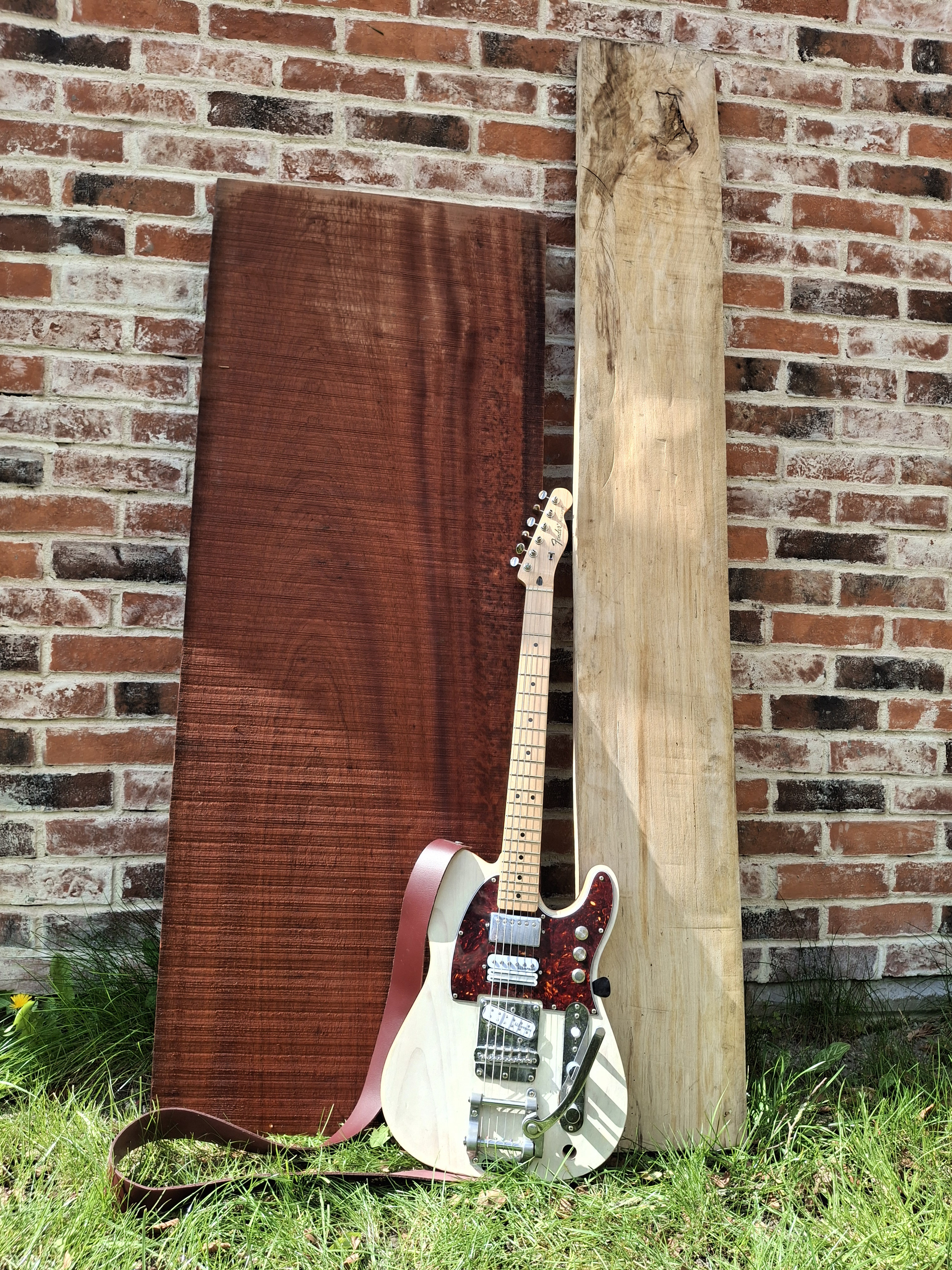
Drew pairs the sycamore with sapele supplied by a longstanding independent York hardwood specialist. Sapele is a dense material more often associated with musical instruments and fine cabinetry than guitar amplifiers.
Most conventional amplifier enclosures are manufactured from MDF or plywood and wrapped in a textured vinyl material known as Tolex. There are good commercial reasons for that. MDF is predictable, consistent and comparatively inexpensive.
But predictability is not what Drew is pursuing. “An ordinary amplifier is essentially a big square box with a logo on the front,” he says. “There often isn’t much thought about how the box itself sounds. It is more about the speaker.
“MDF gives you a uniform sound, but it’s a dull sound. With hardwood, you get more resonance. It feels warmer and more natural.”
The acoustic contribution of a cabinet will always sit within a complex combination of speaker, enclosure dimensions, construction and amplification. Drew doesn't pretend timber performs magic in isolation. He chooses his woods for structural stability, visual character and the part he believes they play in the behaviour of the complete object. “They look elegant,” he says, “but it is functional. The wood is doing a job.”
The locality embedded within the amplifiers extends beyond timber sourced from the surrounding region.
Parts of Maria and Charlotte incorporate reclaimed wood from Drew’s own Georgian house, including sections of an old back door that had begun to decay and needed to be replaced. “I thought, ‘I’m not just going to get rid of it,’” he says.
The fragments were made sound and incorporated into the cabinets, giving the amplifiers a literal piece of the place in which they were built.
“They’ve both got a little bit of the old back door, just to completely cement the fact that they’re from this area.”
This could easily become an exercise in manufactured heritage: a maker loading an object with regional references because provenance has commercial value. But that isn't how it feels in Drew’s company.
He's more interested in connection than branding. He prefers collecting timber and tools in person because the transaction gives him an opportunity to talk to the people who previously owned, supplied or worked with them.
He recently bought a professional sander second-hand from someone in York. He could tell you where it came from, who used it and what it had done before entering his workshop.
“It’s nice to understand where the thing you are buying has come from,” he says. “Even with tools - where the tools came from and what people were using them for.”
This isn't nostalgia for a Yorkshire that never existed. It's a belief that objects become richer when their origins remain visible.
Maria, Charlotte and Emily take their names from the three eldest Brontë sisters.
The idea came while Drew and his partner were watching an online heritage discussion about the Brontë family. The three amplifiers were already taking shape from connected lengths of timber, their grain visibly travelling between them.
“I knew there were three because that was all I could make from the wood,” he explains.
“When you put time into things, they get their own personalities. It sounds a bit daft, but there was a shared story. They felt like sisters. They have the same DNA, with the same wood running through them all.”
The Brontë connection gave that intuition a Yorkshire literary framework. It wasn't a marketing concept imposed before construction. It arrived while the objects were becoming themselves.
Maria is the eldest, Charlotte the middle sister and Emily the youngest. Each carries a different cabinet form and slightly different tonal character. Each contains a Celestion speaker made in Ipswich in 1998. Drew found four manufactured on the same day, allowing the Sisters to share not only timber but speakers from the same production batch.
Once Maria and Charlotte are sold, that small family will disperse - and there'll never be another set.
Future Colson series are already taking shape. The Veils of York will explore a smaller, more compact cabinet design using further sycamore and sweet chestnut. Drew also plans The 27 Club, a sequence of 27 individual amplifiers responding to the cultural mythology surrounding musicians who died at that age.
Even within a named series, he doesn't intend to reproduce a standard model endlessly.
This might be an eccentric basis for a manufacturing business. Drew knows that. “Other boutique makers tend to have a cabinet they build and a stock number,” he says. “People put their name down and receive one of those.
“This is probably an idiotic thing to do, but because there is only one, I’ve got to start from scratch pretty much every time.
“But it feels important to me that they are completely unique. There is never going to be another one like any of them.”
A Colson amplifier can require more than 30 hours of direct work, spread across a much longer period.
There's selecting, measuring and cutting the timber; constructing, fixing and shaping the cabinet; repeated sanding; applying finishes; sourcing and fitting the cloth; soldering, installing and modifying electronics; matching speakers; testing; listening; adjusting; testing again.
Even applying the name presented an engineering problem. Drew didn't want to attach a plastic plaque. He commissioned a metal branding iron so the identity could be burned directly into the wood.
A blowtorch wasn't enough. The hardwood resisted it. Eventually, he bought a 500-watt electric branding tool capable of reaching temperatures far beyond those of a domestic oven. The brand has to be held carefully in position while heat finally penetrates the dense timber. The mark isn't stuck onto the amplifier. Like almost everything else, it becomes part of it.
The sloping cabinet creates further complexity. Standard guitar amplifiers are rectangular partly because rectangles can be manufactured, packaged, stacked and transported efficiently.
Drew’s design is angled because a conventional amp placed behind a guitarist tends to project sound towards the back of the musician’s knees. Players often tilt their cabinets against a wall or buy a separate stand.
Colson’s speaker already leans upwards into the room. The controls sit accessibly on the top. The deep body helps preserve cabinet volume and weight within the sound.
Several musician friends have asked why more manufacturers don't build amplifiers that way.
The answer might be that the resulting shape is harder to make and harder to put into a shipping carton.
There is, however, one additional advantage to the sloping top. A drummer can't rest a pint on it. Colson amplifiers, Drew announces, are “pint-free”.
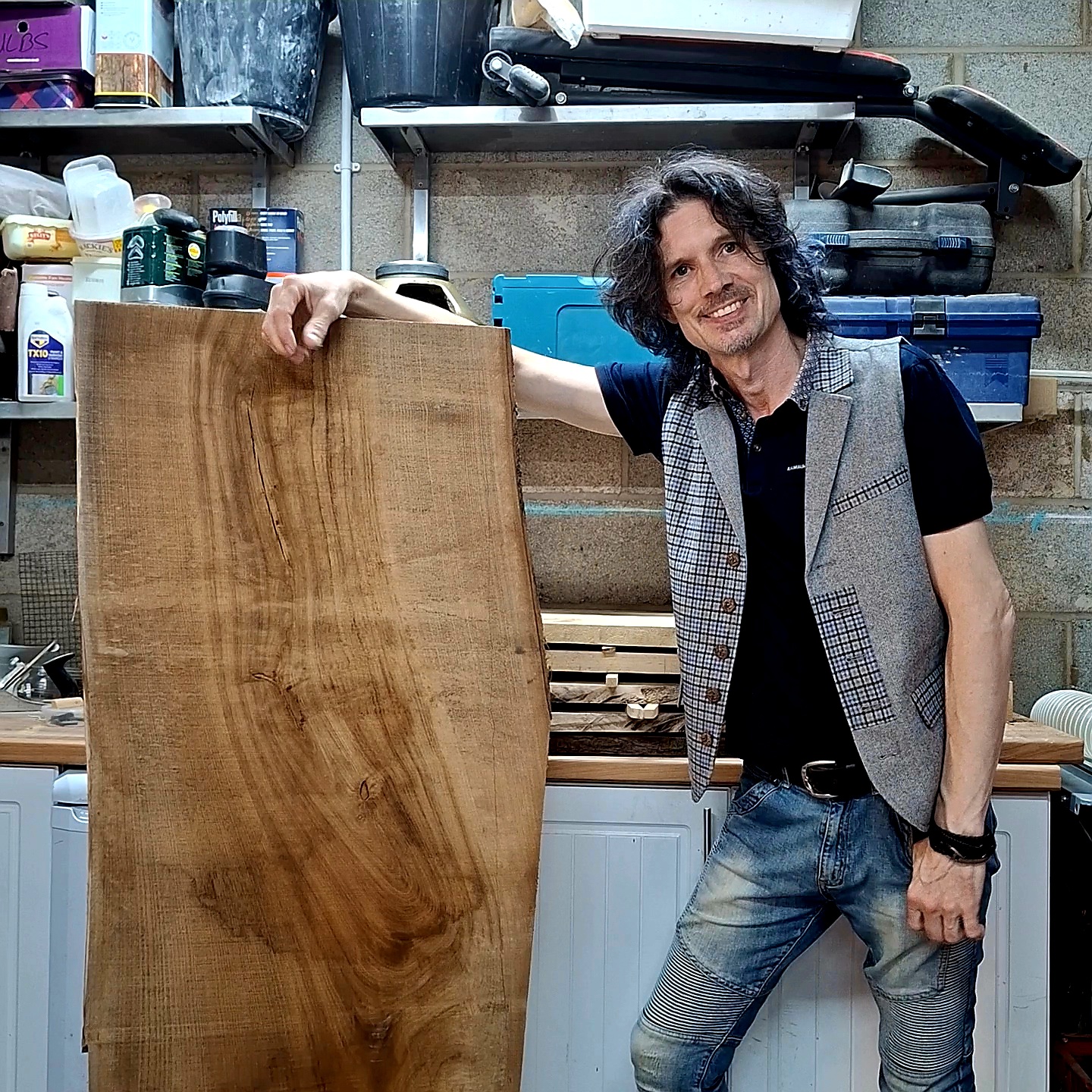
During the day, Drew works as a freelance copywriter.
His route into the profession began in scientific research and development before moving through marketing, technology research and digital agencies. He has written for major companies and ghostwritten articles for senior executives.
The work requires skill, understanding and the ability to make complex ideas human. It also carries an occasional frustration.
Drew will open LinkedIn and see people congratulating an executive for the eloquence or insight of an article. “I’m thinking, ‘I did that.’”
He enjoys writing and continues to make his living from it. But much of the work belongs publicly to someone else.
Colson offers the opposite. It is physical, personal and unavoidably attributable.
“I wanted to think about what I enjoy and what I could make a business from that I can put my name to and be proud of,” he says. “Something that can go out into the world.”
The rise of generative artificial intelligence has also made him consider how writing work may change in the years ahead. He believes the human element - relationships, experience, conversation and nuance - will remain essential, but understands that parts of our profession might be transformed.
The amplifiers aren't a panicked retreat from technology. Drew uses modern tools, platforms and components where they serve a purpose. They are, however, a deliberate investment in forms of value that can't be generated instantly: material knowledge, listening, manual skill and time.
“It felt like the right moment to try to make a go of something that is mine,” he says. “A physical business in an increasingly digital world.
“I like the fact that it goes back to cottage-industry manufacture - bespoke, piece by piece.”
He traces part of that instinct to his grandfather, a bricklayer. When Drew was around eight, his father and grandfather built an extension onto the family home. He remembers watching the older man work with great precision.
“He was making sure everything was right. He said, ‘We’re not just chucking something up. This is designed to last forever.’”
Drew thinks about that now. “There is no computer inside these to become obsolete. It is resistors, capacitors and diodes. It is hardwood. Realistically, these can last for decades and decades.” Perhaps longer.
The Three Sisters were initially priced below £1,000 each - a considerable sum, but notably below many high-end and boutique guitar amplifiers.
Drew admits that establishing a price was difficult. The hours alone would support a higher figure, even before the timber, speaker, electronics and years of experimentation are considered. But he wants the amps to be attainable by serious musicians. More importantly, he wants them to be used.
Drew owns a particularly beautiful anniversary Fender guitar for which he paid close to £3,000. It rarely leaves its case. “I spent too much money on it,” he says. “I hardly ever take it out because it cost so much. I’ve got this gorgeous guitar, but I don’t want to touch it. It never gets played.” His preferred gigging guitar cost around £400. It goes to work.
“That was always at the back of my mind,” he says. “I didn’t want these to become something people were afraid to use because they were too expensive.”
A Colson amplifier might be bought by a collector. It may become a family heirloom. Its owner might feel less like a consumer than the temporary custodian of an object capable of outliving them. But Drew still wants it on a stage.
The hardwood is robust. The cabinets are built to professional specifications. Small feet allow them to be set down safely when carried, and the distinctive form has emerged from the practical frustrations of gigging rather than from a desire to create a static artwork.
“They can absolutely be gigged,” he insists.
“I’d like someone to have one and play it. That’s why I built it.”
There lies the most appealing tension within Colson of York. Drew is making amplifiers beautiful enough to be contemplated but alive only when they're used. Their value lies not in remaining immaculate, but in becoming part of somebody else’s musical life.
They will acquire knocks. Their surfaces will change. New stories will attach themselves to the old timber. They were designed for that.
Towards the end of our conversation, I ask Drew what being a Yorkshire maker means to him. The question produces a long pause.
“That’s giving me goosebumps,” he says.
His answer isn't a declaration of regional exceptionalism.
“I don’t know whether it is because it is Yorkshire for me, or because this is simply the place I call home,” he says.
“I love being here on the outskirts of York. I’m in a rural area, but York is just down the road - Wetherby, Harrogate and Leeds too. I’m incredibly lucky to live here.
“But wherever I called home, I would want to be part of it and build something that was part of the area where I lived.”
For Drew, place isn't a decorative story added after manufacture. It's the network of relationships and materials through which the work becomes possible: the farmer who once stored the sycamore; the York timber merchant who talks with him when he visits; the musicians who test, question and encourage him; the house that gave up part of its old back door; the amp buyer who arrived carrying his guitar and left with Emily.
“I’ve put pieces of my house, as well as my sweat, into these things,” he says.
“It feels to me that we are intrinsically linked to our environment. This is where I live. It is where I grew up. It feels right that I should use the materials around me and build something I am proud of.”
In the room, Maria and Charlotte are waiting.
They're singular objects in an economy built around repetition. Analogue instruments emerging into a culture fascinated by simulation. Pieces of Yorkshire timber that have travelled through woodland, farm buildings, weather, bacteria, a garage roof and Drew’s hands before becoming something capable of filling a room with sound.
They are exquisitely made.
They're built to last.
But that is not quite enough.
Someone must plug in.
Someone must play.
And the thing Drew has released from the wood must become part of somebody else’s story.





