



Sometimes, if we're extremely lucky, we might just find ourselves at a performance that's found its way beneath the skin before we've quite understood what's happening.
The Ballad of Blea Wyke did that on a gorgeous Friday evening in York.
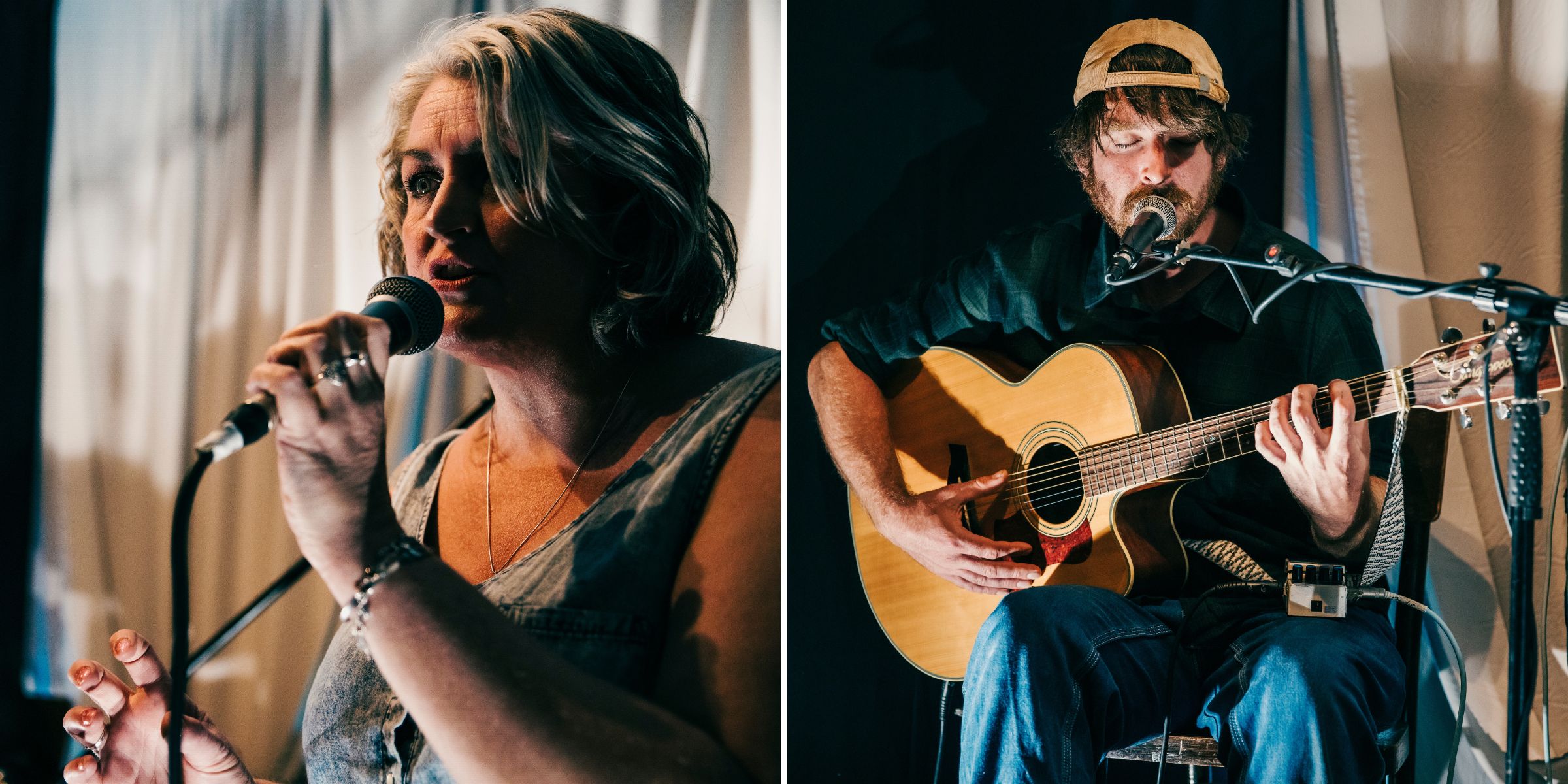
Performed by Yorkshire writer, theatre-maker and poet Hannah Davies alongside musician Jack Woods, this haunting fusion of spoken word, storytelling, poetry, song and live music has just captivated at Rise at Bluebird Bakery in Acomb.
The venue was sold out. The surroundings were intimate, informal and unmistakably creative: an audience gathered at close quarters in a neighbourhood bakery rather than separated from the performers by the machinery and distance of a conventional theatre. That closeness was one of several factors that contributed to the gig's magic.
Before Davies and Woods began, the evening was opened by PitchWitches, a glorious blend of six female voices led by singer-songwriter and choral leader Em Whitfield Brooks.
Bringing together some of Yorkshire’s finest a cappella singers, the group performed a beautifully chosen set of sea-related songs. Their voices rose, divided and folded back into one another: stirring and soulful, with soaring harmonies that seemed to carry salt air, distance and longing into the room.
It was far more than a conventional support set.
Without instruments or theatrical ornament, PitchWitches created a sense of ritual and anticipation. Their songs opened an imaginative doorway into the maritime world that would follow, preparing the audience for a story concerned with transformation, loss, belonging and the pull of the sea.
By the time the final harmony faded, the coast had already begun to feel present.
Then Davies started to speak, Woods’ guitar moved quietly beneath her words, and the walls of the uber-cool bakery cum creative space seemed to fall away.
We were no longer sitting on Acomb Road. We were somewhere high above the sea, on a North Yorkshire coastline both recognisable and altered, listening for the movement of the last grey seal through the water.
The story follows Cerys, a young woman raised within the restrictions of a locked-down city in a not-too-distant future. On her eighteenth birthday, she defies those restrictions and travels towards the forbidden coast and the landscape from which she came.
There, on the crumbling cliffs around Blea Wyke, near Ravenscar, following a quite unexpected encounter, the boundaries between human and animal, memory and myth, body and landscape begin to dissolve.
Davies has taken the traditional selkie legend - the old stories of seals shedding their skins to assume human form - and reimagined it for a world shaped by ecological decline, enclosure, fear and control.
In this version, there are no fishermen concealing seal skins in boxes and trapping women on land. Davies has retained the elemental power of the myth while removing the assumptions that have often accompanied its telling. The result isn't a nostalgic retelling of folklore, but a work that asks what the story might mean now.
.jpg)
The production was first micro-commissioned as part of York Theatre Royal’s Green Shoots programme in 2022 and subsequently developed by Say Owt and Next Door But One, with earlier performances at York Theatre Royal Studio, Theatre at the Mill and Scarborough Fringe.
Yet none of that development is visible as scaffolding.
The completed work feels organic: lyrical without becoming self-consciously poetic, politically alert without turning into a lecture, and emotionally direct without ever manipulating its audience.
Davies is a compelling storyteller. With the most authentic voice.
Her language carries the wind, salt and geological weight of the Yorkshire coast, but it also seemed to possess its own tide. At times, her words gathered speed and urgency; elsewhere, she allowed an image or phrase to remain suspended in the room until another meaning begins to emerge.
She moves between narration, character, poetry and song with remarkable ease.
At the heart of the performance is her ability to create an entire world with little more than voice, expression and gesture. A cliff edge appears. The city closes around us. The sea becomes audible. The remnants of another way of living seem to rise through the ground.
Davies makes us feel both the oppressive limits of Cerys’s world and the pull of something beyond it: older, wilder and far less governable.
Woods’ contribution is essential to that transformation.
Playing live guitar and building layers through loops and craft, he does much more than accompany the text. His music moves alongside it like a second narrative current.
At moments, it supports Davies so delicately that we scarcely notice it entering. Elsewhere, it gathers force and tension, creating a restless undertow beneath her words. His playing can be spare, tender and ominous within the space of a few minutes.
The collaboration is beautifully judged.
Neither performer competes for the audience’s attention. Davies’ voice and Woods’ music appear to listen to one another, responding and overlapping until it becomes difficult to locate precisely where speech ends and music begins.
The show’s own description promises a haunting interweaving of story, music, poetry and song. That's precisely what it achieves.
What gives The Ballad of Blea Wyke its particular emotional force, however, is the deeply personal experience beneath its mythology.
Davies has previously spoken about living through Topical Steroid Withdrawal. The debilitating condition affected her skin at the same time that the pandemic and its restrictions were reshaping life around her.
Within that experience, the image of the selkie shedding its skin acquired a profound personal resonance.
The knowledge adds another dimension to the performance, but it doesn't restrict its meaning.
Skin becomes protection and prison. Shedding it can represent illness, trauma, identity, ageing, freedom or the painful process of becoming oneself. Cerys’s journey towards the coast is consequently both physical and internal: an escape, a reclamation and a return.
There is anger within the work too, although it's never loudly announced.
This imagined future isn't remote enough to be comfortably dismissed. The coast has become inaccessible. Movement is controlled. The natural world is something people have been separated from and instructed to fear. The landscape is damaged, regulated and withheld.
The production asks what happens when access to nature is no longer understood as part of human life, but as something granted or denied by those with power.
It also asks what becomes of us when our connection to land, sea, body and history is severed.
Those questions give the story considerable political weight, but the work never disappears beneath them. It remains, above all, a ballad: intimate, mysterious and driven by the simple human need to tell and receive a story.
Its politics emerge through Cerys, through the choices made around her and through the landscape itself.
That landscape is never mere decoration.
Blea Wyke, on the coast near Ravenscar, becomes an active presence within the work. It remembers. It calls. It threatens. It refuses to be entirely possessed.
In less capable hands, the North Yorkshire coast might have been employed simply as an atmospheric backdrop - an easy source of cliffs, mist and brooding sea. Here, Davies understands it as something with agency and memory: a place carrying the traces of what has been lost, while retaining the possibility of freedom.
This rootedness is one of the show’s great strengths.
It is a work inspired by ancient myth, but made unmistakably in Yorkshire. Its landscape is specific, its creative voices are northern and its ambitions are universal. The production doesn't need to leave the region behind in order to say something important about the world.
Indeed, Next Door But One supported the development of the work partly because it was a piece set in Yorkshire for Yorkshire audiences, while also recognising Davies as a significant voice in theatre and spoken word.
There could hardly have been a more fitting place to encounter it than Rise.
Bluebird Bakery’s Acomb venue has the feeling of a room in which artists and audiences are allowed to meet one another properly. There's no distancing grandeur and nowhere for a performance to hide.
The intimacy demands honesty from the artists, but it also allows the smallest details to register: the catch of a breath, a shift in Davies’ expression, Woods’ fingers moving across the strings, a harmony ending and leaving the room momentarily suspended.
That closeness made an already affecting work feel almost confidential, as though an old story were being passed between people who had gathered after dark because it needed to be remembered.
The timing also felt significant.
The performance arrived only a week after AcombFest had brought another burst of art and culture to the neighbourhood. Together, the two events offered a reminder that ambitious creative work doesn't belong exclusively to city-centre institutions or formally designated cultural quarters.
A sophisticated and emotionally demanding piece of theatre had been performed in a bakery to a full house.
There's sometimes a lazy assumption that accessibility requires artistic compromise: that work presented in familiar, informal or community settings must somehow become simpler, safer or less intellectually ambitious.
The Ballad of Blea Wyke disproves that entirely.
It welcomed its audience without underestimating it. The show dealt with environmental collapse, illness, bodily autonomy, confinement, folklore and the ownership of landscape, but it did so through story, music and feeling rather than explanation. Nothing was simplified. Nothing was made inaccessible. For me, that might be the evening’s most important achievement.
The work understands that myth has never belonged only to the past. Myths survive because they can hold experiences for which ordinary language is often insufficient. They change as we change, carrying old fears into new worlds and allowing private pain to become something shared.
Davies and Woods have created a piece that feels both ancient and urgently contemporary: the story of a young woman moving towards the sea, and of all of us trying to remember what remains beneath the restrictions, identities and protective skins we acquire.
PitchWitches began the evening by summoning the sea with six unaccompanied voices.
Davies and Woods then took us to its edge.
By the end, the sold-out room was utterly still.
Then the spell broke, and we were back in Acomb.
But not entirely.
★★★★★
The Ballad of Blea Wyke is written and performed by Hannah Davies with musician and performer Jack Woods, directed by Em Whitfield Brooks and produced by Say Owt and Next Door But One.
The next performance takes place at Helmsley Arts Centre on 17 July.





