



The first day of the Northern England Dark Skies Alliance conference ended with a walk through York. From the Minster precinct to York St John University’s campus, the question delegates had been discussing all day came down to individual lights. What was each one there to do? Where did its light fall? How much of it was needed, and for how long?
On Friday evening, after the second day of the conference, Mike Hawtin, the North York Moors National Park’s Head of Nature Recovery Projects and Dark Skies Lead Officer announced that the alliance had agreed to expand nationally. In his account of the two days, he said more than 100 delegates had come together and every Northern protected landscape was represented. The announcement gives national scope to a collaboration that began with the North’s 13 National Parks and National Landscapes.
MagNorth was invited to Thursday’s sessions at Merchant Taylors’ Hall on 19 November. The room brought together people who study the effects of artificial light at night and people who decide where it goes. Ecologists, council officers, lighting designers, manufacturers and installers sat alongside landowners, conservation groups, community champions and people who make a living helping others see the stars. The decision to meet in a city gave them a place to test what they were asking of each other.
Dr Jenny Hall, Associate Professor of Tourism Policy and Environmental Justice at York St John University, has worked with Hawtin and his team since 2024 on how dark skies festivals can improve ecological awareness. MagNorth has spent time at those festivals. In York, Hall asked what we do for the people who have difficulty getting to one. If the experience depends on having transport, money or time to get out of a city after dark, its benefits reach some people far more easily than others.
Hall called her approach “the right to the night sky”. She described light pollution as a question of ecological justice. The places where people have the fewest opportunities to experience natural darkness are also places where wildlife has to find its way through a landscape of artificial light. A university can do something about both on a site it already manages. York St John’s Cities Under Stars work puts the campus itself under scrutiny, with its estates team helping to map lighting and researchers studying what happens there after dark.
Dr Abby Mycroft, a geographer and ecologist at the university, described using acoustic detectors and thermal imaging to build a baseline for bat activity. Early observations pointed to more foraging at the back of the campus, where there was more vegetation and insect activity. With the estates team involved, the researchers can use those observations to shape lighting changes and monitor what follows. Mycroft also wants to hear directly from the people who use the campus about where they feel comfortable after dark. A map of the lights can show where the light falls. It takes a different kind of work to understand how a route feels to someone walking it.
Emma Sunley brought another part of the picture from her research with festival participants in the North York Moors. People described awe, wonder and tranquillity, the pleasure of learning something new and a change in their sense of perspective. Sunley wants further research to involve groups who face barriers to taking part. Roy Alexander, of Dark Sky UK and Dark Sky Discovery, approached that same question from the ground up. He described plans for communities to help identify and develop local places where people can experience the night sky, including in towns and cities. What would it take to make an evening under the stars an ordinary thing to do close to home?
Dr Alice Johnston of Cranfield University took the discussion from individual species to whole ecosystems. Her team combined satellite records of artificial light at night with measurements of carbon exchange between ecosystems and the atmosphere. They found associations with changes in how ecosystems take up and release carbon dioxide, particularly through increased respiration. The duration of natural darkness mattered, too. Johnston set out the work still to do on cause and effect, including whether changing the way we light a place can help restore the processes the team measured. The study in Nature Climate Change
Madeleine Fabušová, a Newcastle University ecologist, brought that problem to the roadside. The SAFELUX project asks how road lighting can reduce energy use, skyglow and harm to wildlife. An engineer and an ecologist can look at the same lamp and see different jobs. Her starting point was darkness. Establish where light is needed, then decide how low it can go, where it should fall, when it should switch off and which wavelengths are appropriate. She described bringing lighting engineers, infrastructure specialists and ecologists into the same discussion. Their answers have to work on the same stretch of road.
Neil Jackson of North Yorkshire Council explained how those decisions play out across a county. The council’s programme combines warmer, more directional LED lighting with part-night operation where appropriate. Jackson described working with protected landscapes and consulting residents as the authority makes changes both inside and beyond the two National Parks. The council’s published approach keeps crossing points, major junctions and other places where lighting is needed for road safety out of the part-night changes. Those decisions are made street by street, with consequences for the people whose houses, gardens and journeys the lights serve.
Kerem Asfuroglu, founder of Dark Source, demonstrated how much room there is for judgement before a fitting goes up. His examples from the UK and Ireland included Presteigne in Wales, where warmer streetlights and existing overnight switch-offs were part of a scheme for a working town. His argument was that developers and designers can set out from the beginning to make a place usable after dark while preserving the darkness wildlife needs. The opportunity lies in the design brief, where the amount of light, its direction and its hours of operation are still decisions somebody can make.
At Kielder Observatory, chief executive Leigh Venus has seen what it takes to turn recognition of a dark sky into something people can experience. The observatory opened in 2008 with a modest programme. It now puts on hundreds of events a year and works with schools and communities. Venus talked about the people who interpret the sky for visitors, the accommodation providers who give them somewhere to stay and the practical question of making an evening worthwhile when Northumberland serves up cloud. He argued that the conservation of darkness has to stay ahead of visitor growth. The thing that brings people there is also the thing increased activity can put under pressure.
Dan Oakley of DarkSky International discussed how its designation guidelines are evolving as lighting technology changes and a wider range of places seeks recognition. There is a place for international standards and for the local sites Alexander described. They answer different questions. A reserve gives a large landscape a framework for looking after its night sky. A well-chosen spot nearer home can give someone their first reason to care whether that sky stays dark.
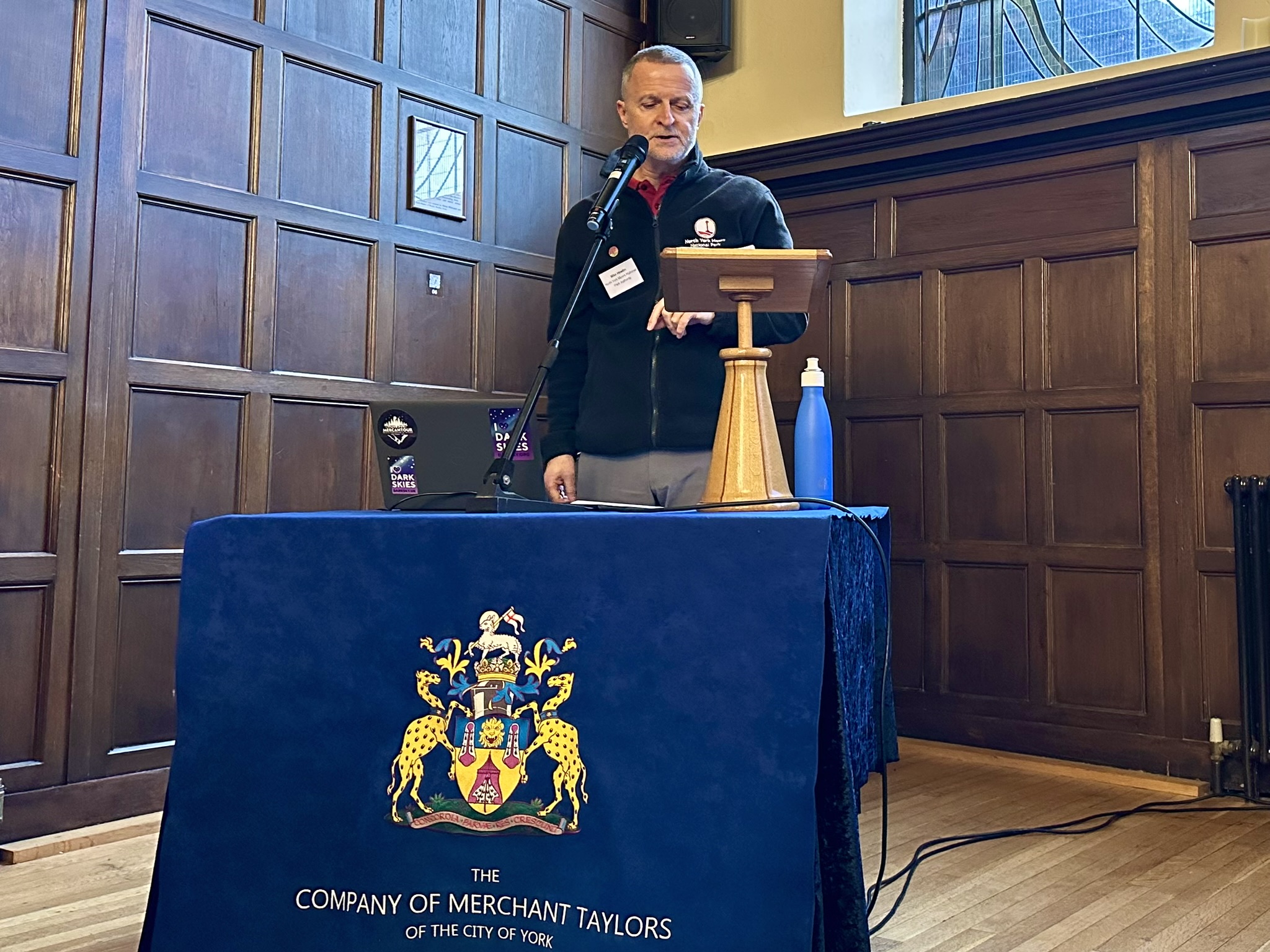
Hawtin has spent years making the case for darkness in places where somebody can do something about it. The North York Moors gained International Dark Sky Reserve status in 2020. Since then, the authority has worked on planning guidance, lighting retrofits and community engagement. In the Dark Skies Friendly Community scheme, run in the North York Moors and Howardian Hills, more than 1,000 lights have been replaced to meet a dark-sky-friendly standard. Hawnby was the first community to gain recognition. Those are changes residents and businesses helped to make, one property at a time.
Hall acknowledged Hawtin’s leadership in York. You could see what it amounted to in the room. He has given people working on different parts of the problem somewhere to compare what they know and a way to put it to use outside their own patch. Hawtin, in turn, credited Hannah Kay, Emma Sunley and Jenny Hall with sharing the work of bringing the conference together. “We can’t let perfection be the enemy of progress,” he said on Thursday.
On Friday the programme moved to York St John University for a working session for protected-landscape staff. In his subsequent account, Hawtin said they discussed how to talk about night conservation, how to share evidence and resources, and how to make their case to policymakers with a stronger collective voice. Hawtin announced the agreement to expand nationally after the session.
There’s a reason the first day ended on foot. Any national effort will eventually come down to choices somebody has to make about a particular place. On a university campus, they might involve a bat’s route through vegetation and a student’s walk home. In a village, they might concern the light outside a front bedroom. What the North has built is a way for the people who understand those places to work with the people who can change how they are lit. York showed how far that work has already travelled from the moors.


