



.png)
There are ceremonies in which history is recited, and ceremonies in which it seems to draw breath again.
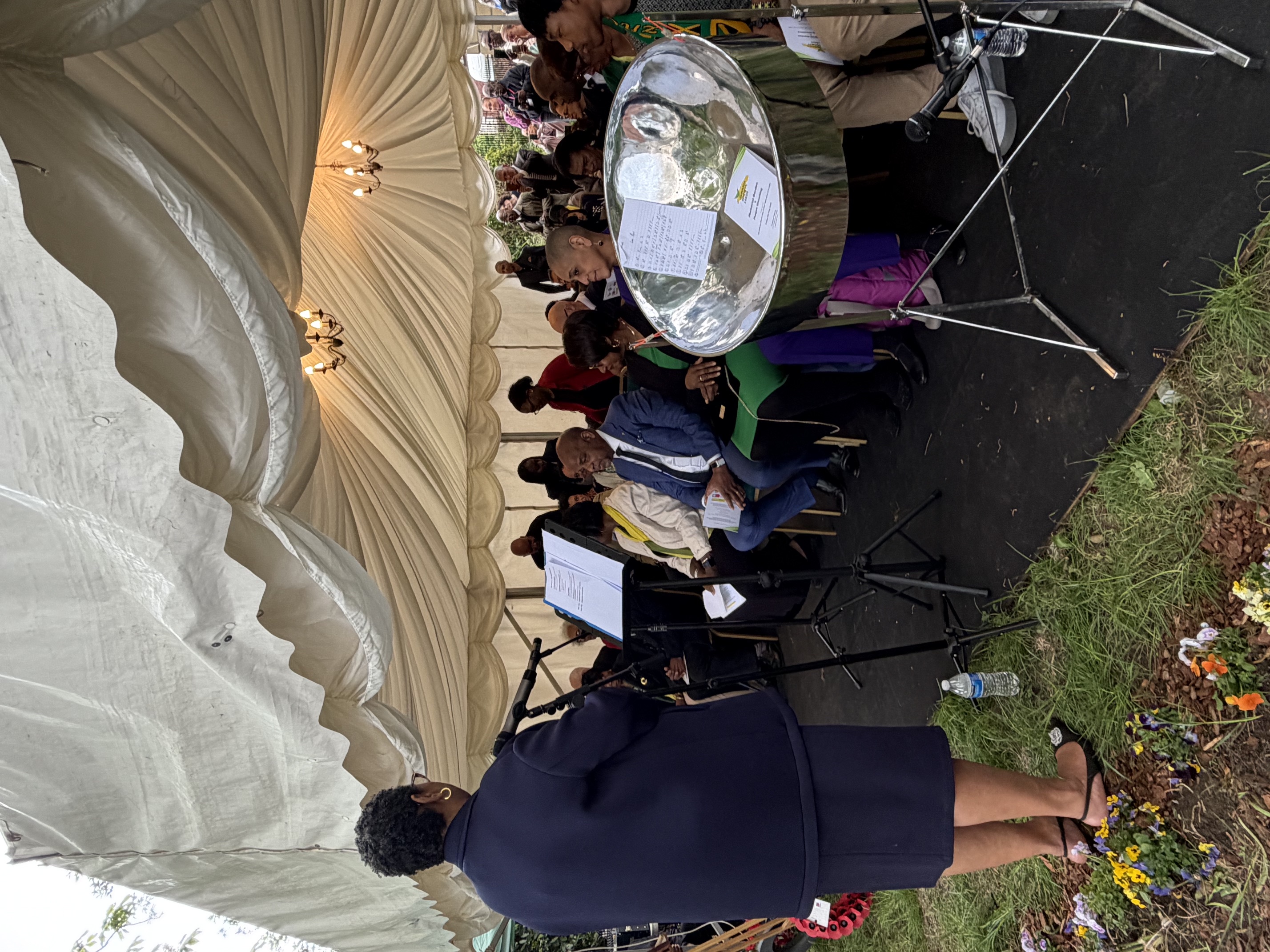
On Friday evening, in the garden outside Jamaica House on Chapeltown Road, the names of Caribbean men who had crossed an ocean to serve Britain in the Second World War were read aloud into the Leeds air by young RAF cadets.
Some names were familiar to the families gathered there. Some had taken years to recover. Some, still, remain unknown.
A new memorial plaque now bears 49 of them.
Behind it lay a story much larger than a list: of teenage volunteers leaving Jamaica and other Caribbean islands to answer Britain’s call; of training camps on the Yorkshire coast; of men who later made Leeds their home and helped build not only post-war Britain, but the institutions, friendships, campaigns and civic life that would shape the city for generations.
And around it, on this particular evening, there was something more intimate still: daughters, sons, grandchildren and great-grandchildren standing together in the place where memory had finally been given physical form.
The private event, organised by Jamaica Society Leeds, marked the unveiling of the Caribbean World War Two RAF Veterans Memorial Garden, created in honour of the veterans who settled in Leeds after the war. It followed years of work by the Society, families and the wider community to gather the names and stories of men whose contribution had too often been left at the margins of the national account. The Society has been working with relatives and the community since 2019 to compile the list now set into the plaque.
Susan Pitter, who led the proceedings with warmth, authority and visible emotion, described the veterans not as a detached historical cohort, but as men whose lives ran directly into the present-day city.
They were, she said, “true trailblazers” - men who “built organisations that are still with us today”, who contributed to “the legislations around justice and equality that we are protected by today”, and who embodied the RAF motto Per ardua ad astra: through adversity to the stars.
She named some of the lives behind the plaque. Errol James, who would help shape laws around race relations. Ferdinand “Ricky” Henriques, who was aboard the Empire Windrush on its final journey from the east before it sailed to the Caribbean to collect passengers whose arrival would become shorthand for an entire generation. Roy Mitchell, whose hands later helped decorate the very Jamaica House behind the gathering. Alford and Gladstone Gardner, who volunteered to defend the “Mother Country” as their father had done in the First World War. And Alford Gardner, Charlie Dawkins, Errol James and Glen English, who in 1948 helped establish the Caribbean Cricket Club, still standing today as the oldest club of its kind in Britain.
This history is essential because it refuses the flattening language so often used about migration. These men were not anonymous arrivals into somebody else’s story. They were among the people writing Britain’s next chapter.
They were organisers, sportsmen, campaigners, fathers, founders, neighbours. They were among the people who made Black civic life in Leeds possible at a time when, as Pitter put it, the Caribbean community needed somewhere of its own “when we were unwelcome everywhere else”.
The ceremony itself carried that mixture of military formality and Caribbean particularity with remarkable grace.
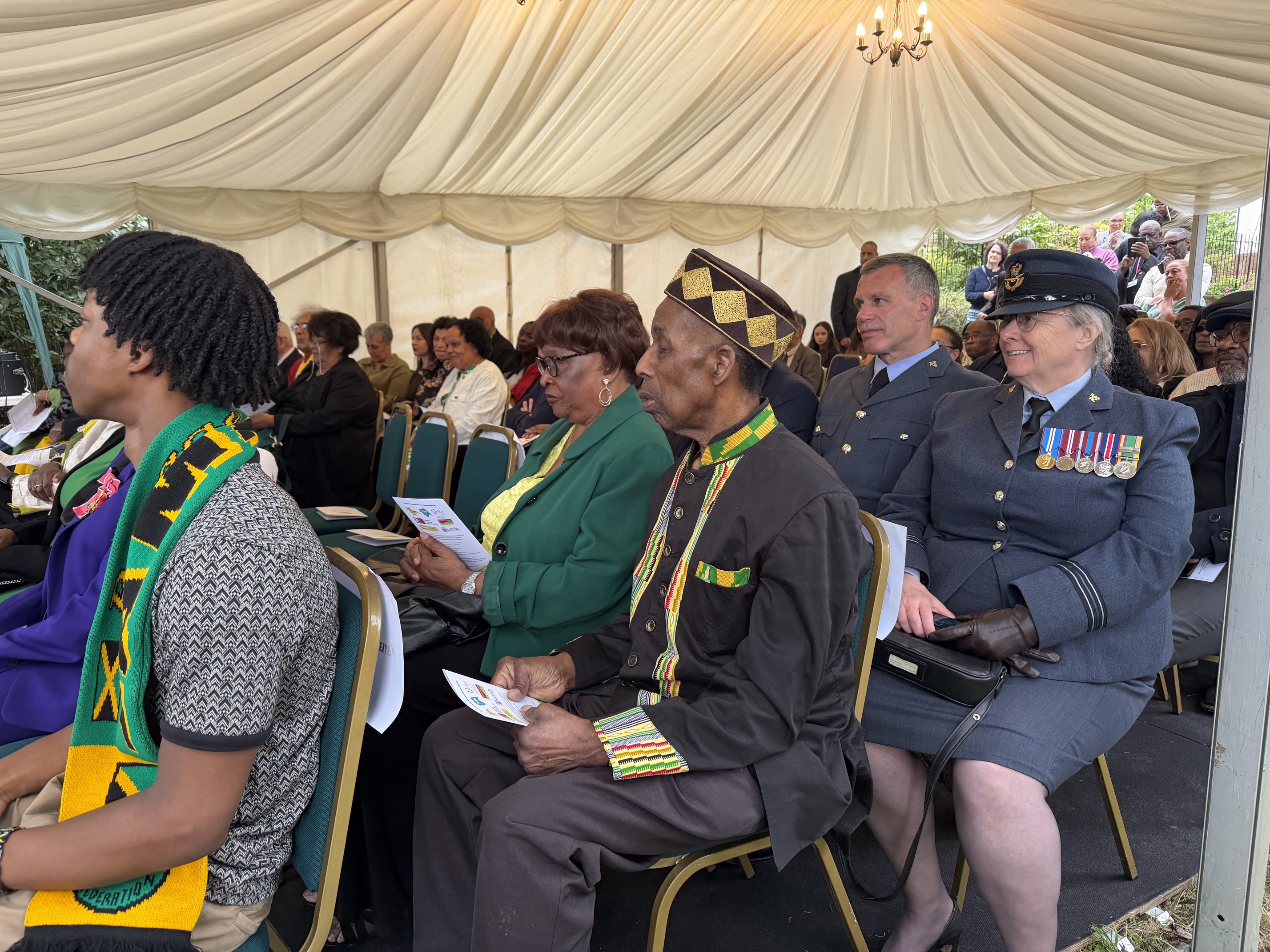
The plaque was unveiled by 97-year-old Robert Crouch, the Society’s oldest member, alongside Cadet Isaac Pitter. RAF cadets from 208 North Leeds Squadron and the Bradford Grammar School Combined Cadet Force read the roll of honour. Wreaths were laid. Then came a moment at once familiar and entirely transformed: The Last Post, not sounded on bugle, but played as a tenor steel-pan solo by Melvin Zakers of New World Steel Orchestra.
It was one of those rare ceremonial choices that did not diminish tradition but deepened it - a British act of remembrance carried through an instrument whose sound belongs unmistakably to the Caribbean. The result was not fusion for the sake of symbolism. It was simply truthful. These men’s story belongs to both places.
Before the unveiling, Yvonne English, widow of Hubert “Glen” English MBE, read a poem she had written in tribute. Glen English had been just 17 when he left his parents and his college place behind to serve in a war thousands of miles away. His widow’s voice held both pride and ache as she read:
“We thought of you today, but that’s nothing new.
We thought about your yesterday and days before that too…
Through adversity to the stars they soar,
defenders of the skies forevermore.”
The Jamaican High Commissioner to the UK, His Excellency Alexander Williams, spoke with the clarity the occasion deserved. The memorial garden, he said, ensured that future generations would know Caribbean people “stood firm in defence of freedom, democracy, and global peace”.
“Their contribution was not a footnote. It was foundational. And today, we enshrine that truth in stone, in memory, and in community.”
That line deserves to stay with the city.
Because this memorial garden is not an isolated act. It is the latest chapter in a long and unusually serious body of heritage work by Jamaica Society Leeds: the Eulogy project, which gathered the lives and memories of first-generation Jamaicans in the city; Rebellion to Romance; the Out of Many Festival; and, most directly, For King, Country & Home, the 2023 exhibition at Leeds Central Library which explored and celebrated the lives of the city’s Caribbean Second World War RAF veterans. The Society’s 2019 Eulogy exhibition remains the most visited exhibition in Leeds Central Library’s 140-year history, while the 2022–23 Out of Many Festival, which included For King, Country & Home, attracted audiences of more than 190,000.
The Society’s own history is part of the same fabric. Founded in 1977 by first-generation Jamaican women and community leaders, it grew out of a simple refusal: when Leeds had nowhere suitable to entertain the great Jamaican cultural figure Louise “Miss Lou” Bennett-Coverley, its founders created something of their own. Nearly half a century later, Jamaica House remains one of the city’s vital civic spaces - not an appendage to Leeds life, but one of the places where Leeds has been made.
That point was present throughout Friday evening. This was not nostalgia, embalmed and carefully labelled. It was living history, held by families and by a community that has spent decades insisting on its own place in the public record.
As one notable speaker put it, in an unscripted thank-you to Susan Pitter near the close of proceedings:
“It’s not just some pictures, is it? It’s our lives, it’s our heritage.”
The men now named in the garden had arrived before the better-known Windrush story.
During the Second World War, thousands of Caribbean volunteers joined the RAF, many of them very young men answering an appeal from Britain at a moment of existential danger. A significant number of the Caribbean ground crew trained at RAF Hunmanby Moor, near Filey on the North Yorkshire coast - a connection that brings this story directly into the North’s own wartime landscape.
That link was present at Friday’s ceremony through Glenn Parsons of the Filey Memorial Campaign, who was invited to read out the names of veterans not yet inscribed on the plaque and to honour those still unnamed. Introducing him, Pitter noted that many of the men who later settled in Leeds had served at Hunmanby Moor.
“In honour of them all, named or unnamed,” Parsons said, “we will remember them always.”
The phrase “named or unnamed” mattered. It acknowledged both the achievement of what has now been recovered and the incompleteness that remains. The plaque is not the end of the research. It is, perhaps, a beginning: a public declaration that these lives are worth searching for, and that absence from the archive must never be mistaken for absence from history.
Among those remembered most tenderly during the ceremony was Alford Gardner, Leeds’ last surviving Caribbean Second World War veteran, who died in 2024. He had served, returned to Jamaica, then came back to Britain aboard the Empire Windrush. Pitter recalled one of the rare moments in which Gardner became visibly emotional: sitting before his commissioned portrait at Buckingham Palace, he had looked at her and said:
“Who would have thought that a little boy running up and down the countryside in Jamaica, with no shoes on his feet, would be here, sitting down, watching the King watching me?”
Then, characteristically, he added:
“And by the way, I’ve not met him once, I’ve met him several times.”
It is a lovely story because it preserves the whole man: not merely “veteran”, not merely “Windrush pioneer”, but witty, proud, alive to the improbability of history and entirely himself.
Pitter’s next question was the one that really lingered after the speeches had ended.
“There are memories of these men that we all have to hold dear and to hang on to them because when we are gone, who has those memories to pass on? Who protects and preserves and champions those memories?”
Jamaica Society Leeds has spent years answering that question in practice. Through exhibitions, oral history, family photographs, books, festivals and now a memorial garden, it has insisted that the Caribbean story in Leeds is not peripheral heritage to be politely noticed once a year. It is Leeds history. It is northern history. It is British history.
.jpg)
And perhaps that is why the timing of Friday’s ceremony felt impossible to ignore.
The gathering took place on Friday 8 May 2026, as the country was absorbing local-election results that showed Reform UK making major gains, amid a political climate in which migration has once again been made to carry the weight of grievances it did not create. That is not an incidental backdrop to a ceremony such as this. It is precisely the reason such acts of public memory are vital. The 2026 local elections has produced a major shift in British politics, with Reform UK emerging as the largest party by councillor gains and making substantial inroads across England.
It would be crude to turn a memorial garden into a party-political prop. But it would be equally dishonest to stand among the names of these men and pretend the present has nothing to do with them.
Because these men were migrants.
They were also volunteers. Servicemen. Founders. Law-shapers. Community builders. Men who came when Britain asked, stayed when Britain needed rebuilding, and helped make Leeds more just, more organised, more culturally alive and more fully itself.
They do not fit the mean little stories now told about migration. They expose them.
When people speak of migrants as though they are a recent burden placed upon a settled nation, the garden at Jamaica House offers a quieter, harder truth. Britain was not built first and diversified later. It was defended, repaired and renewed by people from across its empire and former empire - including young Caribbean men whose names are only now being placed where the public can see them.
And there is a further discomfort here for any politics that tries to divide people into those who 'properly' belong and those who merely arrived. These veterans did not simply serve Britain from afar and disappear again into history. They became part of the civic bloodstream of Leeds. They founded clubs, created institutions, fought for racial justice, raised families, built communities and helped shape the legal and social protections others would later inherit.
As Susan Pitter reminded those gathered, Glen English said as early as 1951 that the success of Leeds would depend on good relations between Black and white people in the city. More than 70 years later, she noted, those words still resonated “today, of all days”.
They do.
The question is not only whether Britain remembers men like these. It is whether Britain is willing to understand what their lives prove.
That migration is not some regrettable modern interruption to the national story. It is part of the national story.
That the North has not merely “hosted” generations of Caribbean people, but been enlarged, strengthened and changed for the better by them.
And that any country now tempted to blame migrants for its failures should first ask itself, with a little more humility and a great deal more historical honesty: where would Britain have been without them?
The memorial garden will now be a place to return to each Remembrance Day. But its importance should not be confined to remembrance. It is also a challenge to the present: to tell the truth about who served, who settled, who built, and who belongs.
The plaque at Jamaica House does not ask for gratitude on behalf of the men whose names it bears. They earned far more than that long ago.
What it asks of us is memory with integrity.
And in a country once again tempted by smaller stories about itself, that is no small thing.
Header Image: RAF Veteran Hubert 'Glen' English





