



In Pennine towns like Halifax, it's difficult to separate the landscape from the cloth.
Water running off the hills helped power mills. Sheep, merchants, dyers, spinners and weavers fed an industry that carried the town’s name across the world. Chimneys and stone buildings rose through valleys whose shape had already determined where people could live, move and work.
The landscape entered the mill as material, power and human knowledge.
The mill then returned to the landscape as wealth, smoke, noise, architecture and social division.
This autumn, an exhibition of contemporary tapestry arrives at a Halifax house built from just that relationship.
Tapestry of the North brings work by northern members of the British Tapestry Group to Bankfield Museum from 12 September 2026 until 6 March 2027. The exhibition includes established professionals, founding members of the organisation and people who've discovered tapestry more recently.
Their work uses an ancient process to interpret landscapes, structures and experiences across the North. The location could hardly carry more meaning.
Bankfield was once the home of Edward Akroyd, one of Halifax’s leading woollen and worsted manufacturers, as well as an MP and philanthropist.
Between 1838 and 1868, his home grew from a relatively modest house into the imposing Italianate mansion visitors see today. Its expansion followed the accumulation of industrial wealth around it.
Akroyd’s influence extended beyond the mansion. Nearby Akroydon was developed as a model village for workers, embodying the Victorian industrialist’s belief that employment, housing, religion and social order could be planned together.
That legacy is neither simple nor incidental to an exhibition about textiles.
The mills brought employment, technical ingenuity and international importance to West Yorkshire. They also concentrated economic power, imposed brutal working conditions and placed workers’ lives under the control of owners whose paternalism didn't diminish the inequality between mansion and mill.
Bankfield became a museum in 1887. Today, its collections tell stories of Halifax and Calderdale through costume, local history, art and textiles gathered from around the world.
Now tapestry enters the former mill owner’s home not as a commodity produced at industrial speed, but as concentrated human time.
Every surface has been built slowly by hand.

Tapestry is frequently misunderstood as a picture embroidered onto an existing fabric.
In true tapestry weaving, the image and the cloth come into existence together. The artist works across the loom, passing weft threads over and under the warp. Colour, form, surface and structure are created through the same physical process.
“A tapestry is not just a picture,” says joint exhibition curator Sally Reckert.
“It’s often described as a conversation between the weaver, the threads and the loom, slowly brought to life by hand. This is art that is woven, not painted.”
We've noted the distinction.
A painter places an image onto a surface. A tapestry weaver constructs the surface through the act of making the image. The landscape isn't only represented; it becomes structure.
That quality gives tapestry a particular affinity with the North.
Northern England has been woven through generations of material knowledge: wool and worsted in West Yorkshire, cotton across Lancashire, carpets in the Calder Valley, lace, linen, dyeing, finishing and the countless specialised trades that grew around them.
Much of that work was repetitive, exhausting and poorly rewarded. Yet the skill required to understand fibre, tension, colour and machinery became part of the cultural intelligence of entire communities.
Tapestry of the North works at a different scale from industrial production, but its makers remain connected to that long history of thinking through material.
The hand doesn't simply execute an idea conceived by the mind. It helps discover what the work will become.
Among the works arriving at Bankfield is Monica Ward’s These Dark Satanic Mills.
The title inevitably summons William Blake’s famous phrase and the image of industry as an assault upon a greener England. In West Yorkshire, however, mills can't be placed neatly outside the landscape as though they arrived from another world.
They were built from local stone and fitted into narrow valleys beside water. Terraces climbed the hills around them. Roads, canals and railways were driven through the land to serve them. Generations organised their days around the mill bell.
The mill became part of the northern view.
Its beauty remains uncomfortable. Great stone complexes can now appear magnificent after the machinery has stopped, the smoke has cleared and the workers’ exhaustion has fallen silent.
Some have become apartments, offices, galleries and visitor attractions. Others stand empty or have disappeared altogether. Their architecture survives more readily than the experiences of the people who kept them operating.
A contemporary tapestry can hold those contradictions without resolving them.
Thread can suggest stone, smoke, water, vegetation and the accumulated marks of human work. The slowness of weaving resists the speed with which industrial history is sometimes converted into attractive heritage.
It asks us to look for longer.
The British Tapestry Group began more than 20 years ago when a small group of weavers held an exhibition in Hebden Bridge.
The beginning is significant. Hebden Bridge sits inside the Calder Valley’s textile geography, surrounded by the physical remains of manufacture while sustaining newer, more enlightened communities of artists and makers.
From those beginnings, the group has developed into a national organisation supporting and promoting contemporary tapestry weaving.
The artists exhibiting in Halifax come from across northern England, including weavers based in the West Riding. Their approaches vary widely: some works are closely observed, others abstract; some draw directly upon landscape, while others explore memory, geology, archaeology or the emotional atmosphere of a place.
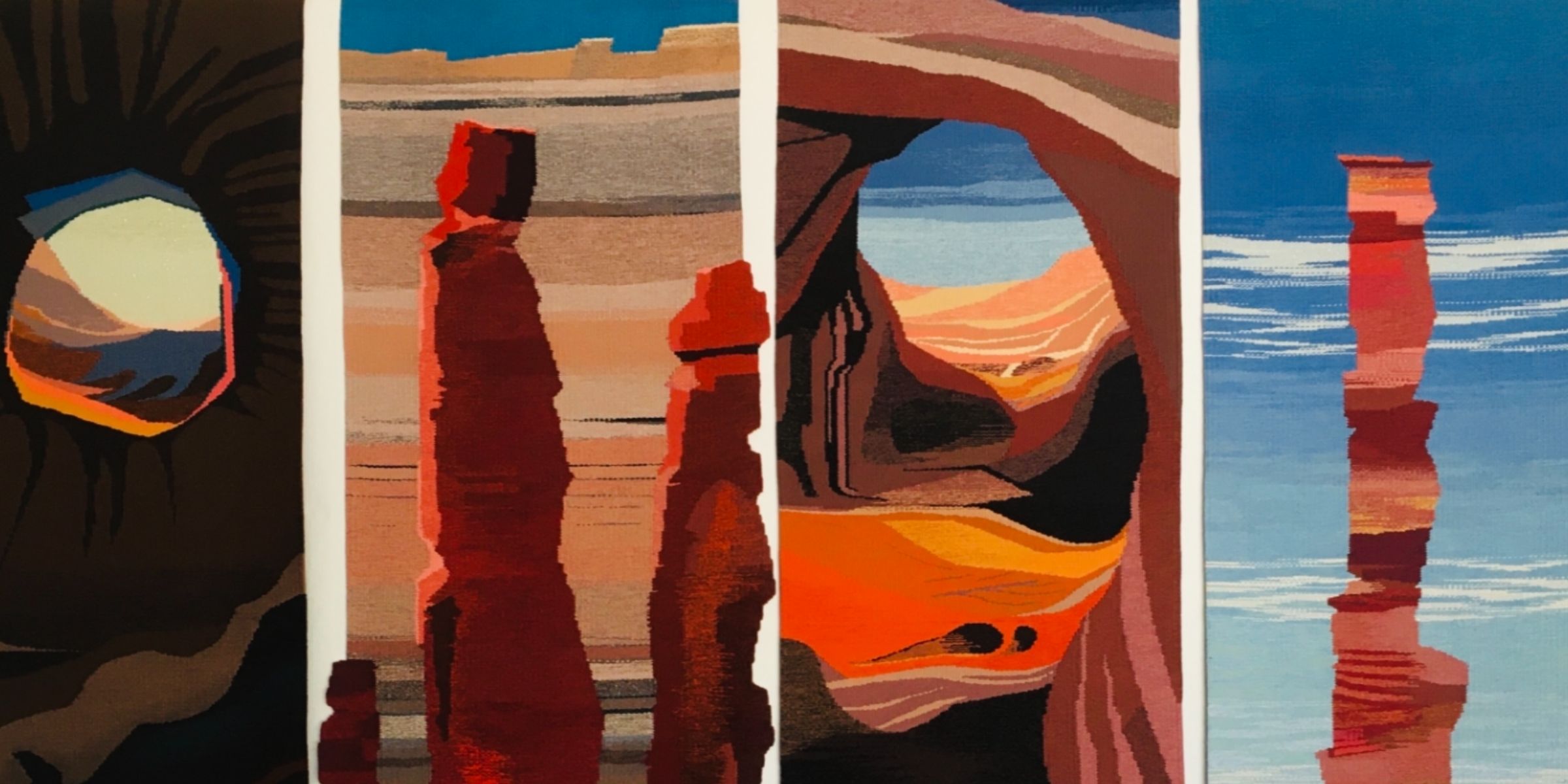
Wendy Robinson’s Rock Art, Old and New suggests marks carried through deep time. Shirley Ross’s Arizona Quartet reminds us that an artist’s northern identity does not constrain the geography of their imagination. Together, the works resist the expectation that northern art must repeat a familiar catalogue of moors, mills and weather.
The North isn't a single view.
It's a set of relationships between land and labour, home and elsewhere, inherited knowledge and individual experience.
The exhibition has already travelled through very different northern settings. It opened at Farfield Mill in Cumbria’s Howgill Fells before moving to Kirkleatham Museum near the North Sea coast. Halifax is its final destination.
Each venue changes the way the work is read.
At Farfield, the exhibition occupied a former woollen mill. At Kirkleatham, it met the histories of an eastern coastal community. At Bankfield, it enters the domestic world created by mill wealth.
The tapestries remain physically unchanged. Their surroundings alter the conversation.

There's renewed interest in slow, material crafts at a moment when much of everyday life is becoming more abstract and frictionless.
Images can be generated in seconds. Products arrive without revealing who made them. Digital work allows ideas to circulate while concealing their physical and environmental costs.
Tapestry refuses invisibility.
Its labour remains present in every inch. The maker has to negotiate the resistance of material, the limitations of the loom and the consequences of each choice. A thread placed badly can't always be corrected without unmaking what came after it.
This doesn't make handwork morally pure, or does it require us to reject technology. It reminds us that knowledge can reside in the body as well as in instructions.
A weaver learns tension through the fingers. Colour changes according to neighbouring threads. A surface develops through repeated decisions too small to register individually but decisive when viewed together.
In a region where textile knowledge was once held by huge sections of the population, preserving those forms of understanding is more than an artistic concern. It's part of cultural memory.
The exhibition will be accompanied by opportunities to meet makers, attend workshops, draw and try weaving in the gallery. Those activities make sure that visitors don't encounter tapestry only as a finished object protected by the authority of a museum.
The loom remains available as a place of discovery.
From the windows of Bankfield, Halifax’s industrial landscape can still be read.
The mansion, park and model village express one Victorian vision of how capital, labour and community should be organised. Beyond them lies a town continuously adapting the buildings and identities left by textiles.
Tapestry of the North doesn't offer a comprehensive history of that industry. Nor should contemporary weavers be required to carry the entire moral weight of the mills simply because they work with thread.
But their arrival at Bankfield creates a powerful connection.
Cloth is returning to the mill owner’s house, no longer as evidence of volume, profit or industrial command. It arrives as individual attention: thread selected, tension judged and images slowly brought into being by northern hands.
The hills went into the mills.
The mills entered the towns.
And now, inside Bankfield, the landscape is being woven again.
Tapestry of the North runs at Bankfield Museum, Akroyd Park, Halifax, from 12 September 2026 to 6 March 2027.
The museum opens Tuesday to Saturday, 10am–4pm.
Admission and parking are free.
Workshops and Meet the Maker events will be announced at tapestryofthenorth.org.
Header image: Arizona Quartet by Shirley Ross





