



For a history that arrives already burdened by myth, you have to go some to better Genghis Khan.
For many of us, the name still conjures a single image: hooves on the steppe, cities burning, an empire advancing with terrifying speed. It is a name that has survived for more than eight centuries as shorthand for conquest, violence and absolute power. But history, when handled properly, is rarely that simple. And this summer, in Leeds, the Royal Armouries will invite visitors to look again.
From 26 June to 1 November 2026, the museum will host Genghis Khan: How the Mongols Changed the World, a major international exhibition bringing 248 rare Mongolian artefacts to the UK for the first time. Drawn from Mongolia’s national collections - with many objects never previously having left the country - the exhibition promises to move beyond the familiar image of the warrior-emperor and into a broader, more unsettling, more interesting story: of empire, mobility, innovation, belief, trade, women’s power, military organisation and the making of the modern world.
It is a big subject for any museum. But at the Royal Armouries, on Leeds Dock, it feels particularly charged.
This is the UK’s national museum of arms and armour: a place where objects are not allowed to sit innocently in glass cases. Weapons here are not just beautiful, brutal or technically impressive. They are evidence. They tell stories about power and fear, invention and defence, status and statecraft, violence and survival. They show how societies organise themselves - and what they are prepared to do in order to endure, expand or dominate.
So an exhibition about Genghis Khan and the Mongol Empire is not simply another blockbuster historical show. It is a chance to consider how force changes geography; how technology travels with armies; how knowledge can move along routes first opened by conquest; and how the story of an empire can be both catastrophic and creative.
That juxtaposition is important: The Mongol Empire did not become the largest contiguous empire in history through soft diplomacy alone. Its expansion in the 13th century was staggering in speed and scale, stretching at its height across more than a fifth of the world’s landmass, from East Asia towards eastern Europe. Its military campaigns brought devastation to cities, dynasties and populations. Its reputation for terror was not accidental: fear itself became part of the machinery of expansion.
But the story does not end there. The Mongol world also connected regions, peoples and systems on a scale that transformed Eurasia. Under Mongol rule, trade routes were secured, envoys travelled vast distances, religious and cultural encounters multiplied, and knowledge moved between East and West. The empire accelerated exchanges in science, medicine, cartography, military technology and administration. What began on the steppe did not remain there.
The Royal Armouries exhibition is designed to sit inside that complexity.

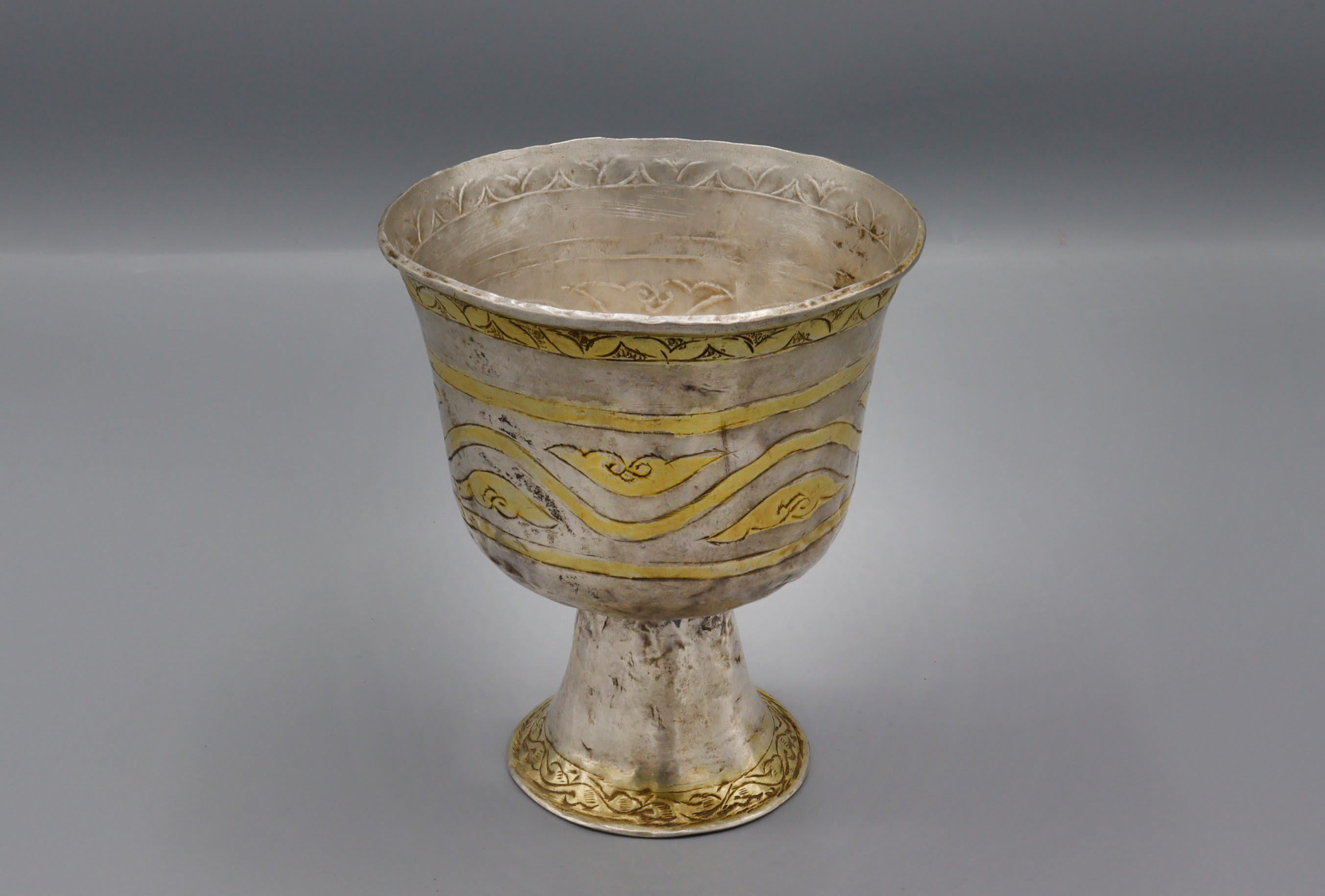
Among the objects coming to Leeds are ancient saddles, ceramics, inscribed coins, armour, and the largest spearhead found in Mongolia. There will be a 13th-to-14th-century helmet from the Chinggis Khaan National Museum, a silver goblet from the same period, and a 6th-to-7th- century figure of a nomad on horseback from the Kharakhorum Museum. These are not merely supporting props in a story about one man. They are fragments of a civilisation: material evidence of mobility, craftsmanship, belief, exchange and power.
The exhibition will also include the stories of those living under Mongol rule, including Genghis Khan’s daughter, Alakai Beki - a figure whose presence points towards one of the more surprising aspects of Mongol history: the political and social power exercised by women within the empire.
That is important, because the popular image of the Mongol world is often overwhelmingly male, martial and one-dimensional. Yet the history is more intricate. Women in elite Mongol society could hold authority, manage territories, influence succession and maintain political networks. The domestic, dynastic and diplomatic dimensions of empire were not separate from its military force. They were part of the same machine.
“Cutting across ethnic, cultural and religious distinctions, Genghis Khan forged a new political and military force, the like of which had never before been seen,” says Nat Edwards, Director General and Master of the Armouries. “In a moment of vision and commitment, history changed and the balance of power began to shift. Today, the epic story of the Mongol Empire, brought into life through these amazing treasures, feels like something to which we should all pay attention and it’s an honour to bring this exhibition to the Royal Armouries.”
“Something to which we should all pay attention” - is more than just a line.
Because the point of an exhibition like this is not simply to marvel at old things. It is to think about the systems behind them. The Mongol Empire was shaped by environmental pressure, mobility, communication networks and military adaptability. Its rise invites questions that remain uncomfortably contemporary: how do societies respond to climate stress? How does information travel across vast territories? How do pandemics move through connected worlds? How do empires impose order? What is lost when cultures collide - and what is carried forward?
And for Leeds, there is another layer too. The Royal Armouries is not a London institution lending prestige to the North. It is a national museum based here. Its presence on Leeds Dock has always mattered: architecturally, culturally and symbolically. It places a collection of global significance in a northern city and asks audiences to travel here, not south, for encounters with major histories.
That's crucial at a time when the geography of cultural power in England is still being contested. Too often (and I know we say this a lot at MagNorth), the North is spoken about as a recipient of culture rather than a producer, host and interpreter of it. Major exhibitions outside London are not an act of generosity. They are part of what a properly distributed cultural life should look like.
This new exhibition will be the second full-scale show in the Royal Armouries Museum’s new special exhibitions gallery, following the success of Gladiators: Heroes of the Colosseum in summer 2025. The gallery is also the first development in the Armouries 700 masterplan, which aims to transform the site and contribute to the ongoing revitalisation of Leeds Dock and the wider South Bank.
That context is worth noting. Because museum exhibitions do not exist only in the rooms where they are installed. They shape footfall, civic identity, tourism, education and the confidence of a place. They create reasons to visit, reasons to learn, reasons to bring children into contact with histories they may never otherwise encounter.
And in this case, children under 16 will be able to see the exhibition for free.
That is not a small detail. For all the talk of access in the cultural sector, cost remains one of the clearest barriers between families and major experiences. The Royal Armouries itself remains free to enter, while this special exhibition is ticketed for adults and concessions. Making it free for children gives the show a wider civic value. It means the story of the Mongol Empire - in all its scale, difficulty and fascination - can become part of a family day out in Leeds, not just a specialist encounter for those already fluent in museum culture.
Alongside the exhibition, the museum is planning a summer programme expected to include daily Mongolian horse shows. This detail feels more than decorative. The horse is central to any understanding of Mongol history: not simply as transport, but as cultural framework. The speed, endurance and flexibility of Mongol cavalry changed warfare. Steppe life shaped military strategy. Mobility was not an accessory to power; it was the source of it.
The show has been produced by Nomad Exhibitions in association with Nantes History Museum, and in partnership with the Chinggis Khaan National Museum in Mongolia. That international collaboration is significant. This is not a British museum telling Mongolia’s story alone. It is an exhibition built through partnership, with collections and interpretation rooted in Mongolian institutions.
“There are few stories to be told that are more epic that that of the Mongol Empire,” says Tim Pethick, CEO and Founder of Nomad Exhibitions. “The Nomad Exhibitions team are thrilled to be able to bring that story vividly to life in this major international touring exhibition.”
He adds that the team has worked closely with partners at the Chinggis Khaan National Museum and Nantes History Museum to shape the interpretation “with original collections from Mongolian museums, and innovative multimedia techniques, alongside fascinating and insightful curation to appeal to visitors of all ages.”
There will, inevitably, be spectacle. A subject of this scale demands it. But the more interesting promise is not spectacle alone. It is perspective.
Because Genghis Khan remains one of those figures whose image has been flattened by repetition. The tyrant. The conqueror. The military genius. The monster. The nation-builder. The world-changer. Each label contains something. None contains enough.
A good exhibition does not tidy that away. It allows contradiction to remain visible.

It should be possible to confront the violence of Mongol expansion without reducing an entire civilisation to barbarism. It should be possible to recognise administrative sophistication, religious tolerance, technological exchange and global connectivity without romanticising conquest. It should be possible to see Genghis Khan as both a destroyer and a maker of worlds.
Isn't that where museums are at their best: not when they provide easy admiration, but when they create the conditions for more difficult looking?
In Leeds this summer, a 13th-century helmet, a silver goblet, a saddle, a coin, a spearhead and a painted image of an emperor will carry more than the weight of their materials. They will carry questions about how history is made, how power is remembered, and how stories change when the objects themselves are allowed to speak.
The empire that began on the steppe helped reshape the world.
Now, for the first time, some of its rarest surviving treasures are coming to Yorkshire.
Genghis Khan: How the Mongols Changed the World runs at the Royal Armouries Museum, Leeds, from 26 June to 1 November 2026.
Museum entry remains free, but the exhibition is ticketed.
Adult tickets: £9
Concessions: £7
Children aged 0–15: Free
Tickets are available HERE





