



Most of us look at York Minster and we see permanence. It is almost impossible not to.
Turn into the city from Duncombe Place and there it is: enormous, familiar and apparently immovable. Stone, glass, towers and centuries. A building sufficiently old to make the passing concerns of the people moving beneath it seem very small indeed.
Sit inside for Choral Evensong and the sense becomes stronger. The city recedes. The light changes through ancient glass. Voices rise into a space created by people who disappeared from the world hundreds of years ago.
It feels enduring.
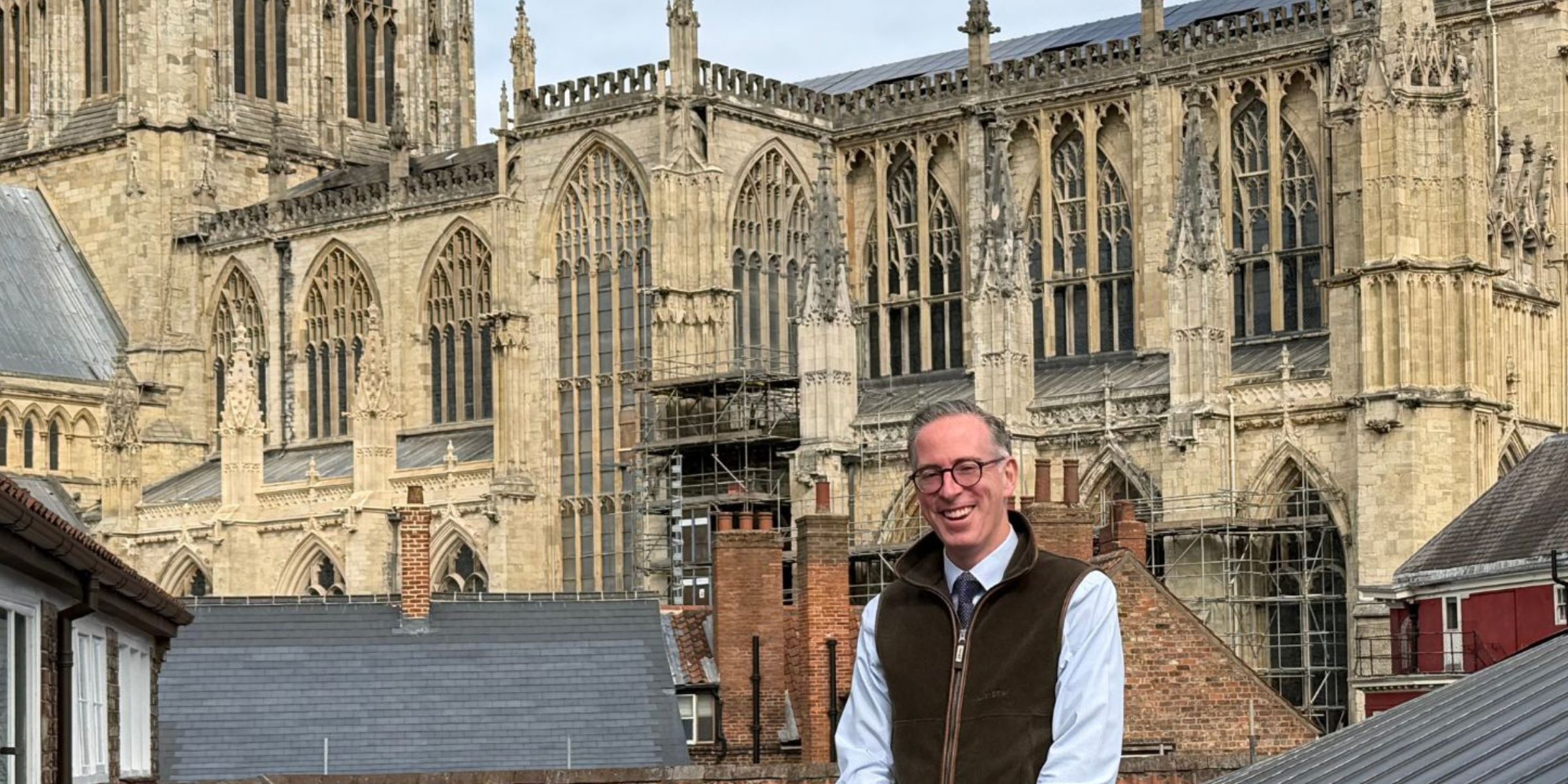
Alex McCallion looks at the same building and sees something rather different.
“I see an incredibly fragile building,” he says.
And suddenly York Minster changes.
McCallion is Director of Works and Precinct at York Minster. It is one of those titles that sounds as though it might have existed in some form for centuries – and, in essence, so has the responsibility behind it.
Look after the building.
Look after the estate around it.
Make sure that what previous generations passed to you can, in turn, be passed on.
Except the job of custodianship in the 21st century now reaches considerably further than stonework and scaffolding.
It involves climate science and carbon reduction. Planning law and renewable energy. Property, income generation and biodiversity. Digital modelling, international partnerships and highly advanced machinery working alongside craft skills that would have been understood by the medieval masons who helped create the cathedral itself.
And beneath all of that sits an uncomfortable truth.
Keeping York Minster alive requires change.
MagNorth first encountered McCallion in July at Energising Britain North East & Yorkshire, held at Bradford City’s Valley Parade.
It was a day deliberately concerned with making the climate transition tangible. Football clubs, schools, farms, housing organisations, community groups and even a fish and chip shop were talking not about net zero as an abstraction, but about the practical business of changing the places people already know and care about.
Then came York Minster.
As we wrote at the time, it felt as though the room sharpened.
McCallion described using planning policy to enable what once would have seemed an extraordinary proposition: renewable infrastructure across one of England’s most sensitive historic estates, including solar panels on York Minster itself.
His wider argument was more interesting still.
Historic buildings could not simply be excused from adaptation because adapting them was difficult.
“We are in a climate emergency,” he told the Bradford audience. “Heritage buildings have a huge role to play in responding to the climate emergency.”
He also challenged a reflex he had encountered repeatedly in conservation:
“I’m sorry, the answer’s no, what’s the question?”
“That’s not good enough in a climate emergency.”
The argument stayed with us.
So MagNorth went to York to find out what happens when that philosophy is applied to one of the most important historic buildings in Europe.
McCallion has been in post at York for nine years.
Ask him what he notices when he looks at the Minster that a visitor might miss and the answer quickly strips away any notion of effortless permanence.
The cathedral holds an extraordinary collection of medieval stained glass. That glass is supported by stone which is itself ageing and, in places, deteriorating.
Climate change is accelerating the problem.
Long periods of wet weather allow limestone to absorb moisture. Rapid transitions into increasingly hot conditions draw that moisture out again. Salts move. Surfaces begin to deteriorate. Different stones, introduced during different periods of restoration, behave differently.
The Minster is, McCallion explains, effectively a patchwork of limestones.
The glass presents another set of challenges. So does leadwork, repeatedly expanding and contracting under increasingly extreme conditions.
When three great lancet windows beneath the Rose Window were removed for conservation, McCallion says failure in the lead network was found to be around 94 per cent.
The response now being developed for the Rose Window includes external protective glazing designed not only to filter ultraviolet light but infrared radiation too – another adaptation prompted by increasing heat.
None of this belongs to some theoretical climate future. It is happening now.
So is another problem familiar to virtually every custodian of historic buildings: scale.
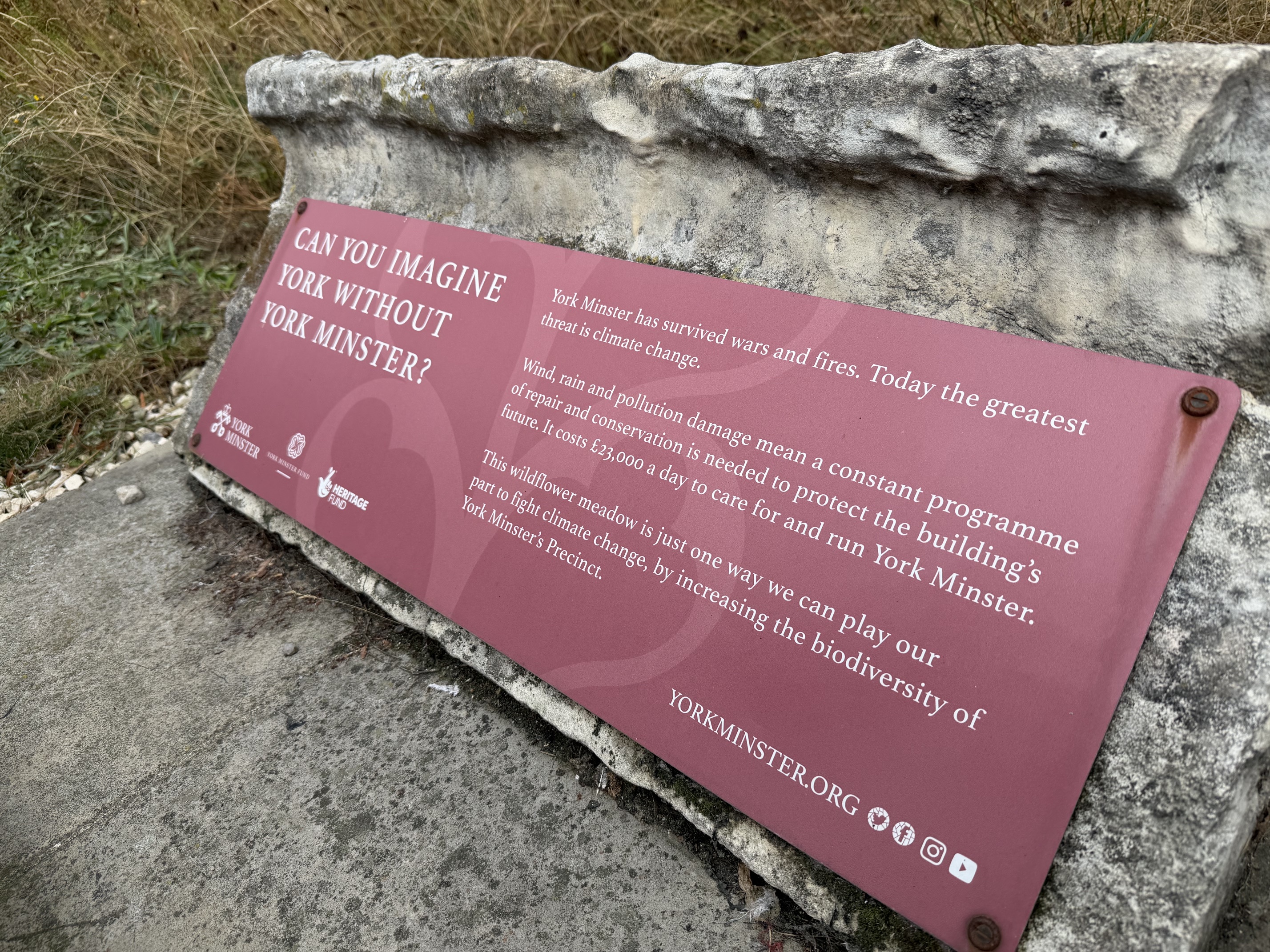
York Minster does not receive an annual government cheque that magically makes its conservation problems disappear. McCallion says the cathedral and its operation cost around £34,000 a day, while the institution remains responsible for generating the income, donations and grants required to sustain the work.
The restoration itself never really ends.
He describes a 100-year scaffold cycle.
Finish one elevation and another waits.
Future campaigns already stretch ahead: window after window, stone after stone, elevation after elevation.
Asked what keeps him awake, McCallion doesn't reach for a dramatic catastrophe.
It is simply “the scale of the challenge ahead”.
That answer might explain much of what has happened across the Minster precinct during his time in York.
When McCallion arrived, significant work to address maintenance and the future of the estate was already under way.
One of his first major tasks was to develop a masterplan.
His advice to Chapter – the governing body of York Minster – was characteristically uncomplicated.
A masterplan that was not embedded in planning policy was, he told them, “a complete and utter waste of time”.
At the time York presented an unusual problem. The city had no adopted modern Local Plan capable of providing the policy framework McCallion believed the precinct needed.
So he looked elsewhere.
The solution came through the Localism Act and the creation of a Neighbourhood Plan for the Minster precinct – effectively producing bespoke planning policies through which the estate's future could be considered.
The process was not quick.
There were four years of development and 32 weeks of consultation. Historic England and City of York Council were among the important partners. Residents and stakeholders were asked what they wanted the future of the precinct to look like.
Eventually the plan went to referendum.
McCallion describes it as one of the more nerve-racking moments of his professional life.
Some 83 per cent voted in favour.
Planning policy rarely sounds like the raw material of an exciting story.
Here, however, it matters.
Because the significance of the Neighbourhood Plan is not simply that York Minster wrote a document.
It created the framework within which difficult decisions could actually be made.
Renewable energy. New buildings. Restoration. Public space. Commercial activity. Residential conversion. Biodiversity. Heritage skills.
Instead of approaching each intervention as an isolated battle over whether change should happen at all, the precinct had established an agreed vision for what responsible change might look like.
Much of that vision has subsequently moved remarkably quickly from plan to bricks, stone, planting and infrastructure.
For McCallion, it has also exposed a deeper problem with the language of conservation itself.
Planning policy requires interventions in important historic assets to be assessed in terms that include potential “harm”.
It is a word he dislikes.
The intention, he argues, is not to harm these buildings.
It is to give them a viable future.
That distinction gets close to the philosophical heart of what is happening in York.
Conservation can easily become confused with stasis.
The safest historic building, according to that instinct, is the building nobody changes.
McCallion questions the premise.
York Minster has never been static.
Neither has its surrounding estate.
Generation after generation has altered, repaired, rebuilt and adapted it. Styles have changed. Materials have changed. Technologies have changed. Uses have changed.
“The estate's looked like this forever,” is the assumption McCallion encounters.
Except it hasn't.
And in the face of a changing climate, he believes pretending otherwise becomes more than unhelpful.
It risks becoming negligent.
Buildings have to respond to the conditions around them.
He uses another phrase that initially sounds surprisingly commercial for a cathedral precinct.
The estate needs to “wash its face”.
The meaning is simple.
Historic buildings that require enormous sums to maintain cannot be separated from the question of how those sums are generated.
A redundant or underused building is still a liability. Bring it back into meaningful use, and it may generate the income that helps sustain the wider estate.
That logic now runs through projects around the precinct.
Historic buildings are being restored and returned to use. Parts of the estate can generate commercial or residential income. Renewable energy reduces expenditure as well as carbon. New facilities may create entirely new revenue streams.
Financial sustainability and environmental sustainability stop being separate conversations.
Both become part of custodianship.
There is another assumption McCallion enjoys challenging.
That modern technology is somehow inherently at odds with traditional craftsmanship.
The medieval masons who created the Minster, he points out, were themselves innovators.
They pushed engineering and technology to their contemporary limits.
Why, then, would fidelity to their achievement require their successors to stop doing the same?
One of the earliest demonstrations came with the statue of the late Queen Elizabeth II on the west front.
Traditional sculptural skills remained fundamental to its creation, but digital scanning and modelling also allowed the team to accelerate parts of the process and test the full-scale work before committing it to stone.
What began as a practical solution became, almost by accident, symbolic of a much bigger philosophy.
Old skills and new technology did not need to sit on opposite sides of an argument.
They could strengthen one another.
That principle has since accelerated.
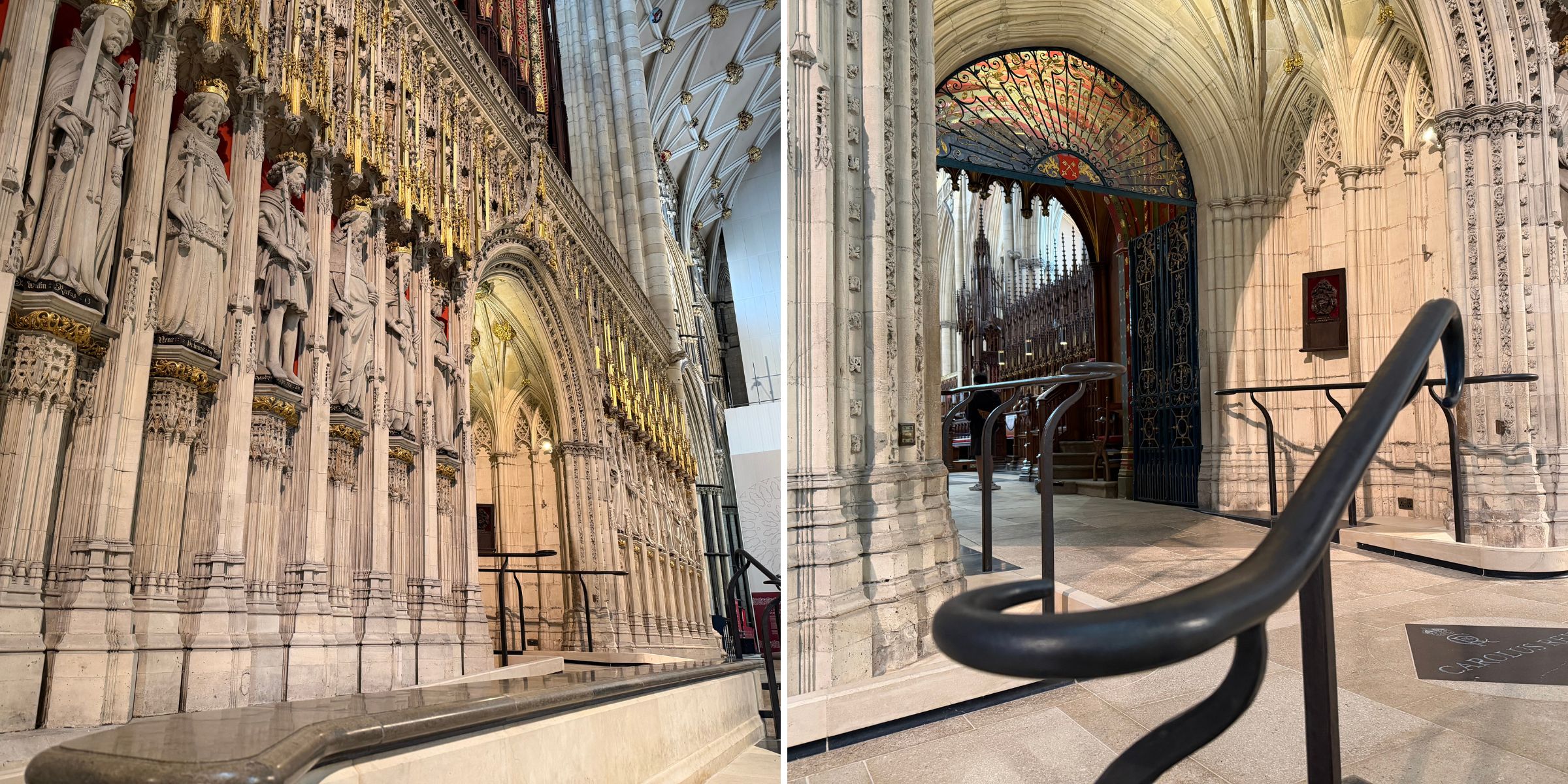
Earlier this year, the Minster completed a new accessible entrance into the Quire.
The work was digitally designed before stone was processed using the new technological capacity developed within the precinct and then finished by craftspeople.
McCallion estimates that an intervention which might once have taken around 18 months was delivered in less than five.
Its most satisfying review?
People have told him it looks as though it has always been there.
Perhaps that is one of the highest compliments a contemporary intervention in York Minster can receive.
New – but not shouting about it.
Modern – but respectful.
Change serving continuity.
This is no longer simply a York conversation.
Historic buildings across Europe and beyond are confronting remarkably similar questions.
How do you decarbonise structures designed centuries before electricity existed?
How do you fund enormous maintenance programmes?
How do you respond to a climate that is already altering the rate at which materials decay?
And where will the next generation of masons, glaziers and other specialist craftspeople come from?
York Minster has increasingly found itself within an international network attempting to answer those questions.
Relationships have developed with major cathedral and heritage institutions in Europe, North America and elsewhere. Knowledge moves in both directions.
McCallion does not present York as possessing a universal solution.
Different places demand different responses.
But shared problems create an obvious case for sharing experience.
A cathedral in northern England can learn from one in Milan or Cologne.
Washington can ask York about solar.
York can learn how another institution approaches skills, stone, glass or climate adaptation.
In an age when the consequences of climate change ignore national borders, custodianship is becoming international too.
And there is something quietly striking about York occupying that position.
For all the global visitors moving through its streets, this remains an intensely local building.
The Minster is part of York's geography and psychology.
People use it to orientate themselves. Its bells enter daily life. Its towers appear between buildings and above walls. People who may never attend a service still think of it as theirs.
That emotional ownership is partly why changing it is difficult.
It is also why getting those changes right matters so much.
At Bradford, McCallion told the room that renewable energy installed on the Minster was partly an act of “moral leadership”.
If it could happen there – within the constraints of a Scheduled Monument, a Grade I listed cathedral and one of the most closely scrutinised historic precincts in Britain – difficulty alone became a less persuasive reason for inaction elsewhere.
But perhaps York's more interesting lesson is not simply if we can put solar panels here, anybody can.
It is that serious custodianship requires a willingness to think beyond the lifespan of the custodian.
The Minster Alex McCallion sees is not simply the magnificent building standing outside his office today.
It is the building that must survive the winters coming next.
And the summers.
The building whose stone will require carving decades after today's masons retire.
The building whose energy will need to come from somewhere.
Whose roofs will need repairing.
Whose medieval glass will still require protection.
Whose surrounding estate must generate enough life and income to help support it.
And whose next custodians are, somewhere, still at school.
There is one part of McCallion's work we have deliberately left largely unopened.
Behind the Minster sits its Centre of Excellence for Heritage Craft Skills and Estate Management.
It brings together traditional craftsmanship, digital technology, research, apprenticeships, international exchange and the practical business of managing one of Europe's most complex historic estates.
McCallion talks about it as one of the most important pieces of the wider plan.
The first time we visited, there wasn't enough time to do it justice.
Perhaps that was fortunate.
Because places like York Minster should probably not be understood from an office alone.
Next week, MagNorth is going back.
We want to meet the people cutting the stone, learning the trades, operating the machinery and acquiring skills that will still be needed long after all of us have gone.
Because beneath the planning policy, solar panels, financial models and international partnerships sits something older and simpler.
Somebody has to know how to look after the place.
And somebody always will.
Header image: Alex McCallion, Director of Works and Precinct at York Minster , with three sector-leading (and potentially invisible) examples of innovative renewable energy interventions, to support the Minster Estate. (MagNorth)





