



.jpg)
Caroline Jones knows the word “death” still makes people flinch. But through Death Cafes, humanist funerals, laughter yoga and even coffin decorating, the Greater Manchester celebrant is trying to create something rare: a warm, honest, practical space for the conversations most of us keep putting off.
There are easier ways to start a community movement than inviting people to talk about death.
There are softer words. Safer posters. Less alarming subject lines. In an age of wellness euphemisms and motivational slogans, death remains the word lots of us scroll past, laugh off, or quietly hope isn't going to not apply to us any time soon.
Caroline Jones gets that. She also thinks it is part of the problem.
Based in Salford, Caroline is a Humanist funeral celebrant, an end-of-life practitioner, a laughter yoga leader, an ex-academic, a former stand-up comedian and - in the language she has chosen for her newest work - The Death Coach.
It's a title that might make people blink. She knows that too. But there's no morbidity in the way she talks about the work. No theatrical gloom. No gothic performance. Instead, what comes through is something much more northern and much more useful: warmth, directness, common sense, humour, social conscience, and a refusal to pretend that avoiding the subject makes anyone safer.
“Talking about death is healthy,” she says. “It doesn’t call it in. It doesn’t make it happen quicker.”
That belief sits at the centre of the important work she does.
Caroline isn't offering medical advice. She isn't replacing doctors, nurses, hospices, palliative care teams or bereavement counsellors. She's very clear about that. Her role is non-medical, pastoral, practical and human. She helps people think about what they want. She helps families have difficult conversations. She helps people record wishes, plan funerals, consider legacy, and face - gently, honestly, sometimes with laughter - the one certainty most of us are pre-programmed not to mention.
“What me, and not just me, but the whole death positivity and death acceptance movement is trying to do is to get us to see that it is going to happen,” she says. “Whether we want it to or not, it’s going to happen to all of us. And you live better and die better if you accept that.”
It's a sentence that could sound bleak on the page. But in conversation with Caroline, it sounds like permission.
Before The Death Coach, there was academia. Caroline spent 16 years at the University of Salford, lecturing in social policy. It was work she loved, and work she believed in. She talks with visible affection about students, colleagues and a course that, at its best, changed lives. But when the programme was closed, and the wider university landscape changed, she found herself having to imagine a different future.
“I’d seen myself doing that up until retirement,” she says. “My career was pretty much set on a trajectory that I was pretty happy with. So it was a huge, sort of, ‘Oh my God, what do I do now?’”
In truth, another strand of her life had already been forming for years.
After her father died in 2016, Caroline spoke at his funeral. As someone who had spent her working life speaking in public, the act itself felt possible. But the experience opened something. She had long been drawn to funeral work. A friend mentioned celebrancy. Caroline trained with Humanists UK and began working part-time as a funeral celebrant. And she loved it.
“I still love it,” she tells us. “It’s still some of the best work I’ve ever done in my life. It’s fantastic.”
Her Humanist celebrant work is rooted in the idea that funerals should reflect the person who has died, rather than move along what she describes on her website as “a conveyor belt of other people’s assumptions.” For non-religious families in particular, that can matter profoundly. Without a priest, vicar, imam or rabbi, people can find themselves asking what a funeral is meant to be, what should happen, who should speak, what rituals are available, and whether they are allowed to do things differently.
Caroline’s answer is usually yes.
“I love good funerals and detest bad ones,” she says on her Humanist profile. “The best compliment I can get for my work is, ‘it’s like you knew them.’”
That phrase is revealing. For Caroline, a funeral isn't a template. It's an act of listening. It is biography, grief, ceremony and care. It is also, at times, humour. A good funeral doesn't have to flatten a life into solemnity. It can hold the contradictions: the tenderness, the daft stories, the difficult bits, the private jokes, the things that made a person unmistakably themselves.
Through that work, Caroline began noticing something: Families who knew what their loved one wanted often seemed steadier. Not untouched by grief, of course. Not spared the pain. But less lost. Less forced to guess. Less burdened by the panic of trying to make irreversible decisions in the middle of shock.
“Families where they knew their loved ones’ wishes usually are handling things with a lot more peace, calm, than people who haven’t got a clue,” she says.
She also began working on “pre-need” funerals, meeting people who were dying and writing ceremonies with them while they were still alive. Again, she noticed something important.
“There’s something about people who are able to face the end, and plan for it, and do what they can to make their families be as calm and as peaceful about it all as possible,” she confirms. “They get a level of peace with it.”
It was that observation that helped lead her towards death coaching.
In the UK, similar work is often described as death doula work. Caroline explains it by comparison with birth doulas: non-medical companions who support, advocate, inform and help people prepare. A death doula, or death coach, does something similar at the other end of life.
“We’ll help people plan,” she says. “We’ll help facilitate difficult conversations with families that they can’t have. We’ll help people note down their wishes. We’ll create rituals.”
And that might be the key: For many people with a religious faith, death comes with a framework. There are prayers, rites, words, orders of service, inherited practices, communal expectations. Even in grief, there is a map. For the growing number of people without religion, that map can be missing.
“If you’ve got religion, there’s a blueprint for death and dying,” Caroline says. “There are things you need to do, there are things you need to say in a particular order. But so many people don’t have religion anymore, so they don’t know how to die, they don’t know what needs to happen.”
That is a startling phrase: “they don’t know how to die.” But it lands because it's true.
We live in a culture that medicalises death, professionalises death, outsources death, hides death and then seems surprised that people feel bewildered when it arrives. For most families, the end of life brings not one task but many: emotional, practical, medical, financial, legal, spiritual, relational. There may be hospital conversations, hospice referrals, funeral choices, family disagreements, old wounds, estrangements, beliefs, rituals, songs, clothes, readings, ashes, burial, cremation, memory, guilt, fear.
And often, nobody has talked about any of it. That's where Caroline believes preparation becomes an act of love.
“Having open conversations with your family is the best thing you can do for them to prepare them for when the time comes,” she says. “They might not want to hear it, they might not be ready to hear it, but it’s the kindest thing you can do for your family.”
She's not being dramatic. She's being practical.
“Otherwise, we could get hit by a bus tomorrow, be in a coma, and your family haven’t got the faintest clue what you’d want,” she says. “They don’t know what funeral you want, they don’t know if you want a priest, a vicar, a humanist, all of it. We don’t talk about it, and we all put it off and think, ‘We’ll get round to it eventually.’ But we don’t. And then it’s too late.”
That's the heart of her message. Not that everyone should become obsessed with death. Not that grief can be neatly managed. Not that planning removes pain. But that silence leaves families “whistling in the dark” at the worst possible moment.
“It’s actually not kind to leave them in that position,” she says.
Caroline is also realistic about the resistance. When she advertises community events - Death Cafes, coffin decorating, opportunities to discuss grief and mortality - she sometimes receives angry responses. Some people are appalled. Some think talking about death somehow invites it closer.
“Somebody said to me a while back at a community event, ‘Yeah, but if you talk about it, you manifest it,’” she says. “And I was like, has nobody mentioned to her that we’re all gonna die?”
There is humour in the line, but also frustration. Because for Caroline, death avoidance doesn't protect us. It isolates us.
And isolation is something she sees again and again at the Death Cafes she runs at Eccles Library on the last Friday of every month.
Death Cafe is an international movement, not a therapy session and not a sales pitch. The format is deliberately simple: people gather, drink tea, eat cake, and talk about death. There's no agenda, no objective, no attempt to push people towards a belief, product or conclusion. It is a space for conversation.
Caroline’s Death Cafes are free, as they must be under the movement’s principles. They're open to people of all faiths and none. Some attend because they're grieving. Some because they are older and thinking about their own wishes. Some because a parent has died, or a partner is ill, or a funeral raised questions they've never been able to ask. Some arrive simply because the subject has been pressing quietly at the edge of their life.
The conversations vary.
“Everyone I’ve run is totally different,” Caroline says. “Sometimes people have come for the first time because they’ve had a bereavement that they were struggling with. So it was very…that was a heavy one. People talking about what they’d been through, basically.”
She believes repetition is part of grieving. Telling the story again. Saying what happened. Returning to the bedside, the phone call, the hospital corridor, the final days, the thing said or unsaid. Many bereaved people know the moment when the wider world seems to decide the story has been told enough times. Caroline wants to offer somewhere different.
“When you’ve been at somebody’s deathbed, you process it by talking about it, or most of us do,” she says. “But once you’ve told your immediate circle, there’s this idea that, ‘Oh, you’ve said enough about this now, let’s move on.’ Actually, I think the more times you tell that story, the more you process it.”
At the Death Cafe, she says, people aren't shut down. They're not hurried. They're not told to look on the bright side, or to be strong, or to stop dwelling. They're listened to.
That might sound simple. It is not. Grief in Britain is still surrounded by strange expectations. We admire composure. We reward resilience. We offer a week of sympathy, then quietly expect people to resume their previous shape. But Caroline rejects the idea that bereavement is something people “get over.”
“I think you move with it, you don’t move on from it,” she explains.
She talks about “continued bonds” - the idea that people continue to carry relationships with those who have died. Not in a way that prevents life from continuing, but in a way that makes life possible again. The aim is not to erase the dead. It is to find a way of carrying them.
“Going through a close bereavement changes you, and it should,” she says. “Every life event has an impact on you and changes you as a person.”
Then comes one of her sharpest comparisons: If someone becomes a parent, she says, nobody asks when they are going to “move past that” and return to who they were before. We understand parenthood as transformative. Yet with death, society often seems to demand a reversal: become yourself again; stop being altered by this.
Caroline tells us that is damaging.
Bereavement, like parenthood, changes the architecture of a life. It may make people more tired, more anxious, more compassionate, more impatient, more attentive, more fragile, more alive to the suffering of others. It may do all of that at once. What it does not do is disappear because a cultural timetable says it should.
This is why the community element of Caroline’s work is so important. It's not only about individual preparation. It's about making spaces where the subject can be held collectively.
One of the most striking examples was a coffin-decorating workshop at Eccles Library. Even written down, the phrase sounds like it could tip into gimmick. In practice, it seems to have done the opposite.
The idea had been forming for a while. When Caroline’s university programme was closing, students were devastated. So, in secret, they held a funeral for it. They painted a cardboard coffin black, added a coffin plate with the name of the course, wore black, and Caroline conducted the evening like a funeral.
“It sounds absolutely mad,” she says. “But there was something about making it a coffin and getting it a coffin that I found really healing.”
Later, while conducting an actual funeral, she saw a hand-painted coffin created by the daughter of the woman who had died. It was beautiful, personal and full of love. The daughter explained that decorating it had helped her begin grieving.
“There’s something about taking things like coffins, which are scary, and things that we tend to only see or think about at a really bad time, and making it into something creative,” she says. “Making friends with it, almost.”
The workshop grew from there. Funeral arranger Kate Ramsey was interested. Co-op Funeralcare agreed to support it. Claire Gorton from Salford Community Libraries helped with the venue. Artist Andrea Tannahill from Art and Soul Manchester came on board to lead the creative side. Paint and materials were sourced. Cake appeared, naturally.
On the day, the undecorated coffin arrived in a hearse. It was carried in with a formal procession, as at a funeral. Around the room were participants, Co-op funeral staff, funeral planners, a nurse from the local palliative care team at Salford Royal, and members of Salford City Council’s bereavement team.
Then people decorated the coffin together.
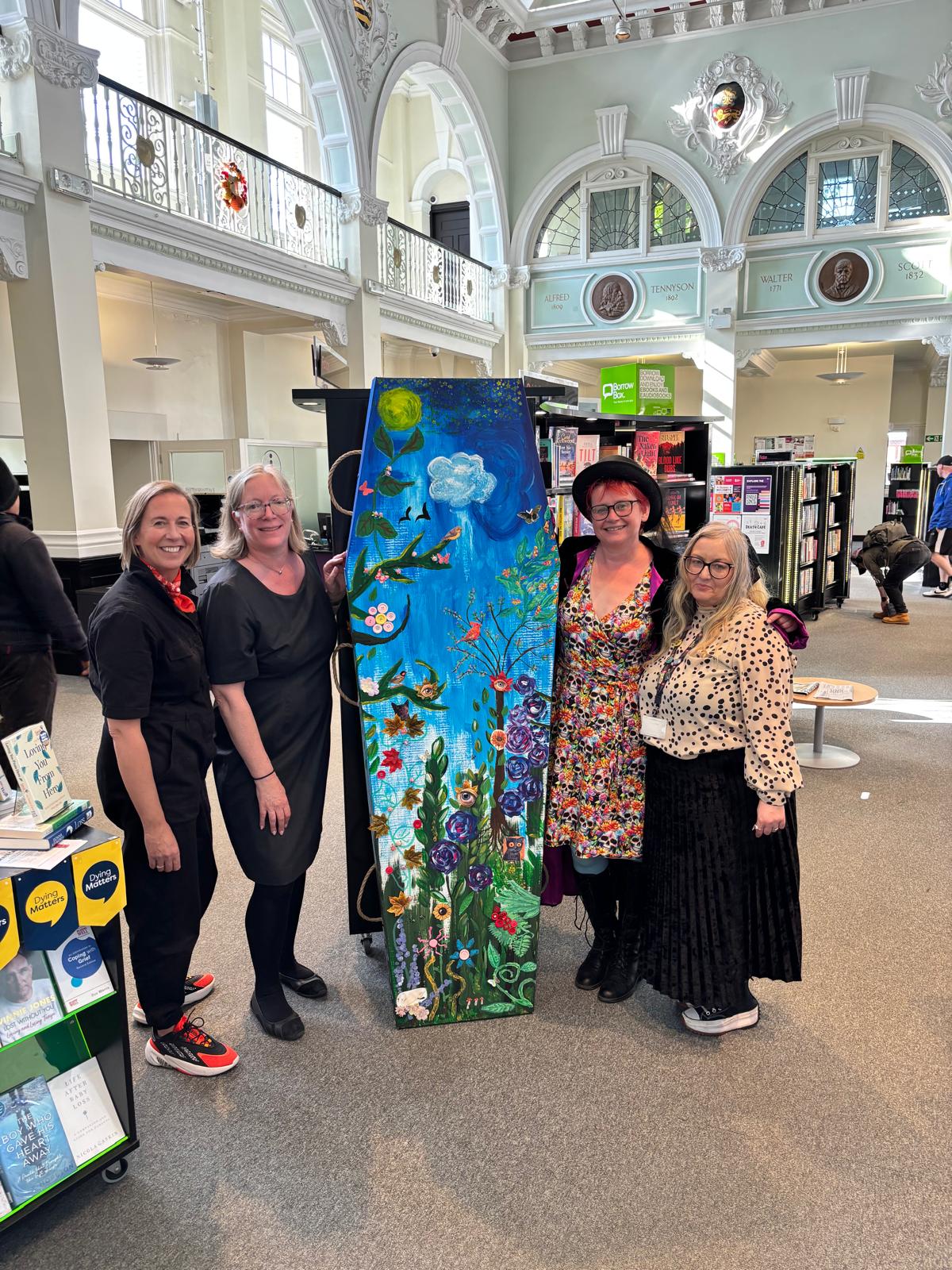
There were no formal talks beyond brief introductions. Instead, professionals joined in. That turned out to be vital. People could ask questions quietly, side by side, while sticking flowers to a coffin. Someone who had unresolved questions about a parent’s death found herself next to a palliative care nurse and was able to ask them. Others talked. Some simply made.
“It meant people were asking questions,” Caroline says. “They were able to just sort of quietly ask, because the professionals all joined in with the decorating. Which worked brilliantly.”
Caroline says she almost stood in the corner crying. “I was just like, I can’t believe this is happening, and it’s working,” she says. “It’s working.”
The decorated coffin became something vivid, collaborative and unexpectedly beautiful. But the deeper success wasn't aesthetic. It was social. A frightening object had been brought into a public library and transformed into a focus for conversation, creativity and care.
“It doesn’t take the grief away,” Caroline says of events like this and the Death Cafes. “It doesn’t make everything better, because it can’t. But it does something.”
That “something” might be the most important part of all.
It helps people realise they're not alone. It gives permission. It interrupts the shame that can gather around grief, fear, planning and uncertainty. It allows people to say the thing that might feel too heavy for a kitchen table or too awkward for a family WhatsApp.
It also fits into Caroline’s broader view of community work. Her background in social policy hasn't left her. She speaks about power, oppression, privilege and equity as naturally as she speaks about funeral music or cardboard coffins. At Salford, she worked around equality, diversity and inclusion. She is alert to the politics of care: who gets listened to, who gets services, who can afford support, who feels entitled to ask questions, who is left alone with bureaucracy and grief.
That is partly why she wants community events to remain free wherever possible. The coffin-decorating workshop cost money. Cardboard coffins aren't cheap. Materials cost money. Time costs money. Caroline is looking at future funding, grants and possible partnerships. Charging participants would be one route. But she is wary of what happens when cost enters the room.
“Once you introduce a charge, that becomes a barrier,” she says.
For MagNorth, that matters. Because this isn't only a story about one woman’s unusual job title. It's a story about the shrinking of communal rituals, the decline of shared religious frameworks, the pressure on social care, the loneliness of grief, the value of libraries, and the need for people who can hold difficult conversations without turning them into services only the comfortable can afford.
It's also, unexpectedly, a story about laughter.
Alongside death coaching and celebrancy, Caroline is a laughter yoga leader. Again, it's easy to misunderstand from the outside. Laughter yoga isn't comedy, exactly, and not yoga in the way many people might imagine. It's a practice built around intentional laughter, playfulness, breathing and group participation.
Caroline came to it after living with long Covid for several years.
“I was just in a really bad place with life,” she says. “I happened to go along to a laughter yoga session and I came out of it going, that has changed my life.”
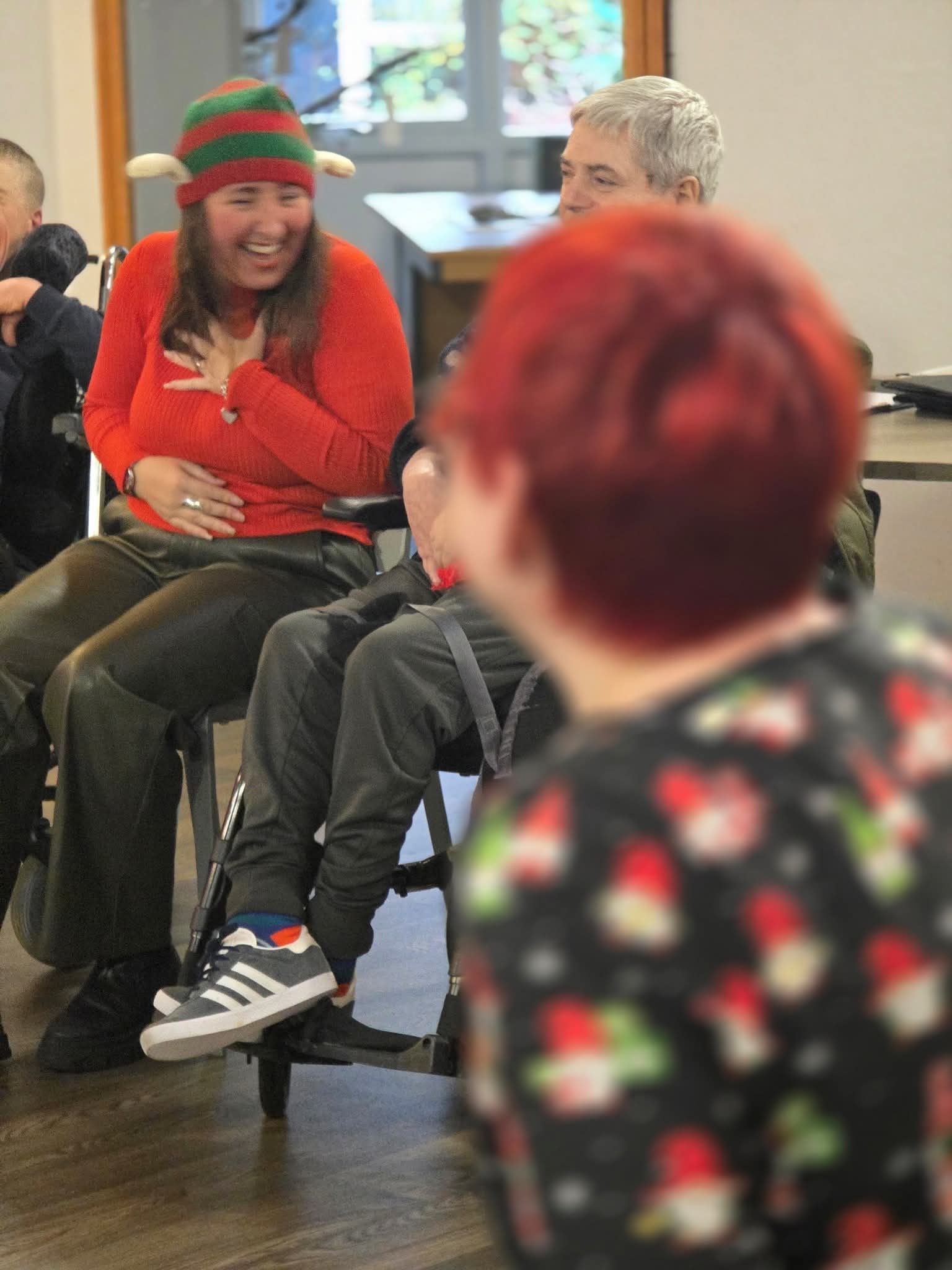
She trained to lead sessions and began offering them in Salford, including in adult social care settings with people living with dementia, learning disabilities and complex needs. Some participants were non-verbal. Some used wheelchairs. Caroline was nervous at first, unsure whether the sessions would translate.
They did. Not always through loud laughter. Sometimes through tapping. Sometimes through tiny signs of engagement. Sometimes through the response of support workers who recognised that someone who often struggled to join group activities was, in their own way, joining this.
“People are finding their own ways to engage with this,” she says.
That connection between laughter and death is not accidental. Caroline’s own Death Coach website says there is “room for laughter and light too.” She means it. Not because death is funny, although sometimes the human beings around it are. But because laughter and grief aren't opposites. They often sit beside each other. Anyone who has been to a good funeral knows this. The moment someone tells the right story and a room full of mourners breaks open with recognition. The strange relief of laughing through tears. The way humour can return a dead person to the room more vividly than solemnity ever could.
Caroline’s work understands that. It also understands that death isn't only an end-of-life issue. It's a life issue.
Towards the end of our conversation, she talks about memento mori - the old practice of carrying or wearing reminders of mortality. Skulls, rings, small objects whose message was blunt: remember you will die. To modern eyes, that can seem morbid. Caroline sees it differently. It's a prompt to stop postponing your own life.
“If you stop putting things off…” she says.
For her, leaving the university was part of that.
“I needed to do that,” she says. “It was remembering that I haven’t got all the time in the world. I’m pushing 50. If I don’t go now, it will be too late at some point. I will regret that. So jump, do it, go for it.”
This is where the whole thing turns.
Because the point of talking about death is not, finally, death. It is life.
“Exactly,” Caroline says. “You live a better life. It doesn’t matter if you’re religious or not, you live a better life for yourself, a happier life, a more fulfilled life, and I think a more meaningful life, having in your mind that it is going to come to an end.”
Then she says the thing that should probably be printed out and stuck on fridges, noticeboards, library doors and the back of every order of service:
“Tell the people around you that you love them,” she says. “Tell them every day, tell them 50 times a day, tell them at the end of every phone call. Tell people how you feel about them and what they’ve brought to your life, because that’s what they’ll have to hang on to once you’re gone.”
There it is.
Not morbid. Not gloomy. Not a manifestation of doom.
Just the old, radical, ordinary truth.
We don't have forever. So say the thing. Write it down. Make the plan. Ask the question. Go to the cafe. Eat the cake. Laugh when laughter comes. Cry when crying comes. Paint the coffin if that helps. Refuse the conveyor belt. Make ritual where none has been handed to you. Carry your dead with love. Let grief change you. Let mortality wake you up.
And before the call ends, before the visit is over, before the chance has slipped quietly into the dark, tell them.
Tell them you love them.
Caroline Jones is based in Salford and works as The Death Coach, offering compassionate, non-medical end-of-life support, planning, legacy work and funeral celebrancy.
She also works as a Humanist funeral celebrant across Greater Manchester and Trafford.
The Eccles Death Cafe takes place at Eccles Library on the last Friday of every month.





