



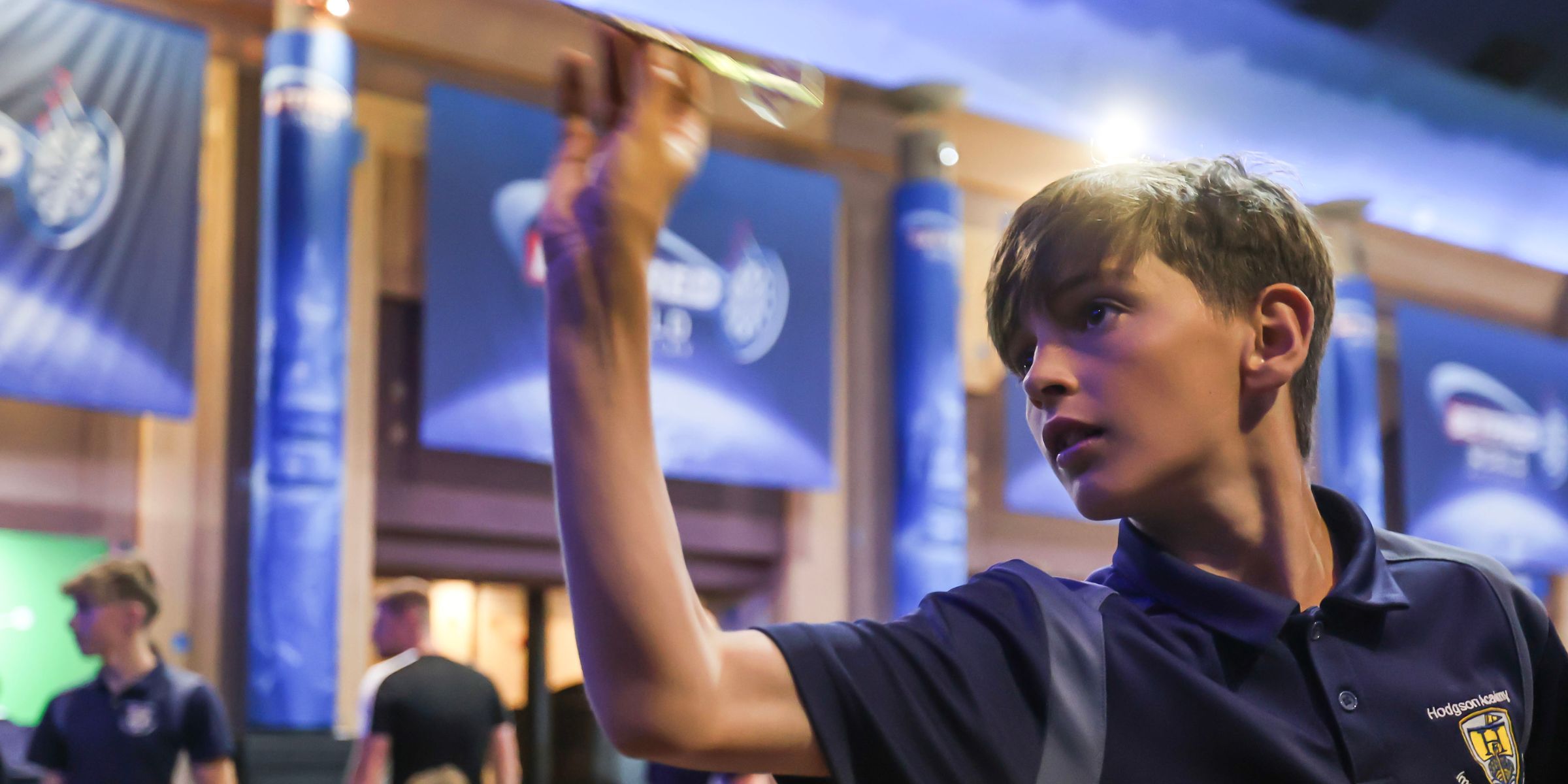
There is noise coming from one of the vast spaces inside Blackpool’s Winter Gardens.
This isn't the subdued concentration of a conventional maths lesson. Nobody is being told to sit still. There are darts landing, scores being called, young people conferring and the unmistakable sound of students enjoying themselves.
Which is precisely the point.
Later that same evening, the Empress Ballroom will become one of the great theatres of British sport. Thousands will gather underneath its barrel-vaulted ceiling and chandeliers for the Betfred World Matchplay, while the finest darts players in the world perform calculations almost as quickly as they release the arrows from their hands.
But for now, a group of local children are encountering the same essential arithmetic at a considerably gentler pace. Some of them have never held a dart before. Some might not particularly like maths. By the end of the session, almost all of them are thoroughly involved in both.
“It’s probably the most fun maths lesson they’ll ever have,” says Darren Barson, CEO of the Junior Darts Corporation. “And they don’t realise they’re doing it either - which is great.”
This is Bullseye Maths, a numeracy programme created by the Professional Darts Corporation and delivered with its partners. Developed in 2022, it grew from concern about the regression in children’s numeracy during the pandemic and from a beautifully simple observation: a dartboard is an exceptionally good teaching tool.
Take away its numbers and it becomes a colourful target through which a child can begin to count and record. Put them back and there are doubles, trebles, addition, subtraction, multiplication - and, with a little imagination, fractions and division too.
It's maths made physical. Visible. Social. Loud, even.
“The dartboard is always seen as something that somebody will play a game of darts on,” Darren confirms. “Actually, it’s a great tool to educate children.
“You can take the numbers off and just use the colours. You can use the two times table, because that’s what the doubles are around the outside. You can use the three times table with the trebles.
“It’s visible, it’s colourful and it’s active - as opposed to sitting and staring at a blackboard.”
In Blackpool, Bullseye Maths forms part of a week of community activity surrounding the 2026 World Matchplay. Around 250 children from across the North West will experience the programme, including pupils from local primary and secondary schools and young people brought by the charitable foundations of football clubs.
Across the country, approximately 4,000 children are expected to take part in an in-person session this year - the programme’s biggest reach so far.
For some, this will be their first point of contact with darts. For others, it might represent an entirely new relationship with numbers.

Dave Allen, the PDC’s Head of Development and the person behind Bullseye Maths, explains that the objective isn't to march into schools looking for the next Luke Littler.
“We knew this wasn’t about finding darts players,” he says.
“We might find a referee or a marker from one of the sessions. Or we might just enhance the maths learning of some of these young people. Whether that makes them more comfortable with money, or with maths in whatever job they eventually do, that’s a great thing.
“They might go away and never pick up a dart again. But they might not be scared of the numbers anymore.”
There'll be lots of adults who remember school mathematics not as a world of possibilities but as a weekly exposure of everything they couldn't do.
Numbers appeared on a page; the quick hands went up; the same kids' answered; and those who didn't understand learned, very efficiently, to become quiet.
Bullseye Maths changes the terms of that encounter.
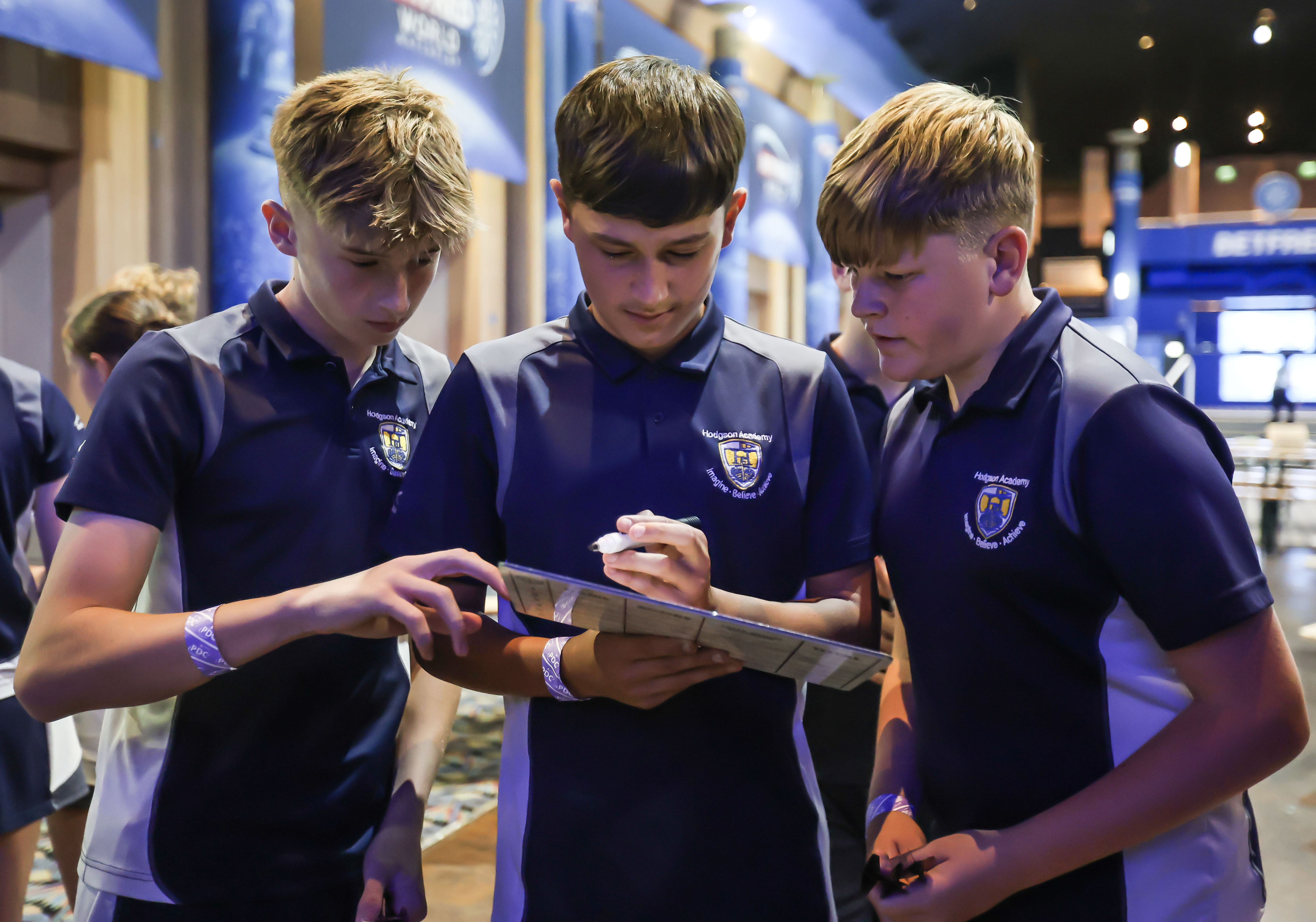
The sessions begin without numbers on the boards. The first challenge is simply to hit one. Children then take part in colour-based games, making tally charts and recording results before the familiar numbered ring is introduced.
Only then come the doubles and trebles, the scoring combinations and the rapid mental calculations upon which professional darts is built.
“We found this is a more inclusive way of doing it,” Dave says. “They’re not worried about the performance side. They’re not worried about hitting a treble 20. Initially, it’s just about hitting a colour on the dartboard.
“We tailor it to the pupils involved and then it advances as we go through the session. It makes the whole learning experience fun.”
Specially designed “equaliser” boards make the doubles and trebles larger. Boards can be lowered for younger children, while a coach works with each group to help with scoring.
One of the final games involves children throwing at a sheet of paper. Those who hit it progress to the next round - but each time, the paper's folded in half.
Half the surface. Half again. And again.
A lesson in fractions has arrived almost unnoticed.
“It’s active learning,” Dave confirms. “They think they’re just playing. Some children who struggle in other elements of school thrive in this sort of environment because it is so different.”
Every participant leaves with a workbook containing further activities to complete in school or at home. The next stage of Bullseye Maths is intended to make downloadable teaching packs available so that schools can deliver their own sessions - even if they don't possess a dartboard.
The long-term ambition is greater still: to build enough evidence and expertise for darts-based numeracy to find a place within the national curriculum.
The PDC has worked with National Numeracy, while Gary Horsley - formerly a college tutor and now the Junior Darts Corporation’s Director of Education - has helped turn the original idea into a structured programme. Training is also being provided to teachers, coaches, community organisations and people running wraparound school activities.
Darts, Darren points out, requires relatively little equipment. It can be played indoors, before school, at lunchtime or during an after-school club. Where football and cricket are already familiar parts of school provision, the dartboard offers another route in.
Crucially, it might reach a different child.
All sport has numbers. Darts is built from them.
A footballer doesn't need to calculate the angle of a pass aloud. A sprinter doesn't subtract every metre travelled from the length of the track. But every visit to a dartboard generates a fresh calculation.
Three darts have to be added together. That score is subtracted from 501. Doubles and trebles bring multiplication into play. As a leg reaches its conclusion, a player must identify the correct route to zero - and do it without pausing to search for a calculator.
“Every throw a player makes on stage involves a number, and that might be a treble or a double,” Dave says.
“Then there is the addition of the three darts they have scored and the subtraction from 501 down to zero. Every leg, every throw, involves addition, multiplication and subtraction.
“The players on stage perhaps don’t get the credit they deserve, because they’re doing those calculations in a millisecond.”
For a child, the answer might initially be found by counting on fingers or working with teammates around a whiteboard. With repetition, the combinations begin to settle into memory.
This isn't the gamification of maths dreamed up in a meeting room and subsequently imposed upon children. The game and the mathematics are inseparable. Take away the arithmetic and darts can't function.
And darts, at present, is functioning rather spectacularly.
Its expansion accelerated during the pandemic, when a board could be bought, attached to a wall and played without leaving the house. While much of organised sport stopped, the PDC continued to stage events behind closed doors and developed a Home Tour in which players competed remotely from their own houses.
People were playing darts. People were watching darts. And when the doors reopened, a rapidly growing audience was waiting outside.
Then came Luke Littler.
Long before he became a world champion, Littler had passed through the Junior Darts Corporation academy system.
The academies began with professional player Steve Brown, who wanted to create a safe place in Bristol where his son and his friends could play. That local initiative gradually developed into the Junior Darts Corporation and an international network of academies, competitions and pathways into the professional game.
Three years ago, Dave says, there were around 50 junior academies. There are now approximately 150 in the UK and more than 200 around the world.
Littler is the first world champion produced by that system - and visible proof that an eight-year-old throwing darts in a community academy might one day step onto one of the greatest stages in sport.
“You plant the tree and it takes a long time to build the roots before you see the tree itself,” Dave says. “Now you can see the end product of all the hard work that has been done over those 15 years.
“Hopefully, in the next few years, we’ll have more players coming through to follow Luke. They might not make that same huge impact—but there may be even better players out there, because the system is now in place.”
Littler’s appeal extends beyond his extraordinary ability. He doesn't seem remote from the lives of the young people watching him.
Football’s biggest stars can appear to exist in another universe. Littler drives himself from Warrington to Blackpool. He watches Warrington Wolves and Manchester United. He's seen in local restaurants and shops. For all the scrutiny and wealth that have arrived at a dizzying speed, there remains something recognisably ordinary about him.
“He’s very human in how he goes about life,” Dave says. “He is still very in touch with his local community.
“He’s somebody young people can resonate with. They may not feel able to associate with footballers because the perception is that they’re untouchable. Luke feels different.”
In Harrogate, a recently opened independent darts shop has a life-sized image of Littler standing in its window on Skipton Road. It's a small but telling sign of the sport’s new visibility.
Manufacturers have seen sales multiply. Independent shops are appearing. Junior academies are filling.
Darts is no longer just enjoying a moment. It's spent years building the structure required to turn attention into participation.

There's another reason darts might speak to children who haven't found their place elsewhere.
“You know, darts itself is probably the most democratic sport there is,” Dave says.
“It doesn’t matter if you’re 60 or 16. It doesn’t matter if you’re big, small or short. Anybody can play. If you’ve got the ability, it doesn’t matter.”
That doesn't mean the professional game is easy. Players can spend two hours on their feet beneath television lights, holding their concentration in front of thousands of spectators. The psychological demands are immense.
But many of the physical characteristics determining who can progress in other sports do not apply. Darts doesn't demand a particular body shape. Nor does a player’s opportunity necessarily disappear in their mid-30s.
Its professional tour is open to anybody over 16 who has the ability to qualify. Doncaster’s Beau Greaves, who emerged as a prodigious young talent in the women’s game, now competes as one of the PDC’s 128 tour-card holders.
Around the main World Matchplay, the Winter Gardens is hosting a much wider celebration of participation. The Women’s World Matchplay is set to take place on Sunday, alongside the final of the JDC’s girls’ series. Earlier in the week, winners from the World Disability Darts Association competed on the famous stage before the main evening session.
Those players may not be full-time professionals. But they experienced the walk-on, the lights, the crowd and the possibility of leaving Blackpool with a World Matchplay trophy.
The PDC has also supported Rainbow Laces and the LGBTQ+ darts community Out on the Oche, creating spaces in which people can watch and participate without concealing who they are.
“Our main core is professional darts, but we’re trying to be as inclusive as we can across the different areas of the sport,” Dave says.
“We want darts to be an inclusive place where people feel able to be themselves, whether they come to watch the events or to play.
“It’s about changing the perception that darts is just for 40-year-old men with beer bellies. It’s actually for anybody who wants to pick up a set of darts.”

There can be few more appropriate places for these worlds to meet than the Winter Gardens.
Opened in 1878, the complex was created as an ambitious inland companion to Blackpool’s seaside attractions - a place where visitors could be entertained regardless of what the Lancashire weather was doing outside.
The Empress Ballroom followed in 1896. Built by Manchester architects Mangnall and Littlewood, it was once among the largest ballrooms in the world. It's hosted political conferences, dance championships, concerts, trade unions, Queen, The Rolling Stones - and, since 1994, the World Matchplay.
Blackpool has never been embarrassed by spectacle. Its architecture understands that sometimes people need lights, music, scale and a little glorious excess. Darts understands that too.
By evening, the Empress Ballroom will be transformed. Walk-on music is going to fill the room. Supporters will arrive in costume. Every double missed and checkout completed will be magnified by the great television drama of the professional game.
But before all of that, the students are taken onto the stage.
For a few minutes, they're allowed to see the arena as the players see it: the boards, the lights and the sweep of this magnificent old room waiting for its audience.
One of them might just have discovered an unexpected aptitude for darts. One might go home and ask for a board. There may even be a future professional among them, although nobody needs that to be true.
Perhaps the most important child in the room is the one who arrived believing they were no good at maths - and leaves having added, multiplied, subtracted and halved without fear. (and perhaps even realising it).
Darts has risen meteorically because it offers drama, precision and personalities with whom thousands of us feel an immediate connection. Its deeper achievement could be the way it's now using that success: building pathways, reaching into communities and inviting more people towards the board.
The bullseye is tiny.
The welcome around it is becoming very wide indeed.
All images: Taylor Lanning Photography/PDC





