



.jpg)
Before Byker became a photographic project, it was somewhere Sirkka-Liisa Konttinen wanted to live.
That matters. Looking at the photographs now, with the knowledge of what happened to those streets and the recognition the work has received, it’s easy to imagine an artist arriving with a finished purpose. Her account begins with finding a home and being captivated by the people around her.
“It wasn’t a project,” she told MagNorth recently. “It was a place I wanted to live in.”
Konttinen’s sustained attention to working-class life has made her an important figure in documentary photography. A founding member of Newcastle’s Amber Film and Photography Collective, she has work in collections including Tate and the Victoria and Albert Museum. In 2011, a body of her photography, together with Amber’s films, was inscribed on the UNESCO UK Memory of the World Register: recognition of an extraordinary account of the North East through decades of social change.
In conversation, she returns to how that work was made. People welcomed her. She spent time with them. She brought photographs back.
“Half of documentary photography is about relationships,” she confirms.
Her earliest experience of photography was itself a family relationship. During childhood summers at a cottage beside a Finnish lake, her aunt photographed Konttinen and her brothers. The pictures were evocative, made by someone who, she recalls, had little sense of how good a photographer she was.
At around twelve, Konttinen borrowed her aunt’s camera. By fourteen, she was saving pocket money for her own. An amateur photography club, a train journey away, taught her to process film and make prints. The pleasure was homegrown: photographing friends and whatever she encountered, without much knowledge yet of photographers elsewhere.
When I ask what has guided her choice of subjects, she resists giving the work a theoretical origin. She describes responding to what affects her: beauty, something that inspires her, the experience of being somewhere with a camera.
“Rather than create, I appreciate.”
The route to Newcastle was a collective decision. Amber’s founding members wanted to leave London, settle in an industrial city and establish relationships with its communities. Living there was part of the intention.
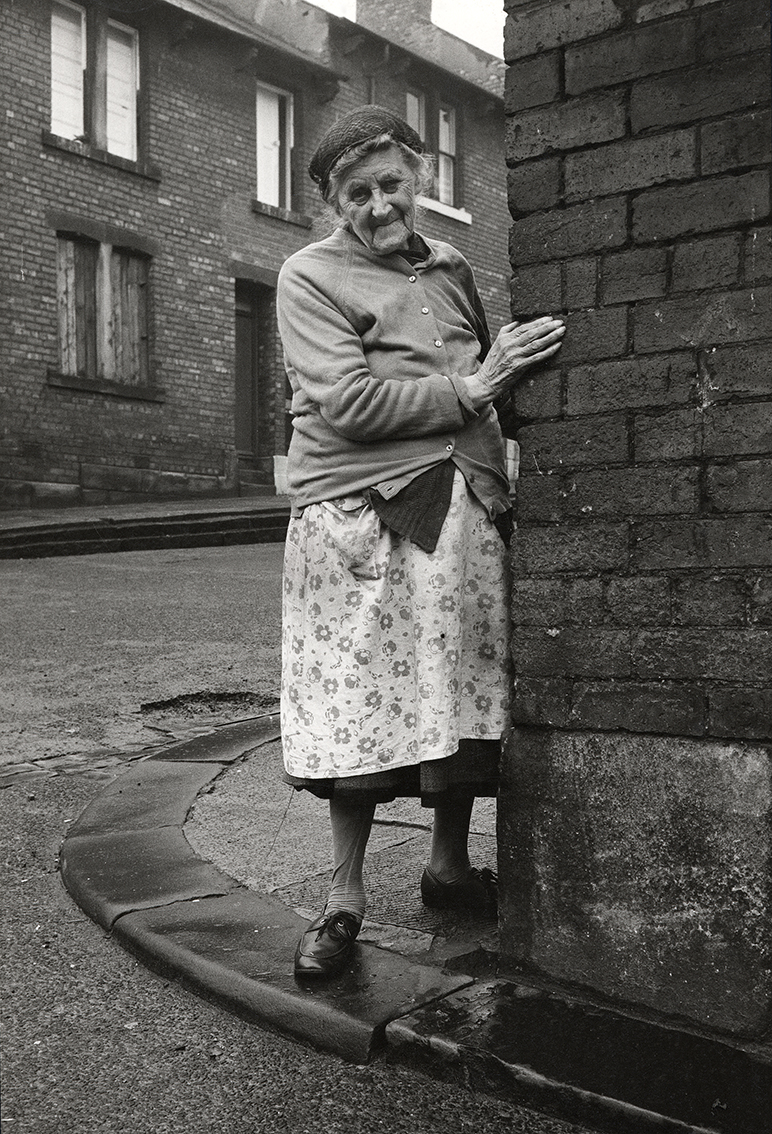
In Byker, Konttinen found a community still vibrant and open, even as the industries that had sustained it declined. Much of life happened outside. Children made games and adventures among buildings already being dismantled. Adults and older neighbours watched over them. Her photographs began as a way of showing the remarkable place she had found herself living in.
An abandoned hairdressing salon became her studio and darkroom. Beside a bus stop, its window held an evolving exhibition. The pictures were visible within the neighbourhood whose life they recorded. When someone asked her to remove a photograph for personal reasons, she did.
Over years, the work became a project and the possibility of a book emerged. People still bring yellowed, tattered copies of Byker for her to sign. She finds that deeply touching.
There was another, more immediate circulation of photographs. Konttinen gave people prints. Returning to their homes, she sometimes found those pictures framed on the wall, becoming part of the setting for another photograph. The exchange left something with the people who’d welcomed her.
Her account of redevelopment carries the weight of those relationships. She remembers homes neglected in anticipation of demolition, and neighbours who would have preferred refurbishment. The promise of new housing included central heating and indoor toilets. Crucially, she recalls, it also included the prospect of moving with their neighbours and keeping the community together.
In her experience, that promise didn’t materialise. The programme took longer than expected; people were dispersed before new homes were ready, and many established themselves elsewhere. Her recollection makes clear how much can be lost when the relationships of a street are treated as something that will simply follow its residents to a new address.
Yet returning to Byker required her to listen to people whose experience differed from her own.
Invited back in 2003, she spent a year researching before committing to the work. She had heard disturbing and sad accounts of the estate, but didn’t want problems alone to determine what she photographed. At meetings, she encountered residents who loved the new Byker, its architecture and their lives there. She recognised the strength of that attachment: it was how she had felt about the place where she first lived.
That recognition helped open the way to Byker Revisited.
She was no longer a resident, so becoming involved took other forms. She volunteered with an asylum-seeker support group for three years and joined other organisations. Relationships developed before people participated in the photographs. Across six years, the project came to include roughly a hundred households.
The invitation was playful and demanding: how might someone introduce themselves to the world, and to neighbours who might know little about them, in one picture?
People helped choose the setting, what to include and how to dress. For some asylum seekers and refugees, Konttinen recalls, clothing was among the few possessions that were their own. Its colour mattered to their identity, and therefore to the photograph. Other residents wanted an activity within the frame to communicate something about themselves.
“The ingredients come from them,” she says.
Her task involved arranging the frame and light, then allowing something spontaneous to happen. Working with a medium-format camera that gave her ten exposures on a roll, she waited for a significant moment. Afterwards, she made prints and returned with a selection so they could decide together which photograph to use.
Almost always, she recalls, they chose the image she favoured too. The attraction was not necessarily the most flattering likeness. It was the sense of a story beginning.
Stories also exist alongside the images. Konttinen speaks of text and narrative as an essential part of her work. Even Coal Coast,whose photographs contain no people, is about a mining community, approached through the traces she found on the beach and the voices accompanying them. Looking back, she sees communities as the thread drawing her towards the subjects with whom she has spent time.
Konttinen tells me she hopes the photographs will remain useful to people in their lives now. Every photograph becomes a picture of the past almost as soon as it’s taken; that need not exhaust what it can offer.
.jpg)
The forthcoming exhibition Under Development: What Happens When Cities Change? brings documentary photography from Tyneside and East London together through the AmberSide Collection and Four Corners Archive. It asks about the human consequences of decisions over housing and planning. Konttinen’s account gives those questions an intimate scale: who can step outside, who encounters a neighbour, where children can play.
Asked what should matter when planning for communities, she begins with architecture. She remembers streets in the old Byker with few cars, where people could spend time outdoors and get to know one another. She also relays a friend’s appreciation of the newer estate, where spaces inside the perimeter wall allow children to play and adults to keep an eye on them.
She is careful to say that planning is beyond her expertise. But she has lived with the consequences of its choices, including the traffic outside her own home when her daughter was young. Her priority is clear: human beings over cars, and room for more communal ways of living.
The thought takes her back to Finland, to growing up with a wider circle of families whose doors were open to her. Perhaps, she reflects, her sense of communality comes from knowing the richness of being part of a village.
It is a fitting place for our conversation to arrive. The child photographed by her aunt, the neighbour making pictures in Byker, and the artist returning to listen to new residents are connected by that experience of belonging. Her photographs ask us to give time and attention to the people with whom a place is shared. Decades after some of them were made, that remains a question for the future of our streets.
Under Development: What Happens When Cities Change? opens at Newcastle Contemporary Art on 17 October 2026.
Header image: selmuun, Byker Revisited, 2004 ©Sirkka-Liisa Konttinen (Courtesy of the AmberSide Trust)





