



The function of a garden is more than just the production of food-stuffs and flowers; it’s a spot of solitude, brimming with connection to a greater rooting in the world, by and large a place of quiet. Strange then, is the feeling of tranquility amongst raised beds of trailing beans, in and amongst a carpark full of busy shoppers.
Atop the Merseyway Shopping Centre in central Stockport, there exists a space of rewilded bliss, where plants burst forth above the heads of patrons.
Harvest is nigh, despite seasonal afflictions disrupting yield, and The Landing Garden is due to celebrate a milestone: Five years of growth. Its’ sister project, and founder, Where the Light Gets In, is in on the proceedings, having achieved a decade of operation in its own right.
A brainchild of Sam Buckley, in cahoots with Stockport Council, a standalone kitchen garden it is not. The Landing was founded as a community interest company in 2021, proving capable of more than just feeding the tables of WTLGI. The strip of land, perhaps too small for cramming in additional parking bays, had been empty for over twenty years prior. Throughout the years it has transformed into a space of learning, community, and, of course, growing.
Chief grower, Nathan Phipp-MacIntyre, cares for the plants and the engagement with the space. He hails from a permaculture background, and translates this into his work by balancing the growing with an enhanced focus on education.
“Being supported by the restaurant is quite special and rare, but we’re about process over product.” he says, sitting under a beam adorned with garlic bulbs now swaying in the breeze. Poor weather has driven us into the embrace of the restaurant space, where Nathan talks me through the garden’s influence on the menu ahead of harvest guests arriving.
“This year the hot weather really affected our crops, and we struggled with the usual harvest. Typically we experience a hunger gap between spring and summer, but due to the second spring when the weather dropped again, we’ve had another recently. Our winter stock isn’t quite ready, but the autumn produce hasn’t dropped either.”
Regardless, restaurant and garden work symbiotically, making adjustments to their offering with what they do have in abundance. For the harvest celebrations, this looks like a green tomatillo salsa, shiso-cured mackerel, and tarragon-dressed rabbit. Never in dearth, the dining room is embellished with hoards of marrow, of all shapes and sizes. Sam ensures his menu is always steeped in narrative, especially that of the garden they all work to maintain.
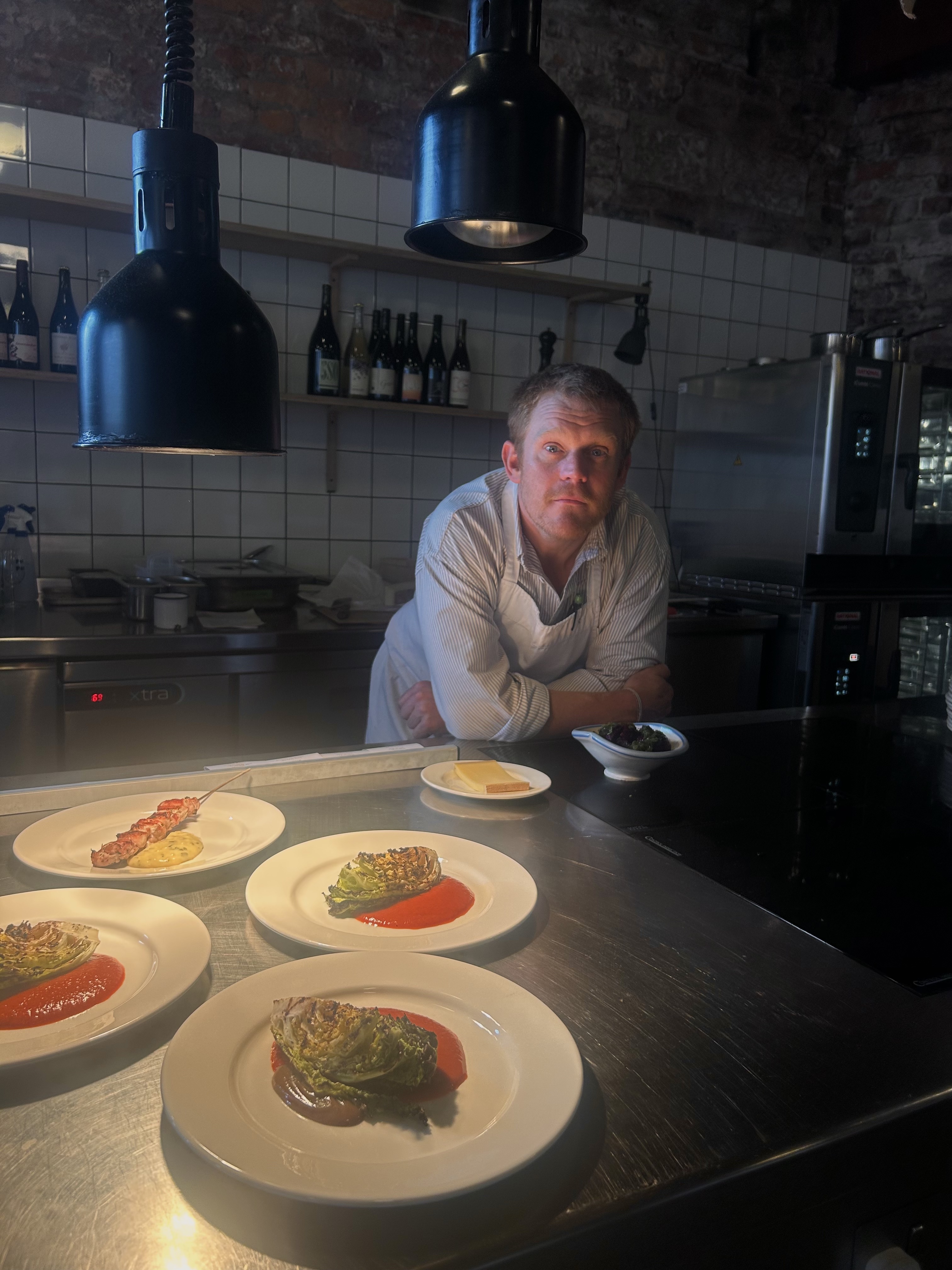
As friends, residents and locals flock into the room, chef Fergus stands grilling flocculent cabbages and chunks of rabbit over wooded-flame. “The garden is our source of inspiration, it’s our barometer on the way in which seasons pass. Our seasons aren’t as defined anymore, and we really felt those hunger gaps this year. Having such a sensitive space makes us more responsive cooks, one where we can understand the life of the thing you’re now going to use.”
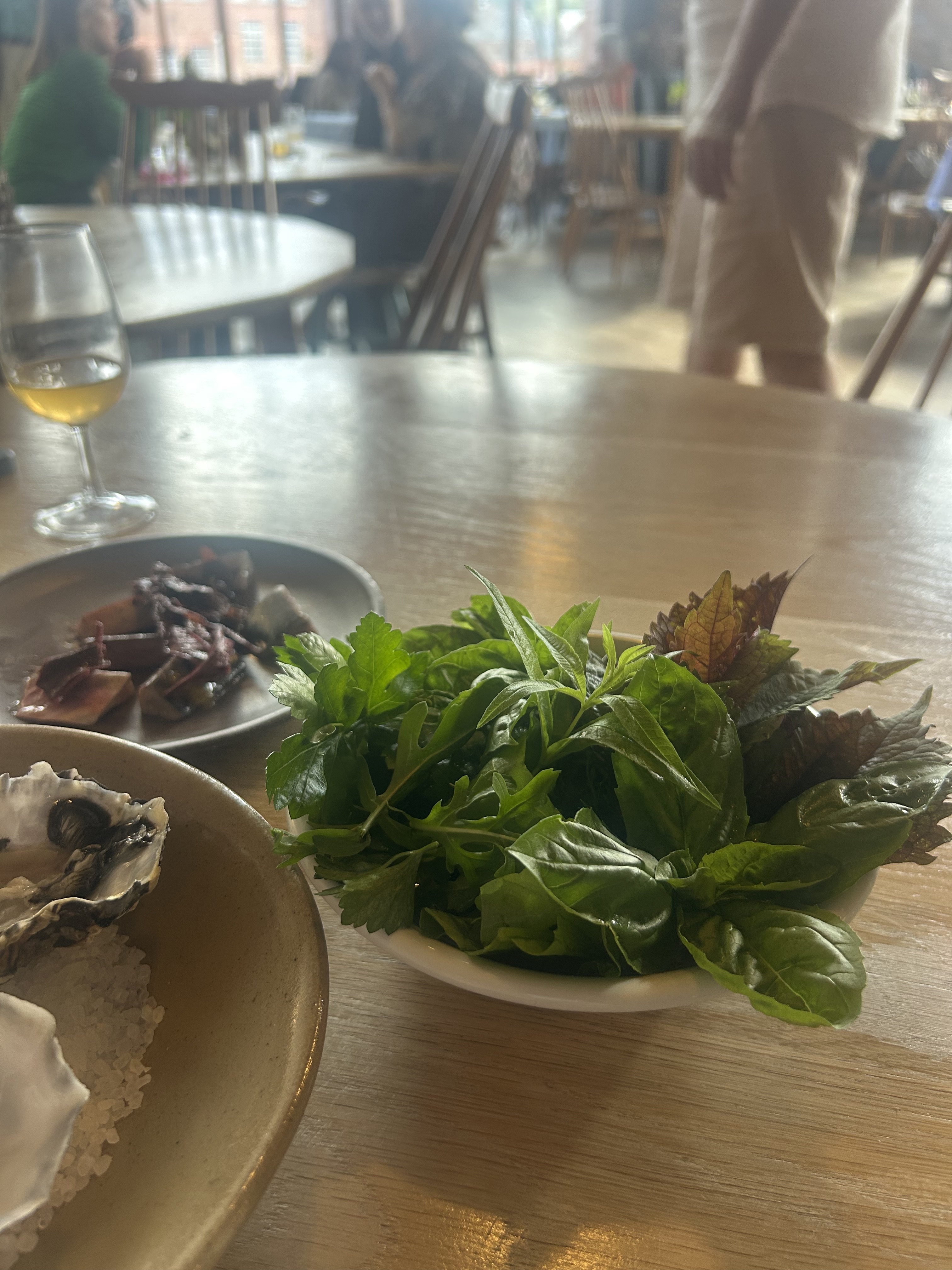
Most on the nose of this narrative is the Landing Salad, a permanent fixture of their culinary offering. Specifics are altered around the life-cycle of the produce, today boasting a herby mix of offcuts. Several guests are tucking into the greens as I approach them on their relationship to the garden. “There’s such a lack of greenspace in Manchester, and so no one ever teaches you how to grow.”
Georgina, a resident in the area, seconds this. “The waiting list for allotments is obscenely high, I waited three years for my plot in Stockport. Despite the rising demand for spaces during lockdown, when was the last time new allotments were created?”
When indeed. Aside from community projects, the borough has not opened new allotment sites in decades. “People think it needs to look like an allotment, but if you can have one in a car park you can have one anywhere. We need more spaces like The Landing, every time I see a spare bit of land I think you could put a garden there.” she remarks, adding that perhaps assumptions of the time required and complications of maintenence contribute to the lack of green thumbs.
Volunteers are invited up to the space every Friday morning, with no obligation and near-free-range over the site. Nathan begins the tour with a “taste walk”, letting the individual dictate their contribution based on interest and skills they might like to gain. One volunteer, Tom, proudly shows me the seeds they have been sowing in straw beds. For the rest of the workload, the chefs visit the site twice a week, with the front of house team contributing when possible.
For the anniversary bash, Nathan replicates this experience with the guests and would-be volunteers, dolling out harvest samples as we walk. “Basically, we grow radishes above Anne Summers.”
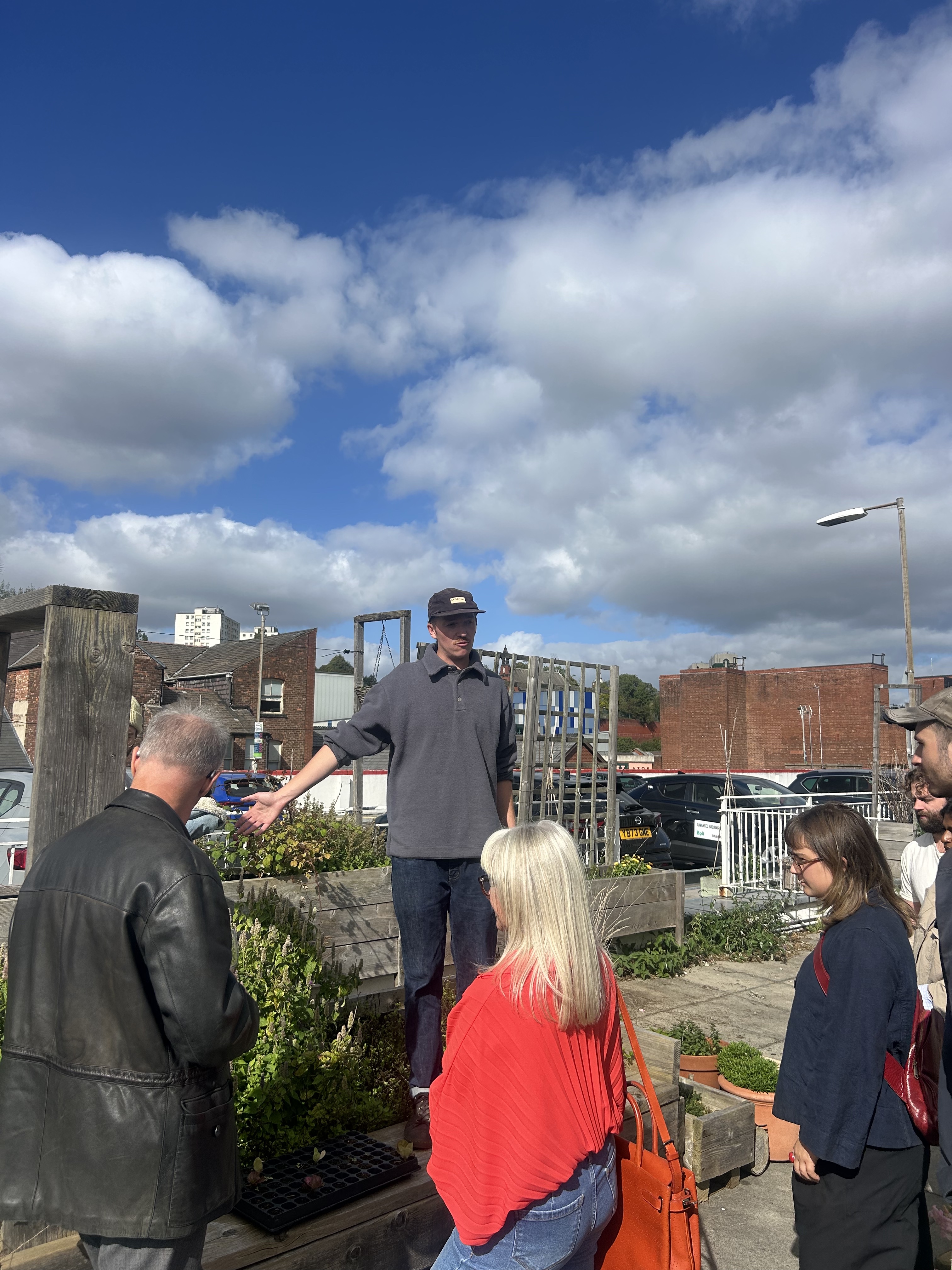
The concrete is covered in raised beds, each with their own chaotic charm. While not quite intentional, the grower team produces all compost on site, leading to frequent self-seeding surprises. Residual heat through the carpark supports the site, and with rising temperatures in the climate, the space is stocked full of plants typically suited to a hotter disposition– sichuan pepper coats one side bed.
Never has there been a greenhouse so wild, tucked between a skylight into the marketplace and a bathtub filled with lavender. It remains largely out of view, covered by a gigantic peacock butterfly mosaiced from bottle tops. The mural is one of ten in a local trail created by Plastic Shed, in partnership with neighbouring schools and Stockport Council.
Serving as testament to the gardens commitment to learning and engagement, the lepidoptera is but one of many recent projects to engage children and young people. “I used to run about playing in the dirt all the time. Nowadays, kids are quite scared of getting muddy, we want to help with that.” Nathan is keen to educate on the importance of top soil, a finite resource, and the true investment of food production.
A recent campaign saw The Landing and WTLGI collaborate with Adswood Primary School, teaching children the size of a wheat bed needed to produce a single loaf of bread in a bid to connect them to the food cycle. Having the resource so easily available meant the project was far more hands on than a classroom session may have been.
Schooling is not just for the younger Stopfordians, collaborations have frequented between the team and Manchester School of Architecture. Student groups were given the space to explore using mycellium bricks and sheep’s wool to produce sustainable design briefs for growing sheds. Wool is woven tightly to the space, with felting projects held at the garden for anyone who might like to try their hand at craft in cultivation.
Sam has nothing but ambition for kitchen and garden: “We’ve got plans to expand our outreach and value to the community. I prefer it on days like today, when we open up into this informal, relaxed space. It might just be how it ends up, people just coming in and having their tea.”
Guests chitter over plates of marshmallow strewn in damson compot, sharing stories of produce, place and people. There’s nothing but art in the menu; the hands that planted the seedlings bore the fruit and laboured over its preparation. You don’t just taste their story, you experience it.
This narrative of life is entwined with The Landing, asking how inner-city communities might best nourish themselves, their land and their skills. It’s an odd juxtaposition to see concrete slabs broken through by sorrel, dandelions and fennel– but one that begins to bridge the disconnect between austere urbanopolis and recovery of an ecosystem.
The Landing Garden can be found on the rooftop of Merseyway Shopping Centre Car Park in Stockport, SK1 1HG. Volunteer sessions run every Friday morning, from 11am.
Header image: Nathan Phipp-MacIntyre of The Landing Garden (Jess Berry)





