



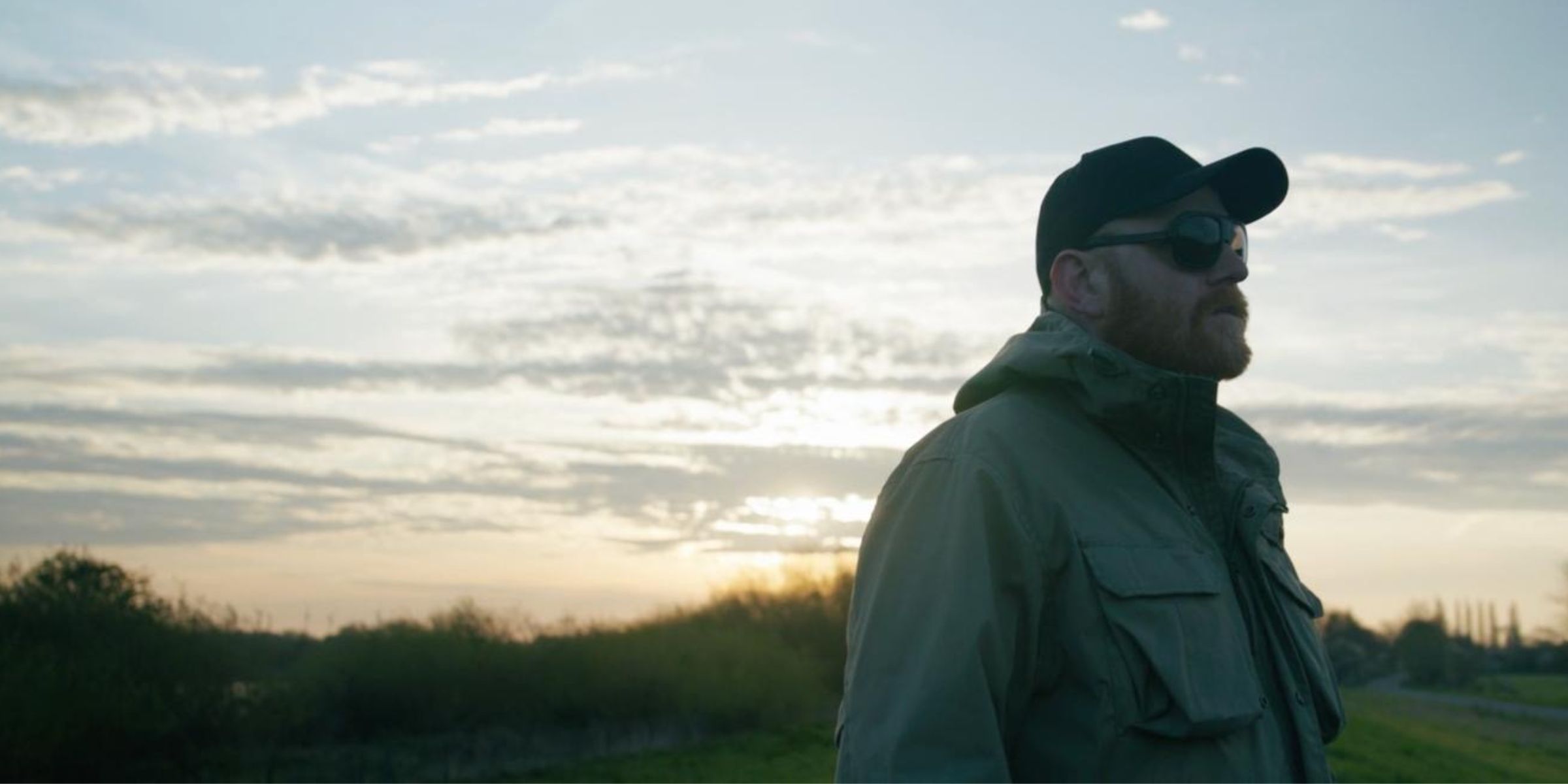
Earlier this year, Joe Hodgson was asked whether Sandra’s Wedding, the band he fronts and writes for, might create a song for Goole's bicentenary.
Joe thought a song felt “a bit old hat”. Songs were the band’s bread and butter, but this one would need to carry history, heritage and more information than three or four minutes could comfortably hold.
“So I just floated the idea; ‘Why don’t I do it as a poem? Like a spoken-word thing.’ And it came back, ‘Absolutely. Just do whatever you want.’”
Joe was given free rein.
For a while, he did almost nothing with it.
Joe describes himself at university, leaving assignments until the last minute. The bicentenary poem followed a familiar route. He knew it was coming down the track. He thought about it, roughly. He worried about it. He didn't put pen to paper because he couldn't find the beginning.
Then the deadline became real.
“I made the conscious effort: right, I have to start putting some stuff to paper. Then it was a bit of a jigsaw. I wrote a verse and thought, ‘Oh, I’d like to include this.’ After that it was a bit of a whirlwind, because I went and recorded it, did the music, did the filming - and it was kind of done in a flash.”
The resulting film wasn't a solo enterprise. Katie Harriman, an old sixth-form contemporary of Joe’s and the filmmaker behind Flygirl Films - directed it. Hull musician and producer Pat Dooner of Broken Orchestra helped shape its atmospheric soundtrack. Joe had worked with Pat before and trusted him enough not to labour over the music.
The first version, however, was barely a recording at all.
Joe put a piece of piano music on his laptop and read the poem into a voice note for his friend David West, another Goole native, now living in London. David listened while driving.
“By the end of it, I was just in tears,” he says. “He’s such a powerful, powerful poet.”
The roughness helped. Joe’s reading was melancholy and unguarded. When the time came to record it properly, he discovered the familiar terror of having accidentally captured something that might not return on command.
One formal attempt was delivered too cleanly and too emphatically.
“It was almost like a window salesman,” Joe says. “It just didn’t sound right.”
David was frank: it was nowhere near as good as the voice note.
This is part of the danger of trying to make an official statement about an unofficial place. Too much polish and the life drains out. A town becomes footage, landmarks and adjectives. An honest voice becomes a presentation.
Joe had no interest in making a presentation.
He'd once imagined becoming a poet rather than a songwriter. Simon Armitage is a major influence; Tony Harrison’s long poem V offered another kind of permission, as did Philip Larkin. What attracted Joe was room: space for a piece to wander through history, class, memory and contradiction without having to resolve them into a chorus.
The poem begins with creation - Goole made from what was once water and marsh, a town seemingly brought forth “out of nothing”. But Joe didn't want to march dutifully along a civic timeline.
More importantly, he didn't want to sound like somebody visiting.
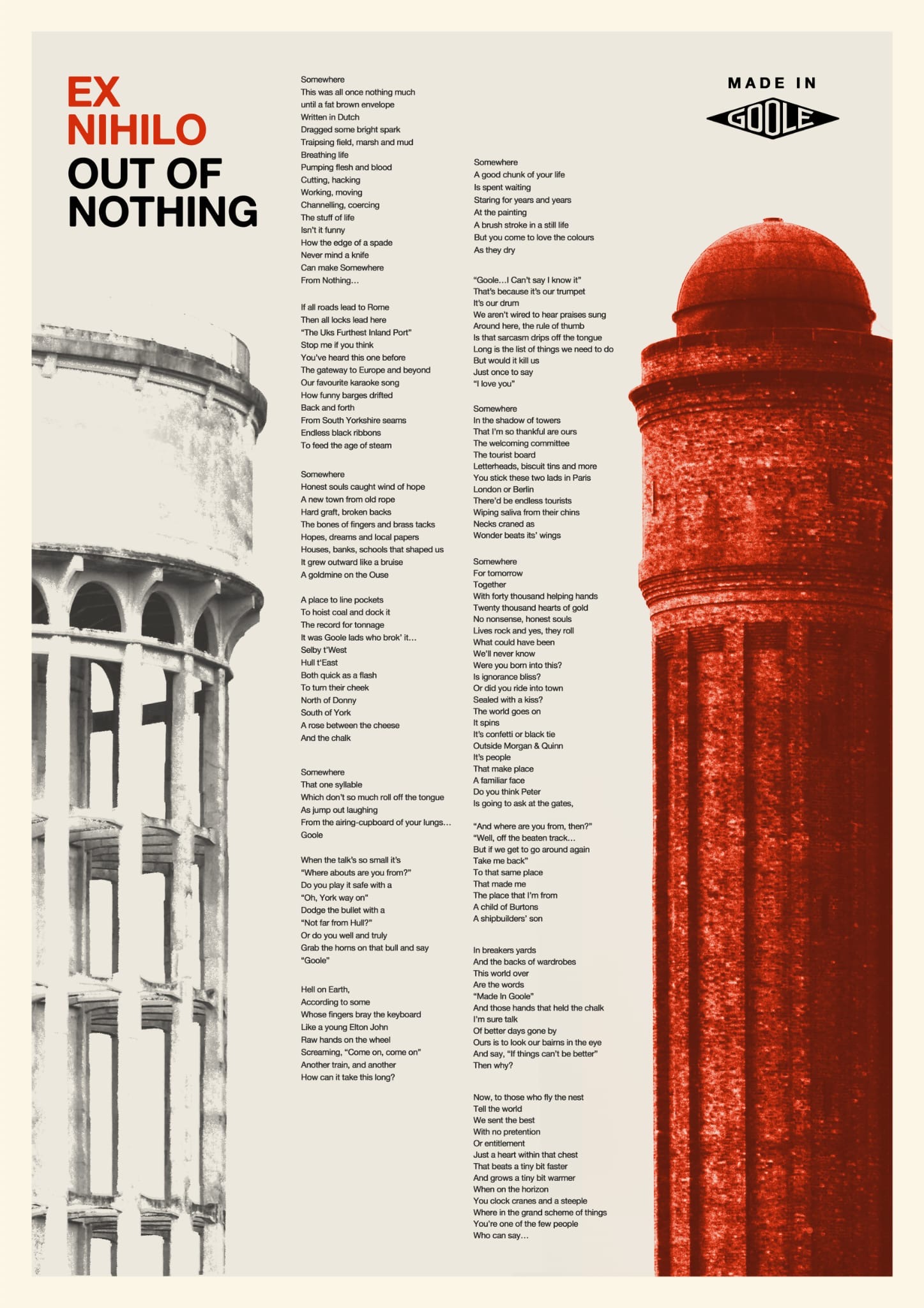
There are ways outsiders learn to write about places like Goole. They identify the approved heritage assets, ask a local historian for the charming names and then arrange them into a reassuring procession.
In Goole, that can mean the Tom Puddings - the compartment boats once used to transport coal - and the water towers known locally as the salt and pepper pots.
Joe knows their importance. He also knows what happens when they become compulsory.
“If they’d got some outsider from the town to do a poem, they would have talked about Tom Puddings. Being someone from Goole, I’m always a bit like, ‘For fuck’s sake, we’ve heard about them a million times. Think of a different way to get into that subject.’”
The same applied to the towers. He wanted to touch them lightly enough that local people would recognise the reference, but he was determined not to arrive bearing a line about “the majestic salt pot”.
His details come from somewhere more intimate.
Goole’s shipyard was a significant employer for men; Burton’s clothing factory offered work to generations of women. Joe’s own family history runs through both. His father began as an apprentice at the shipyard. Joe describes himself as “literally a product of those two strands” of the town’s working life.
Elsewhere, the poem glances at Morgan & Quinn opposite the church: the wonderful collision of ceremony and ordinary commerce that any local person can see immediately. David remembers coming out of the church after his wedding, confetti in the air, with the stubbornly everyday shopfront across the road.
“As soon as you can make that connection, you’re like: this is amazing,” he says. “This poem just hits the nail on the head.”
Joe also folds in the brown envelope. In present-day Goole, he says, there is a familiar suspicion that anything which gets done must have involved one passing discreetly between somebody and the council. He connects that modern cynicism to the authority and conflict involved in the drainage of the surrounding land centuries earlier.
It's history told sideways: not dates mounted behind glass, but an old power relationship heard in a current joke.
“It’s just the idea of subverting everything a little bit,” Joe says. “I’m not saying I’ve reinvented the wheel in terms of poetic licence. But it was quite cathartic, in a way, to get some of that stuff out.”
The film is affectionate, but it is not an advert. It cannot contain every grievance or list every instance of fly-tipping. Nor does it pretend that affection makes a place flawless.
“The one thing about art,” Joe confirms, “you’ll never see it through someone else’s eyes.”
He's been thinking about this in relation to the band, too.
“You know what’s really shit? I’ll never be able to watch us as a band. I’ll never know what we were actually like. Even if you’re filmed, it’s not the same. You’ll never, ever, ever know what it was like to watch yourself as a band.”
Making anything requires that surrender. You put it into the world and lose control of where it travels, what it unlocks and who might be sitting in the room.
Joe wasn't in the room when I first watched the film.
It was Yorkshire Day in Goole. Mayors from across the county had arrived in robes and gold chains to mark the town’s 200th year. A family sitting in deckchairs in West Park had watched the civic party appear and asked me: “Who the hell’s this?”
Before the dignitaries had processed along the high street and past Ramsdens, where a sign offered cash for wedding rings, the juxtaposition between civic gold and financial necessity looked like it might pass without much comment.
Then Joe’s film played.
It was the moment of the day for me. It did what the pageantry couldn't. Goole ceased being a host location or a set of challenges and solutions seen through a coach window. Here was a voice from inside the town: amused by it, sometimes exasperated by it, alert to its strangeness and unable to treat its people as background.
Joe couldn't attend because Sandra’s Wedding were playing Humber Street Sesh in Hull. Katie sent him a photograph of the audience.
“I said, ‘Going down like a lead balloon?’ She said, ‘No, everyone clapped.’”
I tell him that the film is the reason we're now sitting in a pub beer garden in Upper Nidderdale. That it stayed with me after Yorkshire Day and changed the way I thought about Goole. That I wanted to know the person who had made it because, before we'd met, I recognised something in it.
Joe pauses.
“I feel like it’s done its job then.”
This, he says, is the payoff. Not only applause or numbers, but the threads that appear later between people who didn't previously know one another.
“You just don’t know who’s in the room.”
People from Goole sometimes locate themselves by saying they live “not far from York”. Or they say East Yorkshire and leave it there.
Naming the town can bring the wrinkled nose, followed by the compulsory five-minute defence: no, it is not that bad; yes, it is fine; here are the reasons you have misunderstood it.
Joe has always said that Sandra’s Wedding are from Goole. The band’s songs frequently return to the emotional landscape of industrial northern towns, and videos have used archive footage of the docks. When people responded to one by saying, “That was my dad”, the historical image became family memory again.
But pride can become another enclosure. After a decade of making music, Joe's aware of the danger of being known only as “the Goole band”. He talks about drawing a line under that phase and beginning something new creatively - not because he's abandoning the town, but because nobody should have to perform their place of birth forever.
The shame and the branding are closer relatives than they initially appear. Both allow an imagined outside audience to set the terms.
Joe's interested instead in what small towns share. Goole, Selby, Castleford and Pontefract carry different histories but a similar post-industrial question: we used to be this; what are we now?
The question is frequently answered on local Facebook pages by the people most determined to pronounce their town dead. Joe has noticed that those who are most vocally negative rarely engage with anything positive happening there.
Yet he can see independent businesses opening, a gaming café, a boxing club growing, spaces for families and people willing to stake their effort on the town. Together, they're evidence of life.
“It doesn’t matter where you are,” he says. “If there’s someone passionate about what they’re doing, that’s a massive benefit.”
If he won an absurd amount on the EuroMillions, Joe says, he would buy up the empty town-centre units and make them affordable for local businesses, artists and makers. It might be a fantasy, but it's not a grandiose one.
“All people want is somewhere to be proud of in the middle of the town.”
This isn't nostalgia for a lost retail mix. It's a desire for somewhere people can participate in, rather than merely remember - and because it's verbalised by an Economic and Community Development professional (that's Joe, again, btw) - it should be heard.
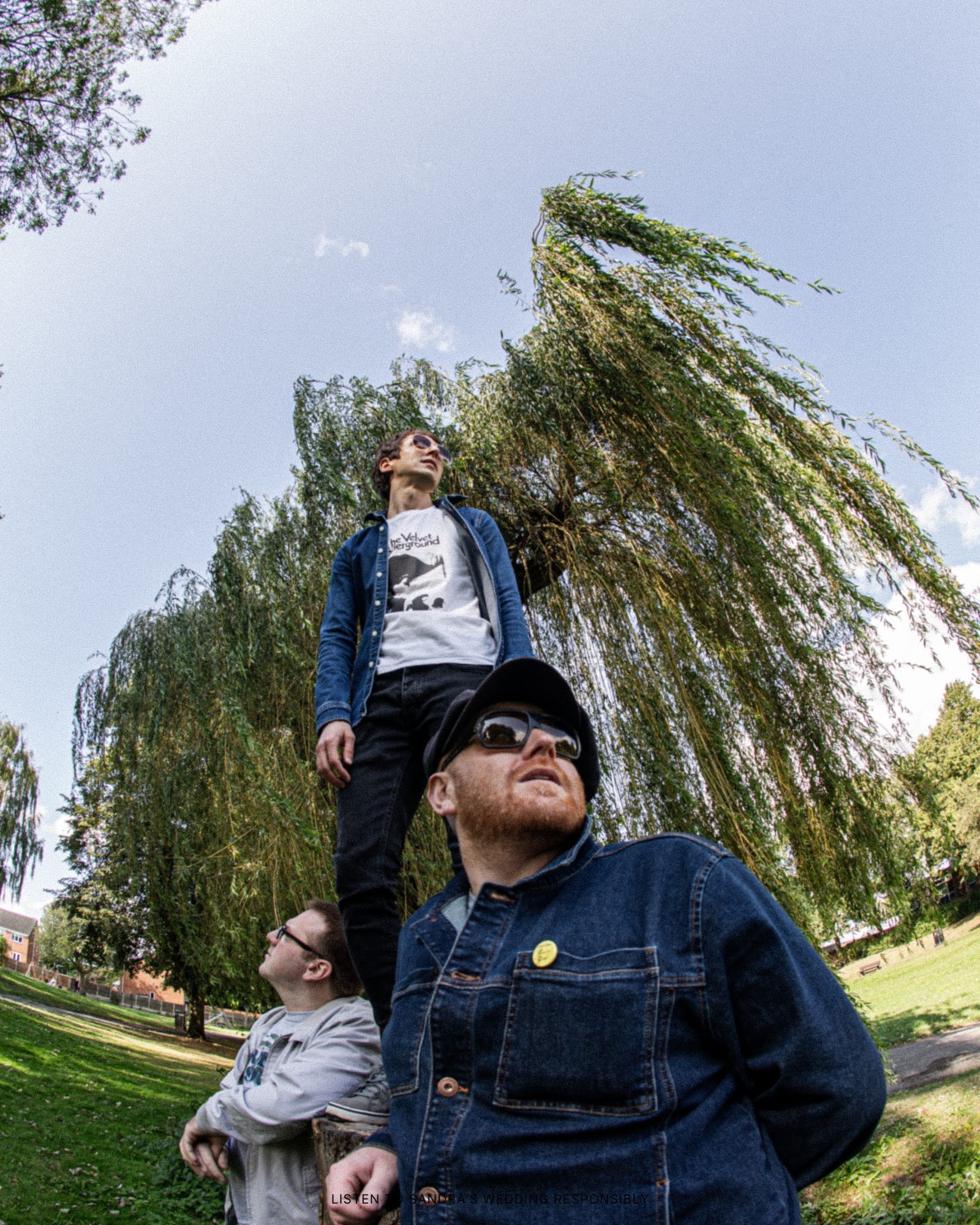
The same instinct runs through Sandra’s Wedding.
The band have built a substantial body of work beyond the usual machinery of the music industry. Their songs are funny, melodic and warm, even when they're dealing with frustration, class and decline. The difficulty is not making records or finding people who love them. It is reaching enough of those people through a system that increasingly asks musicians to become full-time manufacturers of promotional debris.
Joe's got no appetite for it.
“You don’t make music to then put eighteen reels out in a week.”
Sandra’s Wedding have tried the approved routes. Once, they paid a PR representative £1,000.
“We might as well have taken it outside and fucking burned it, because nothing came from it.”
He's weary of a music economy populated by people claiming to understand mysterious levers of exposure, and equally suspicious of acts whose heavily supported campaigns are sold as heroic DIY stories.
What Sandra’s Wedding do, he argues, is “proper indie music”. They pay for the records, make the decisions, sell the physical copies and take them out into the world themselves. Independence here isn't a haircut or a guitar sound. It's ownership of both the work and the consequences.
The anger doesn't make Joe defeated. On the contrary, it looks like it's freeing him.
“The mantra going forward is: I just don’t fucking care anymore.”
He doesn't mean that he's stopped caring about songs. He means he's stopped seeking permission for them.
“I just want to make as many records as I can.”
Joe thinks in projects rather than individual tracks. Several albums are already turning in his head: an accessible, jangling record that returns to the band’s roots; a collection following the life of an ordinary miner towards the day his pit closes; an imagined American coast-to-coast journey, recorded as though the songs had been caught in hotel rooms along the way. There might even be a record of unapologetically sentimental love songs.
“I don’t think about a song,” he tells me. “I think about ten songs within an idea.”
He works full-time and gigs around that. And the writing doesn't respect the boundaries of either life.
“I’m always writing. And I couldn’t stop that now. It’s just this muscle.”
He holds much of it in his head. The different records sit there like plates spinning, waiting for one to gather enough force to become the next thing. It's exhilarating and, he admits, beginning to tire him out.
The method makes sense when he describes what draws him to a subject.
“You want to draw some poetic scene or feeling from the most mundane thing. I love that.”
This is where the poem, the film and the records meet. It's why a shop opposite a church matters; why archive footage of dock workers can make strangers write about their fathers; why an ordinary miner on an ordinary final shift can become an album; why Goole mustn't be reduced to its most photogenic structures.
It's also why comparisons with Paul Heaton, however understandable, have occasionally troubled Joe. Heaton is an influence, and Joe admires the accessibility and observation in his work. But he's worried that people might mistake his own vocal delivery for an affectation.
“Sometimes I do consciously think, ‘I’m going to try not to Heaton it up.’”
The comparison ultimately matters less than the source. This is Joe’s voice because these are Joe’s words, shaped by the place that taught him how people speak, joke, evade embarrassment and tell the truth without making too much of a performance about it.
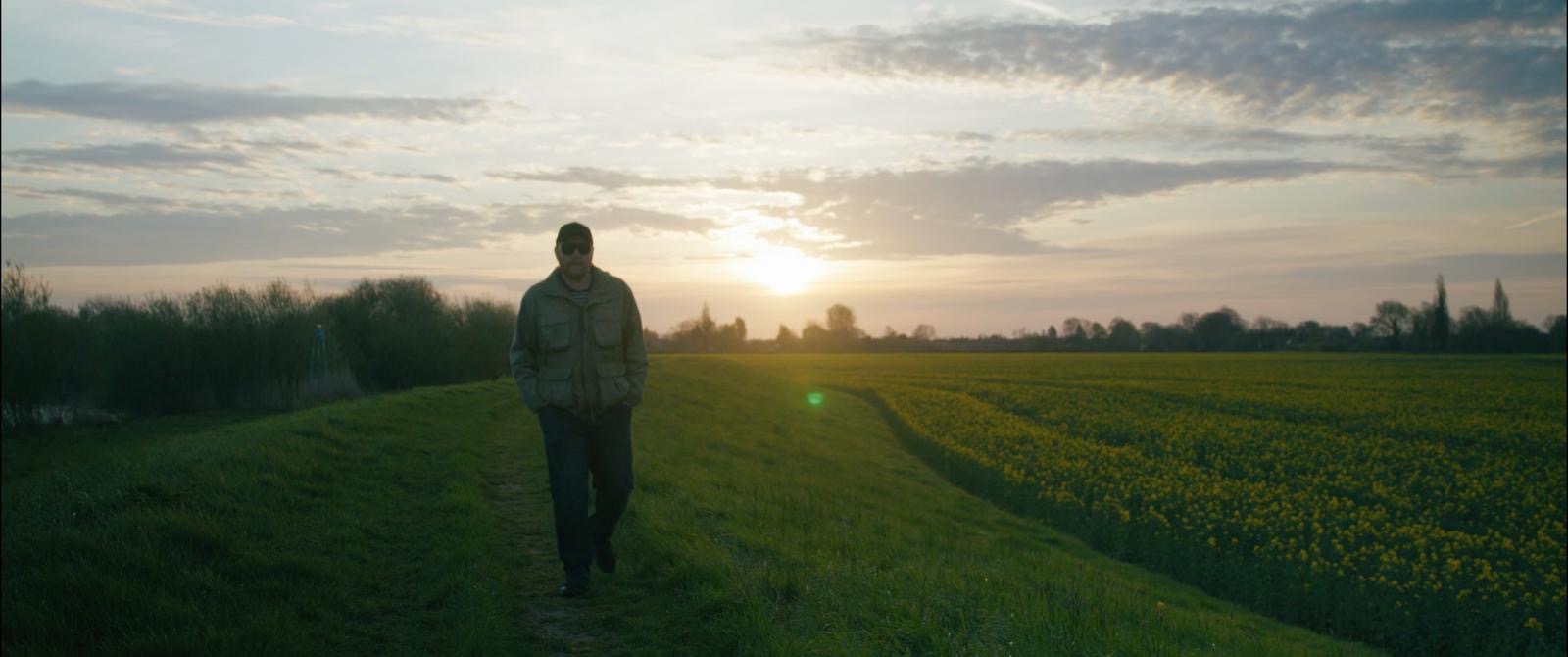
Towards the end of our conversation, I ask Joe what someone who had never visited Goole might understand from the film that they wouldn't learn from a map, a headline or a council strategy.
He reaches for the simplest answer and briefly worries that it might sound like a cliché.
“It’s just literally the people. There’s no other way of saying it.”
He talks about going into town and saying hello to everyone. About knowing people in several different parts of life: seeing somebody at the football, meeting them elsewhere, watching their children grow. About knowing the good that is happening and the bad.
“That, to me, is what a community is.”
The remarkable thing, he says, is that we now have to remind ourselves this is normal. In many places, people don't know their neighbours or possess an obvious route back into shared life. Goole still retains “a good chunk” of that everyday recognition.
Visitors often surprise local people by describing the town as clean, tidy or pleasant. Joe is not pretending it's perfect. He is noticing the modest pride people take in their own patch and the expectations outsiders reveal when they seem astonished that Goole might contain a beautiful park, decent streets or a warm welcome.
This is where the film is most quietly political. It doesn't argue that nothing has been lost. Goole knows industrial change, neglected high streets and the pain of institutions withdrawing. But decline isn't the whole inheritance.
“You’ve got the perceived decline of what’s been lost,” Joe says, “but people don’t realise what they’ve still got.”
What they still have can't always be measured in a regeneration plan. It's the person who knows your child, the football crowd that gathers when something matters, the business owner who believes the town is worth another attempt, the friend listening to a rough voice note on a London road and finding himself suddenly back home.
Joe’s poem didn't create that value. It did something both smaller and much more important.
It paid attention to what was already there.
Ex Nihlo; Joe, Katie and Pat's beautiful film will be available to watch this weekend, as part of the Goole 200 celebrations.
Sandra's Wedding play Grimsby's Shop Local Festival on Saturday 29 August - and Music in the Park, Goole on Sunday 30 August.
All images: Joe Hodgson





