



“We started off online supporting local musicians and refugee projects, we went hybrid with international performance, and now we have brilliant refugee musicians playing to a live audience in my own village,” saysthe rather inspirational Fiona Frank.
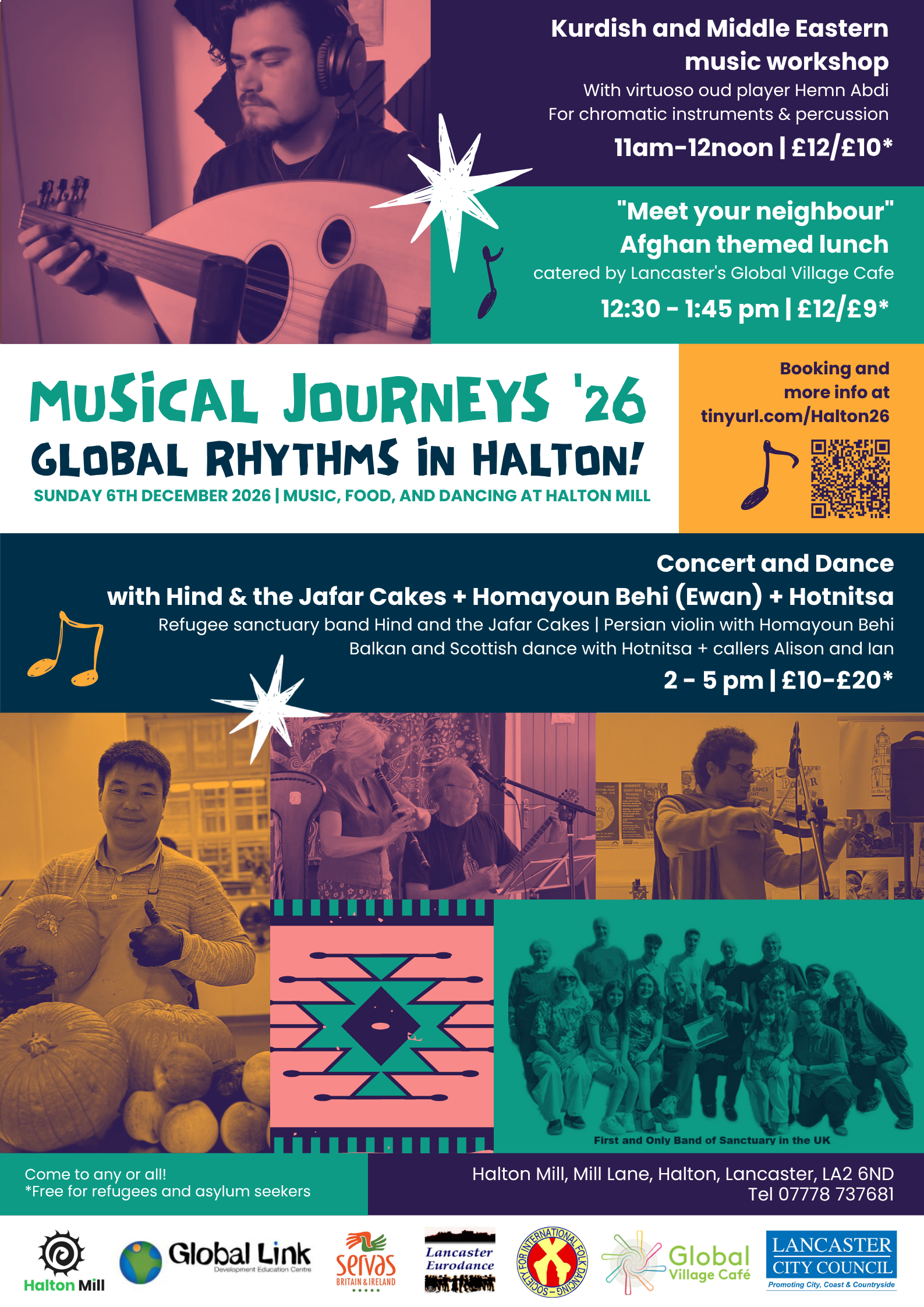
That village is Halton, three miles outside Lancaster. On Sunday 6 December, at the Old Mill on the banks of the Lune, Hemn Abdi will spend an hour introducing people to Kurdish and Middle Eastern music. By lunchtime the Global Village Café will be serving Afghan food. Later, there’ll be Persian violin, a band that came together at a refugee and asylum seeker centre in Halifax, and someone to call the steps if you’ve never tried Balkan dancing.
Judith Coyle, who sent us the programme and a clip of Abdi playing with Frank, describes Musical Journeys as “a northern music initiative that creates opportunities for cultural exchange.” There’s a practical question behind that phrase. What does it take to get people into a room where they can play, be heard and make a living from what they do? Fiona and everyone involved, might just have an answer.
Halton Mill has its own story about what people bring with them. In 1948, a group of men who had served with the Polish forces fighting alongside the Allies took on the building and started Luneside Engineering. They tried several ways of making a living, including building mechanical elephants for seaside resorts, before finding their footing in precision engineering. The beautiful old mill now houses workspaces, studios and events.
Fiona Frank is a musician and a founding director of the mill in its present form. She began Musical Journeys online during the pandemic, when live work disappeared, to support musicians and raise money for local refugee projects and young people’s mental health. She says the series has now raised £11,000 for refugee, music and environmental projects in the UK and overseas while providing paid work for musicians.
Last year’s international cabaret brought six performances into a hybrid event. Judith puts the amount raised at around £4,000, which went towards performers’ fees as well as supporting three Amazonian projects. Among them was the Dom Phillips Institute, set up to continue the work of the British environmental journalist killed in Brazil in 2022. His sister, Sian Phillips, plays in Hotnitsa, the Lancaster band appearing at Halton this December.
Abdi, who is originally from Iranian Kurdistan, leads the morning session. There’s something particularly special about being invited to spend an hour with a musician before a concert. You get time with the instrument and the person who knows it, and you can carry some of that attention into the rest of the day.
Watch Hemn Abdi and Fiona Frank playing together. Video supplied by Judith Coyle.
Frank first saw Hotnitsa alongside Hind and the Jafar Cakes at a Servas gathering in Hebden Bridge earlier this year. She wanted to bring the two acts together again on her own patch. The Jafar Cakes formed through another Northern Beacon; St Augustine’s Centre in Halifax and became the UK’s first Band of Sanctuary. In Halton, they’ll share the afternoon with Hotnitsa, Persian violinist Homayoun Behi, known as Ewan, and Abdi on oud. Alison Newbery and Ian Buckley will lead the Scottish and Balkan dancing.

The ticketed lunch has a name of its own, Meet your Neighbour. The cooks are from Lancaster’s Global Village Café, where people who have sought sanctuary share their food and cooking traditions. On the menu are keema aloo, made with minced lamb and potato, and a spiced vegetable ghormeh. You can come for lunch, the workshop or the afternoon alone.
That flexibility is part of how a day like this works. So is the money behind it. Servas Britain and Ireland is supporting the event through its Refugee Support Fund. Global Link is also involved, and Lancaster City Council’s Integration Fund means local refugees and people seeking asylum can attend free of charge. Those arrangements are as important as the welcome at the door. They help determine who can actually walk through it.
Frank describes the work as “making connections across borders and seeing where they lead.” One connection made in Hebden Bridge has already led to a day in Halton. What happens after that is up to the people who come. There’s time to sit down together before the dancing starts.
Sunday 6 December 2026 · Halton Mill, Mill Lane, Halton, Lancaster, LA2 6ND
Header image: Halton Mill & Fiona Frank (Rogerio Rodrigues)





