



.jpg)
From the Tees Transporter Bridge to a decaying Huddersfield board school, The Victorian Society’s 2026 Top Ten Endangered Buildings list is a stark reminder that the North’s industrial, civic and social heritage still needs urgent champions.
The North of England is not short of buildings that tell the story of modern Britain. Railway stations, schools, cemetery chapels, bridges and institutes were not decorative extras in the Victorian and Edwardian age. They were the infrastructure of ambition: places built for movement, learning, work, worship, welfare and civic pride.
Now several of those buildings are at risk.
The Victorian Society has revealed its Top Ten Endangered Buildings 2026, launched by its president Griff Rhys Jones OBE, and this year’s list includes a particularly strong group of northern sites. Among them are the Tees Transporter Bridge between Stockton-on-Tees and Middlesbrough, the former Strand Railway Station and Railway Men’s Club in Barrow-in-Furness, Oakes School in Huddersfield, and St Michael’s Roman Catholic Cemetery Chapel in Sheffield.
Together, they form a kind of northern map of Victorian endeavour: industry on the Tees, railway expansion in Barrow, mass education in Huddersfield, and municipal burial provision in Sheffield. Each is listed. Each is historically significant. And each now faces an uncertain future.
The Victorian Society’s annual list is designed to draw national attention to buildings at risk, many of which are vacant, underused or trapped in cycles of neglect. The 2026 selection includes two Grade II* and eight Grade II listed buildings across England and Wales. But, as the Society makes clear, listing alone has not been enough to secure their survival.
“Once again, we are travelling all over England and Wales on a fascinating, enlightening and intriguing tour,” said Griff Rhys Jones. “Railways, markets, art schools, institutes, monuments to the dead, chapels and even a transporter bridge: they all become intriguing as soon as you start to examine their stories.”
He added: “There is no building here that cannot be recycled. The desolation comes because all of these candidates for assistance are Grade II listed. Two are Grade II starred… The Victorian Society is drawing your attention to important buildings that are under threat from decay or neglect.”

Few structures on the list carry the symbolic weight of the Tees Transporter Bridge. Opened in 1911, the Grade II* listed bridge spans the River Tees between Middlesbrough and Port Clarence. Designed by engineer G.C. Imbault and built by Sir William Arrol & Co Ltd, the firm associated with the Forth Bridge, it was created to move workers and goods across the river without blocking the busy shipping lanes below.
At 260 metres long and 69 metres high, with its suspended gondola once carrying vehicles and pedestrians across the Tees, the bridge is one of the great feats of Edwardian engineering. It is also one of the defining images of Teesside.
But the bridge has been closed since 2019 because of serious structural concerns. Its future remains unresolved, with repair and restoration costs estimated at around £60 million — far beyond what local authorities can easily shoulder alone. Ownership and responsibility are shared between Stockton-on-Tees and Middlesbrough Councils, while the central question remains whether the bridge should be treated primarily as transport infrastructure or as heritage.
For the Victorian Society, that distinction matters because it could shape the funding routes available. But for local people, the bridge is more than a category. It is part of the region’s identity.
“You don’t need me to tell you that people love this bridge,” said Griff Rhys Jones. “It is a symbol. It is a monument. And more than that it is a link and a potential working part of Stockton and Middlesbrough. Got to be saved. Got to be operational again.”
James Hughes, Director of the Victorian Society, described it as “one of Britain’s most remarkable feats of engineering and a defining landmark of the North East”, adding that “a clear strategy, supported at national level, is urgently needed”.
In Barrow-in-Furness, the former Strand Railway Station and Railway Men’s Club is another northern building whose history mirrors the growth of a town.
Built in 1863 and designed by E.G. Paley, the Grade II listed station dates from the early phase of Barrow’s rapid industrial expansion. At the time, the town was being transformed by iron ore extraction, the Furness Railway and dock development. By the late 19th century, Barrow was being spoken of in grand terms: Prime Minister William Ewart Gladstone famously predicted it would become “another Liverpool”.
The Strand station stood at the heart of that transformation. Its life as a passenger station was relatively short-lived, however. A new through-route and Barrow Central station opened in 1882, and the Strand site was pushed into secondary uses.
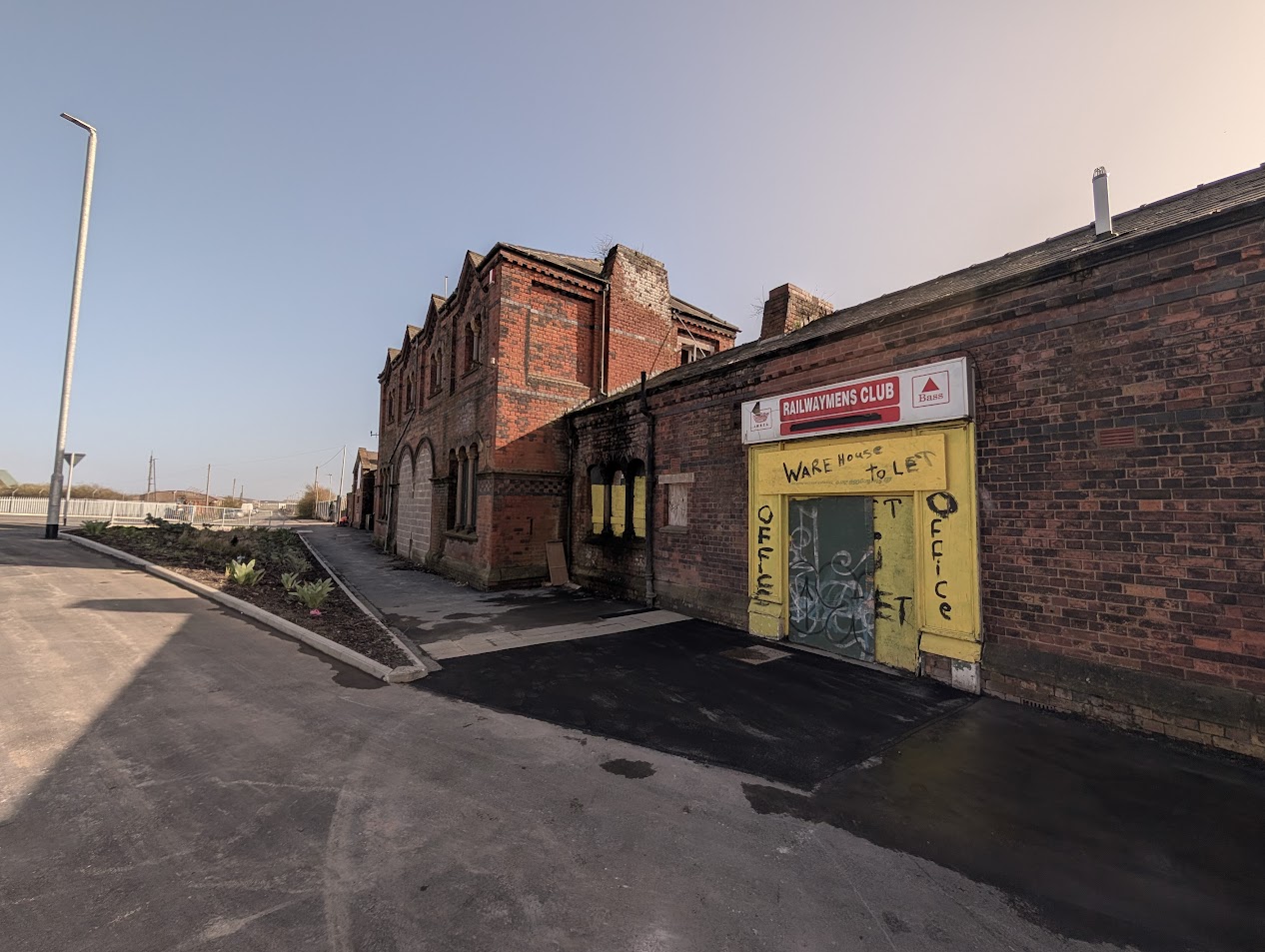
Yet that was not the end of the building’s story. It became a reading room and library for railway employees, later evolving into the Railwaymen’s Club. For more than a century, it served the community as a social and educational hub. It finally closed in 2008 after 101 years of operation.
Today, the building is vacant and deteriorating, owned by an absentee landlord and lacking a clear future.
“I love a railway station,” said Griff Rhys Jones. “The Victorians were almost at their best building their handsome, accessible, useable, human-scaled transport network, on lines that changed the world. Here is an example of a good building that has already been repurposed. This is the green option. Use it again. Don’t let it fall into decay.”
The phrase “green option” runs through the Victorian Society’s case. Reuse, not demolition, is presented not only as a heritage argument but as an environmental one. Buildings like the Strand station were made to last. The challenge now is to make them useful again.
In Huddersfield, the former Oakes School tells another chapter of Victorian reform: the rise of state education.
The Grade II listed school was built in 1873 by Charles Fowler and extended in 1885 by Ben Stocks. It belongs to the wave of board schools that followed the 1870 Education Act, which marked the beginning of compulsory elementary education for children. Such schools became landmarks in their communities, standing alongside churches, chapels and pubs as evidence of a new civic settlement.
But Oakes School has been empty for years. After closing soon after 1970, it was used for residential purposes and later as Wellington Court Residential Care Home. Since then, it has been left to decay. Windows and doors have been covered and recovered. Holes in walls and roofs have appeared and enlarged. Nearby Victorian buildings, by contrast, remain in active use or have been successfully converted.

That contrast is central to the Victorian Society’s argument. Oakes is not in an area without demand, life or examples of regeneration. It stands among streets where Victorian housing, industrial buildings and community spaces have continued to adapt.
“Oakes School is a clear example of a building that could and should have a viable future,” said James Hughes. “Its continued decline is not inevitable, but the result of inaction.”
Griff Rhys Jones was more direct: “Actions speak louder than words…The council must not allow this useful, listed, and important building to be further abandoned…It is time for the owners to get active or get off.”
The Society is calling on Kirklees Council to take enforcement action and on the owner to sell the building if they are unwilling or unable to secure its future.
The fourth northern entry is St Michael’s Roman Catholic Cemetery Chapel in Sheffield’s City Road Cemetery. Designed by Charles Hadfield and built in 1898, the Grade II listed chapel is one of three originally built within Sheffield’s largest municipal cemetery.
It represents a once-common but increasingly vulnerable building type: the Victorian cemetery chapel. These structures were part of the 19th-century response to urban growth, overcrowded burial grounds and the need for landscaped municipal cemeteries that could offer ceremony, dignity and denominational provision.

St Michael’s was built for Roman Catholic use, with support from the Duke of Norfolk, a major Catholic patron, but it has always been owned and maintained by Sheffield City Council.
Today, the chapel is long unused and deteriorating. A specialist report in 2018 identified serious structural concerns, particularly with the roof, where missing tiles, vegetation and likely compromised structural integrity were noted. Limited stonework repairs have taken place, but there is still no clear plan for the building’s future.
“This is a sad story,” said Griff Rhys Jones. “People are still dying. Cemeteries are getting over full. We need space to bury our dead. And yet we have so many decaying and neglected Chapels of Rest on our books.”
The Victorian Society argues that St Michael’s is part of a wider national pattern. Cemetery chapels across England and Wales are falling into disrepair, often because responsibility is unclear, costs are daunting, and modern uses are difficult to define. Yet these buildings were designed for moments of great communal importance. Their loss would be cultural as well as architectural.
Although the Society’s 2026 list covers England and Wales, the northern entries are striking because of the range of stories they tell.
The Tees Transporter Bridge speaks of industrial engineering and regional identity.
The Strand Railway Station speaks of railways, labour and Barrow’s explosive growth.
Oakes School speaks of compulsory education and the social infrastructure of working communities.
St Michael’s Chapel speaks of Victorian burial culture, faith and municipal responsibility.
Close to the North, the list also includes buildings with strong relevance to the Midlands and Welsh borderlands: the New Market Hall in Bridgnorth, the former Derby School of Art, and the Faenol Mausoleum near Bangor. These broaden the story into commerce, art education and funerary architecture, but the northern group has a particular coherence. They are buildings of public purpose.
They were not built merely to impress. They were built to serve.
The Victorian Society’s message is not that every endangered building should be frozen in time. Quite the opposite. The organisation repeatedly stresses reuse: finding sustainable, practical futures that allow old buildings to keep contributing to modern places.
James Hughes said the 2026 list “demonstrates both the richness of our Victorian and Edwardian heritage and the scale of the ongoing challenge in securing its future”.
“These buildings were created with foresight, ambition and a strong sense of civic purpose,” he added. “Too often today they are left without clear ownership, investment or direction. With the right commitment, every one of them could have a viable future; what is needed now is the will to act.”
That challenge feels especially urgent in the North, where Victorian and Edwardian buildings are often woven into the identity of towns and cities shaped by industry, migration, education and municipal ambition. To lose them is not simply to lose attractive architecture. It is to lose evidence of how these places were made.
The Tees Transporter Bridge, the Strand station, Oakes School and St Michael’s Chapel may differ in scale, function and fame. But each asks the same question: what do we do with the buildings that built us?
For the Victorian Society, the answer is clear. Repair them. Reuse them. And act before neglect becomes irreversible.
Header Image: Tees Transporter Bridge (Credit: CAV Aerial)





