



There is a swamp near Ruby Tingle’s home in Manchester. She visits it often, sometimes wearing a ball gown.
It is not a costume she puts on in order to become an artist. That distinction seems largely absent from Tingle’s life. The dresses, ponds, amphibians, flowers, field recordings and half-human creatures belong to the same interconnecting world - part natural history, part private mythology - which she has spent much of her career assembling around herself.
“I spend most of my time down at the swamp, usually in a ball gown,” she says, as though this were the most ordinary arrangement imaginable.
The sounds she gathers there seep into her music. Water, birds and amphibian calls are threaded through electronica, alt-pop and experimental sound design, sometimes manipulated until the natural world begins producing its own rhythms.
Tingle calls it “music from the swamp”.
Now, that music is travelling with her to Whitby.
On 17 October, Wildings opens at Pannett Art Gallery: the culmination of a year-long curatorial research project supported by an Art Fund Jonathan Ruffer Curatorial Grant. Bringing together historic artworks, newly created collage, sculpture, installation, scent, film and performance, the exhibition is Tingle’s response to the Soper Collection and to the landscapes and creatures surrounding its new home.
It is also an encounter between a contemporary northern artist and two women whose lives have too often been interpreted by other people.
The Soper Collection contains the work of George Soper and his daughters, Eva and Eileen. Together, they created an extensive record of British wildlife, rural labour and the countryside across painting, drawing, printmaking, illustration and sculpture.
Eileen became particularly well known for her illustrations of Enid Blyton’s Famous Five books. She was also a remarkably gifted wildlife artist who exhibited at the Royal Academy while still a teenager. Eva painted, drew, modelled and created delicate studies of birds, but her work has remained less familiar to a wider public.
The sisters spent much of their lives at Wildings, the family home and wildlife sanctuary in Hertfordshire. Its gardens grew around them. Animals moved closer.
By the end, badgers were reportedly entering the house to be fed. One story describes somebody opening the back door to find a badger sitting outside, waiting for its dinner. Mice appeared from coat pockets. The separation between home and habitat seems to have become wonderfully uncertain.
For Tingle, the name of the estate contained an entire exhibition.
“When I heard the name of the house, I thought it was so beautiful,” she says. “It sounds like rewilding, and it feels very of the time now - the things we’re talking about in conservation.”
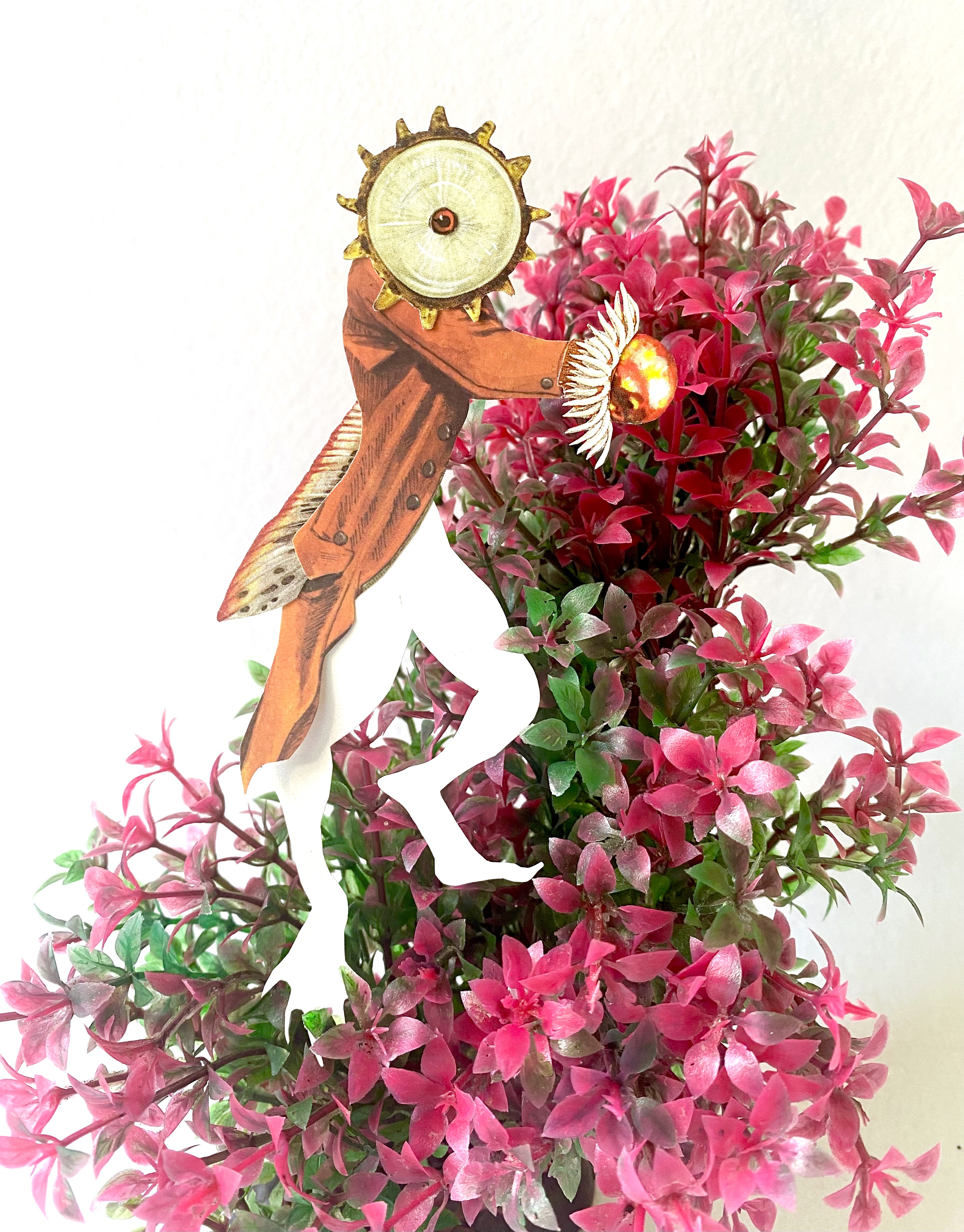
But as she worked, the word developed another meaning. Figures began emerging from her collages: elaborately dressed beings assembled from animals, plants, minerals and human bodies.
“I started to think of the Wildings almost as a group of characters,” she explains. “These new figures that are like caretakers of nature.”
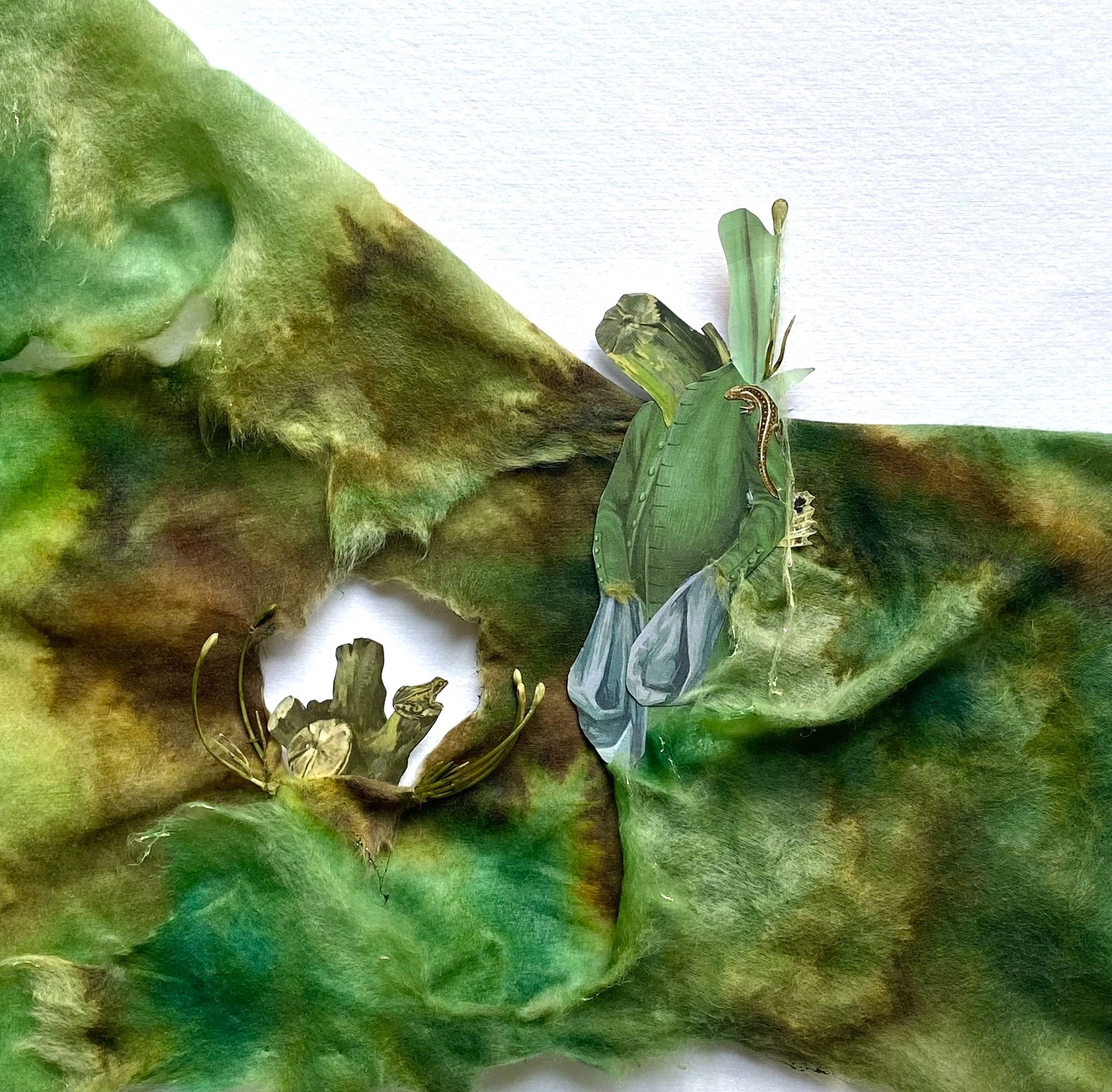
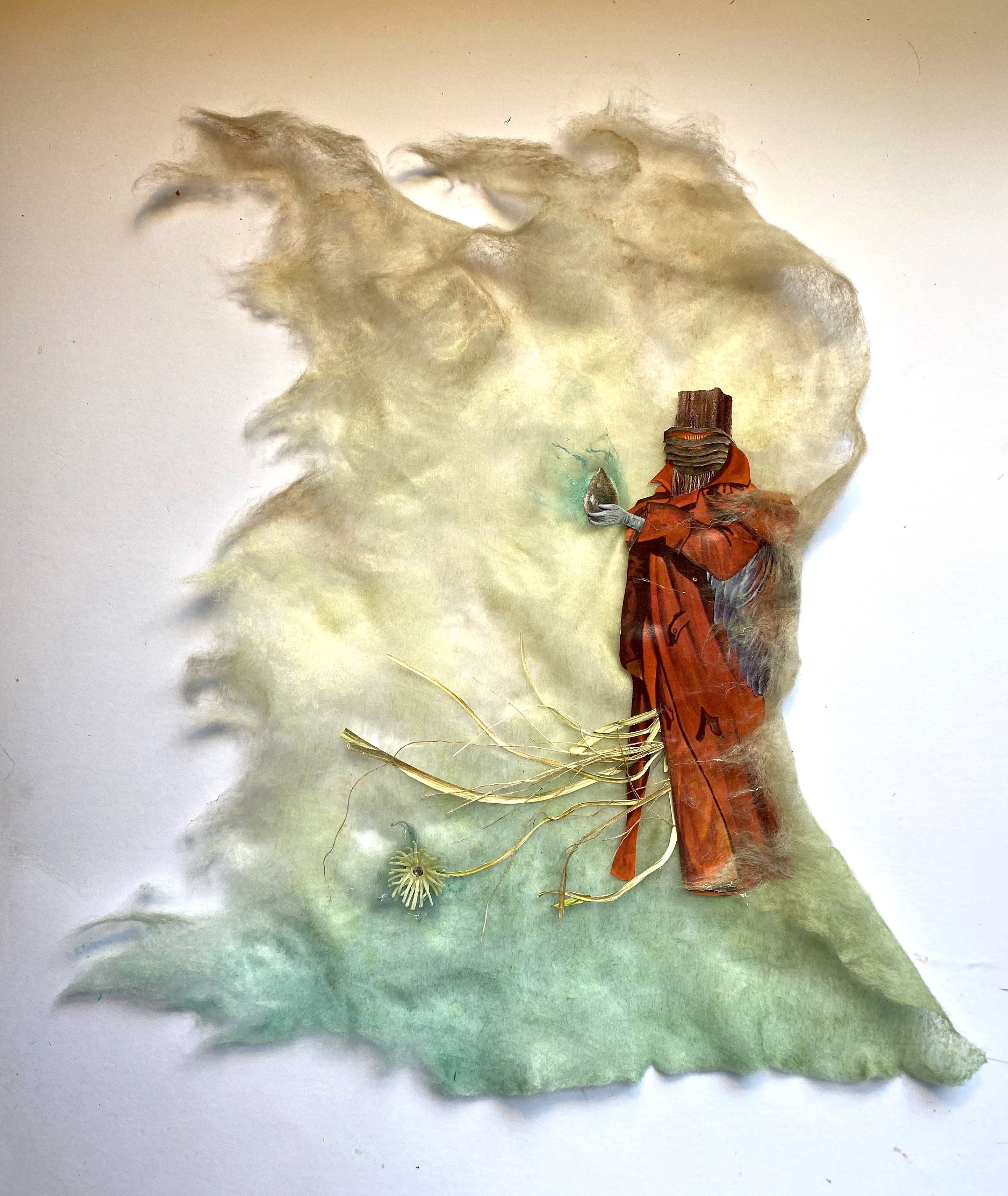
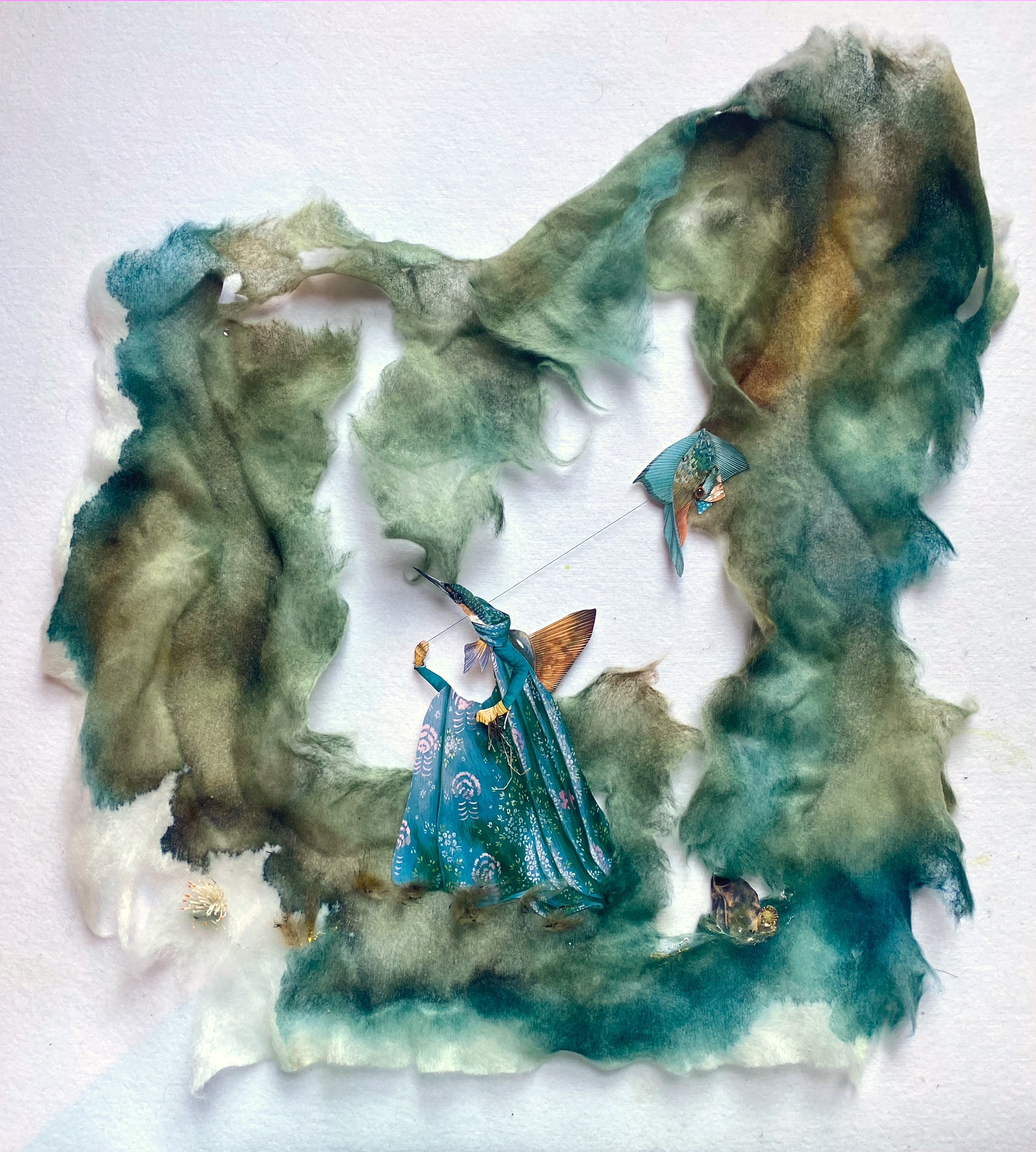
They are strange but not monstrous. They appear to have adapted to their environments rather than conquered them: a shepherdess of real and imaginary creatures; a woman with the head of a kingfisher flying another bird as a kite; a solitary figure carrying something precious across a wet, fibrous landscape.
Ruby Tingle’s world is fantastical, but it is constructed through intense observation of the real one.
Tingle was born in Sheffield, close to the Derbyshire border, and has lived in Manchester for around 17 years. Childhood visits to Whitby and the Yorkshire coast formed part of her early relationship with the North’s landscapes.
She is an artist, musician and performer, but she also describes herself as an amateur naturalist. Her particular fascination is herpetology: the study of reptiles and amphibians.
“I’m obsessed with storytelling and fantasy stories, magic and cryptozoology,” she says. “But I’m also a scientist - an amateur naturalist. I’m always out birding and looking for amphibians.”
Her work occupies the territory between what has been scientifically recorded and what remains unknown. She calls it “unnatural history”: not a rejection of evidence, but an imaginative exploration of the gaps around it.
“There’s a space between what’s documented in science and what we’re actually looking at. When it isn’t documented, how does it become fantasy - fantasy and fact?”
When Tingle first encountered the Soper Collection at Pannett Art Gallery, she recognised something that belonged within this territory. There were exquisitely observed animals, but also anthropomorphic figures: kingfishers and shrews sailing through invented adventures with crabs.
She wanted to understand why this collection was now in Whitby - and what new relationships might be created between the art, the gallery, Pannett Park and the wider North Yorkshire landscape.
The Art Fund grant enabled her to be employed by Pannett Art Gallery as a temporary independent curator. It also allowed her to travel: moving between the collection, the Soper archives and the habitats that could bring its creatures back into the present.
She visited Bempton Cliffs to see gannets and puffins. She spent time with Whitby Naturalists, walking alongside retired scientists and botanists who could identify the smallest fragment of plant life beneath their feet. She worked with Whitby Lobster Hatchery and explored the Esk, the moors and the coast.
In Hertfordshire, she stayed near the Sopers’ former home, met people connected to the family and saw ferns descended from plants that once grew at Wildings. She went out at night to watch badgers from the same lineage of animals Eileen had studied.
Then she returned to the archive.
“Going and seeing the badgers and then looking at her sketches of badgers made it feel much more tangible,” Tingle says.
Research did not proceed neatly from archive to studio. It moved backwards and forwards between paper and place, recorded history and living creature.
At Pannett Park, Tingle found something particularly precious: a population of midwife toads.
Unlike the familiar drawn-out croak, their call can resemble a small electronic note - a clear, repeated bleep ringing through the darkness. Recordings of the toads now appear in the music accompanying Wildings, alongside sounds gathered at Bempton and during other journeys across the project.
The creatures outside the gallery have entered the work inside it.
Although Wildings responds to the work of the whole Soper family, Tingle deliberately brings Eva and Eileen towards the centre.
George, she suggests with an affectionate bluntness, has “had enough attention”.
The sisters have frequently been described through their father, through Eileen’s association with Enid Blyton or through accounts written about them by men. Tingle found some of those descriptions unkind and, at times, distinctly sexist.
Her experience of the archives revealed something more complicated.
Eileen might have lived reclusively, devoting much of her daily life to animals and the garden, but her letters disclose a determined professional artist. From Wildings, she maintained correspondence with America and London, secured significant commissions and clearly stated what she needed.
“She was an incredibly forthright woman,” Tingle says. “She was selling work to America and London and getting these big commissions. She was quite demanding and very strong.”
The letters encouraged her. They also suggested how a collection’s meaning might change when contemporary women are given an opportunity to work with it.
“If more artists - especially women artists like me - start to come in and deal with the collection, that narrative might change.”
During nearly two years of developing the project, the affinities became unexpectedly intimate.
Wood mice had always lived at the bottom of Tingle’s garden. As work on Wildings intensified, they began coming into the house. Birds followed.
“Nature decided to move into the house,” she says. “I was like: this is just like the Soper women.”
It sounds like one of Tingle’s invented myths. It also happened.
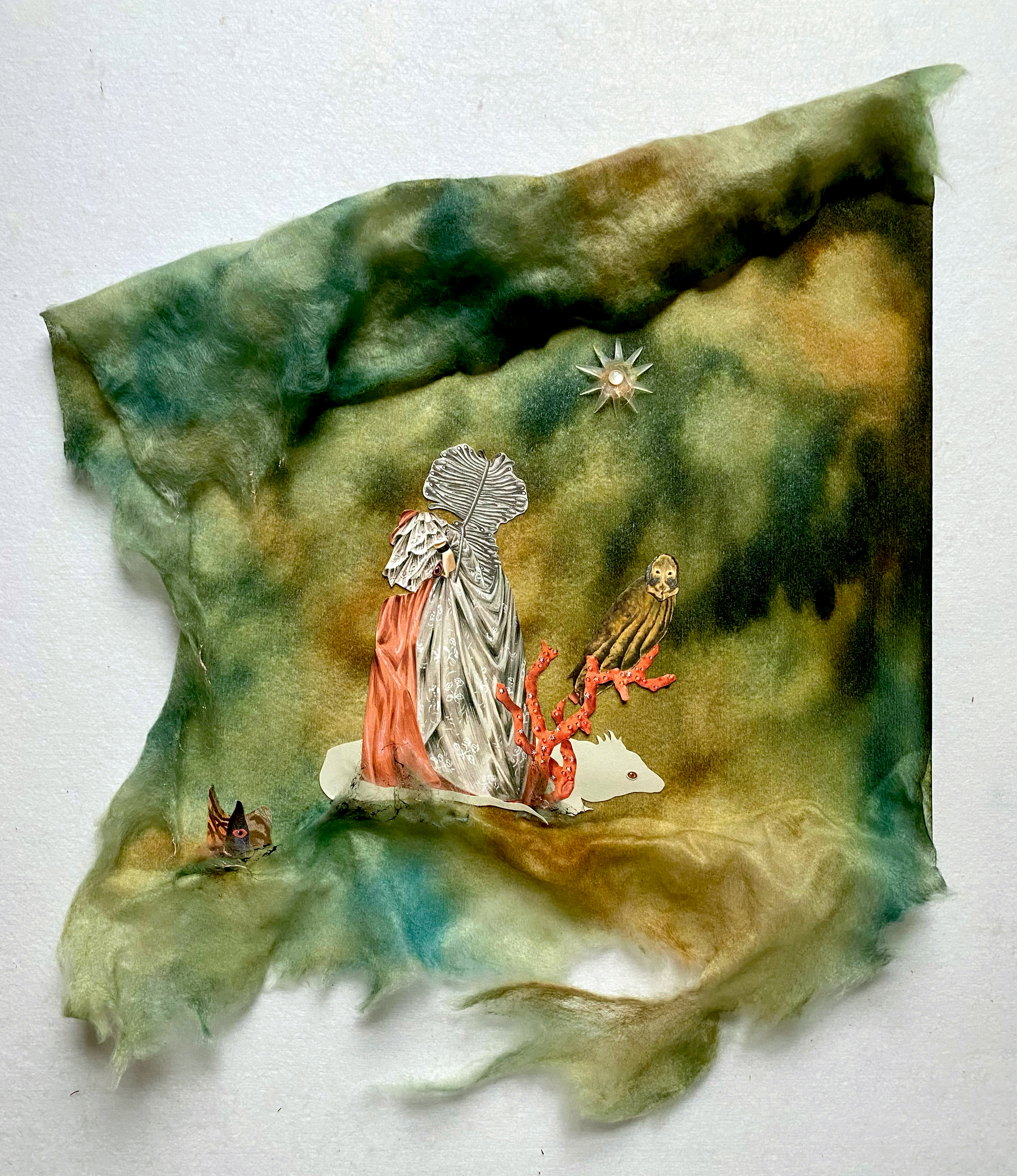
The artworks created for Wildings are seductive things.
Dyed and distressed fibres become bog, meadow, sea mist and moor. Cut paper figures occupy these unstable terrains, accompanied by frogs, otters, birds, shells and hybrid creatures. Household plastics and second-hand objects are reconstructed into unfamiliar specimens.
Their colours are rich and often playful. Yet Tingle does not consider the work escapist.
“I think there is a bleakness in some of the images, even though they’re quite bright and magical,” she says. “There’s a feeling of sorrow in some of them.”
Much of her material is found, salvaged or bought second-hand. She is particularly drawn to plastic flowers and toy animals - remnants of a 1990s childhood fascination with imitation nature.
“If it’s here, we should use it instead of it going to landfill,” she says. “But at the same time: why do we have all these plastic flowers and plastic nature? We need to stop making these things.”
That unresolved contradiction gives the work some of its strength. The artificial flowers are beautiful. The plastic creatures are enchanting. Both are evidence of a culture capable of loving representations of nature while steadily degrading the living thing.
Tingle often works with wildlife and conservation organisations so that environmental understanding becomes part of an exhibition, particularly for children and school groups. In Whitby, as we've mentioned, her collaborators include the Lobster Hatchery and the town’s naturalists.
She is not issuing instructions from the gallery wall. She is attempting something more elemental: making people look closely enough to care.
Pannett Art Gallery has given Tingle curatorial control of the space. She will select Soper works from the archive - including pieces rarely seen - and place them alongside her own art and the work of invited collaborators.
This is not her first intervention into a museum collection. At Warrington Museum & Art Gallery and The Whitaker in Rossendale, she brought historic objects into temporary installations of her own. Wildings represents a significant expansion of that approach.
The exhibition will engage more than the eye.
Olfactory artist Steven Calver has created four scents to accompany new collage works. Rather than filling the whole gallery, the fragrances will be contained beneath beautiful small cloches, allowing visitors to encounter individual landscapes intimately.
One evokes the exposed sea air and campion around Bempton. Another draws upon the flowers once recorded at the Wildings estate. There is a musky, forested badger scent and another inspired by the lily pond in Pannett Park.
Visitors will be able to move from artwork to artwork, lifting each cloche and breathing in another part of the journey.
Music and film extend it further.
Tingle began writing lyrics almost two years ago, drawing phrases and impressions from Eileen’s writing, the archives and her research journeys. The resulting Wildings EP is her first fully self-produced record, combining poetry, electronica, alternative pop, natural sound and field recordings.
For Tingle, music and visual art are not separate practices.
“It’s a way to tell parts of the story that I can’t tell visually,” she says. “For me, it all works as one.”
The opening performance will be relatively intimate. Tingle will be joined by KINRAR and JONOA, appearing as anthropomorphic birds to perform stripped-back versions of the songs.
A week later, she will present music and a film with Whitby Lobster Hatchery as part of this year's Musicport. The film is a nature diary: a record of one year at the swamp and of journeys through the Wildings landscape, loosely echoing Eileen Soper’s own diaries.
The project will reach its loudest and most theatrical form on 5 December, when Tingle and a full band perform at the Whitby Krampus Run Ball around the time the exhibition closes.
This is not an exhibition to visit once and consider completed. It will continue changing shape throughout its life.
When Tingle first began travelling to Whitby, she travelled alone.
She stayed in hotels, walked through unfamiliar places and sometimes found the experience lonely. Through the collection, that changed.
Naturalists, conservationists, gallery staff, artists and local residents became part of the project. Returning to Whitby now means returning to friends.
“I’ve built this new little community around the collection,” she says. “Those people are now going to be more interested in it or have a link to it. That’s made it a personal experience rather than it just being a special project.”
It is a reminder that culture does not only interpret communities. Sometimes, quietly, it creates them.
Tingle understands the fragility of the spaces in which those relationships form. She was previously represented by PAPER, the small but hugely importnat Manchester gallery where she also maintained a studio.
“That became my community,” she says. “They knocked it down, which was horrendous. Through that, we’ve lost a whole thing in my life.”
In Manchester, she sees artists and independent organisations being displaced from central neighbourhoods, forced further out as development removes affordable space.
“Everything’s just been torn down and squished and shoved out.”
But they continue. At Rogue Artists’ Studios in Gorton, AWOL and other dispersed spaces, people keep producing work and - crucially - keep turning up for one another.

This weekend, Tingle performs at 50MV in Crosby as part of A Rose Is a Rose Is a Rose, an evolving international postcard project led by Belinda Worsley and Elaine Fisher. She has contributed visual work; her music will be presented through headphones; and the project’s rose fragrances have been developed with Calver.
The connection began almost accidentally.
“I’m the kind of person and artist who likes to find the links and connections in the accidents,” she says.
At a time when formal creative infrastructure across the North is increasingly vulnerable, those connections matter. A gallery inside a public park in Whitby, a room near the sea at Crosby, a studio pushed towards the edge of Manchester: each becomes a place where artists and audiences can still find one another.
And where strange new things can begin.
After almost two years, Wildings has changed Ruby Tingle.
The curatorial grant, the authority to work with the collection and the responsibility of shaping a major exhibition have required her to become more forthright, establish firmer boundaries and occupy a new professional space.
Creatively, the project is still refusing to end neatly. New soft sculptures have appeared late in the process - too late to develop fully, perhaps, but soon enough to suggest where she might travel next.
For now, the installation itself remains partly unknown. Tingle plans to construct a new work inside one of Pannett’s tall historic glass cabinets, assembling it spontaneously in the gallery.
There is risk in that. She welcomes it.
“I do just build stuff on site,” she says. “There is vulnerability in it, but it’s part of the process and the risk. I quite like working like that.”
When the exhibition closes, she expects to feel its absence. Projects of this scale consume two or three years of an artist’s life. Finishing can resemble grief.
"The research I've undertaken on the Soper collection has led me to a huge variety of special habitats and wildlife experiences across the country - I was able to get close to a host of animals who physically surround the Soper works and feature in them, all of which are of critical importance in our current climate. Persecuted Badgers and Gannets, the local moors which are recovering from wild fires, vital conservation work by Whitby Naturalists & Whitby Lobster hatchery, along with the amphibian population which is in global crisis, point to the Soper collection being more relevant today than ever, in its depictions and celebration of the natural world.
"The colour plates and anthropomorphic works by Eileen Soper particularly inspired me, as an artist who is fascinated by the liminal spaces between what is documented as scientific fact and fiction.
"Fairies and magical creatures feature along side familiar animals and habitats in these educational works, using imagination and enchantment to teach us about the environment. I believe story telling can connect people of all ages and backgrounds to nature, and have used this as a tool in new collages to create my own characters and unnatural history.
"My hope is that this project is the beginning of many more artists working with this collection, and to build a legacy which makes it a highlight of Whitby and Hertfordshire culture."
Before then, the Wildings will have the gallery.
They will carry the Soper sisters out from the archive and place them among contemporary creatures. Midwife toads will call through electronic music. Bempton’s winds will be captured beneath glass. Badgers will move between drawings, diaries and night-time encounters. The Esk will generate new myths.
And perhaps, when visitors step back into Pannett Park, the familiar world will appear fractionally less settled than it did before.
“I want people to come away with a sense of magic and wonder,” Tingle says, “and to look at nature in slightly new and different ways.”
Outside the gallery, something may already be watching.
Ruby Tingle: Wildings
Pannett Art Gallery, Whitby
17 October until the gallery’s December closing
Related releases and performances
Ruby also appears at A Rose Is a Rose Is a Rose at 50MV, Crosby, opening Saturday 12 September from noon, with a soirée from 6pm; it continues Sunday 13 September from noon until 4pm. Event details from 50MV.
Header image: Credit KINRAR





