



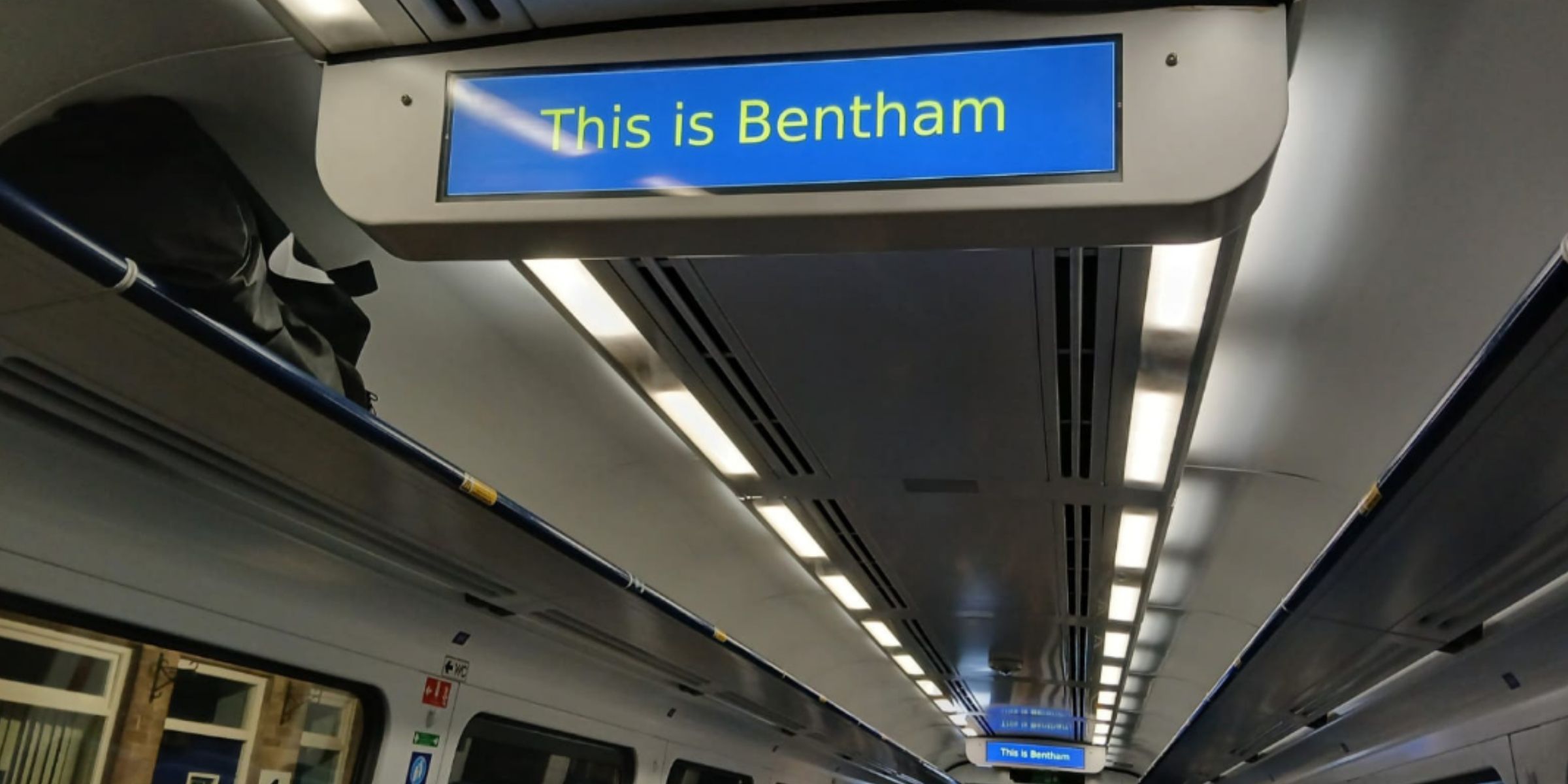
There is a particular way of looking through the window of a train.
Fields arrive and disappear. Stone walls run beside us for a few seconds before turning away. Villages appear as rooftops, chimneys and brief domestic glimpses. A river catches the light. A bird lifts from wet ground. Somebody working in a garden looks up as we pass.
We may find it beautiful. We rarely know what any of it means.
The people living within that landscape remain almost entirely invisible to us. Their histories, memories and understanding of the land are reduced to scenery moving behind glass.
A community arts project called outside it is beautiful wants to change that.
Working along the Bentham Line, the 75-mile railway connecting Leeds and Morecambe - the project is inviting local people to create poems and stories about the nature, heritage and communities encountered along the route.
Those words will become a book, a podcast, artwork at participating stations and, as the project develops, an audio experience capable of responding to a passenger’s physical journey.
Using GPS technology, stories connected to particular locations will eventually be delivered to travellers’ phones as the train approaches them.
The anonymous landscape will begin to speak.
The Bentham Line crosses an extraordinary section of northern England.
Leaving Leeds, it travels through former industrial communities and the Aire Valley before reaching Skipton and moving west through limestone country, the Yorkshire Dales and the edge of the Forest of Bowland. It continues towards Lancaster and Morecambe Bay, carrying passengers between cities, market towns, villages, farms, wetlands and coast.
It is widely celebrated for the beauty outside its windows. The railway itself is also one of the oldest in the country: passenger services reached Bentham in 1850, and the station marked its 175th anniversary in 2025.
But beauty can sometimes become a way of not looking properly.
A view might be admired without the viewer understanding the lives, labour, wildlife or environmental pressures contained within it. A picturesque village can also be a place confronting isolation, inadequate transport or the loss of local services. Open country may hold peat, curlews, buried infrastructure, contested histories and memories that cannot be identified from a carriage.
The title outside it is beautiful carries a little of that ambiguity. It sounds like an invitation to look up - but also a challenge to ask what lies beneath the attractive surface.
Created and produced by international journalist, filmmaker and photographer verity healey, the project brings together poet and playwright Sarah Hehir, Yorkshire writer and facilitator Becky Cherriman, Manx-Liverpudlian writer Erin Craine and Community Producer Ben Pearson.
Their intention is not only to write about the communities beside the railway. It is to provide the conditions in which people can write about their own places.
“outside it is beautiful is a celebration of what we can see out of the train window, but often know nothing about,” says healey.
“It’s easy to get on a train and forget to look out and enjoy the incredible natural landscapes we are travelling through. Often, we have no way of knowing more about the people living along the route, or the nature and wildlife around it.
“The project aims to promote a greater understanding of places, nature and people. It will curate and share the stories of people living along the Bentham Line as an audio adventure, to bring inhabitants and visitors closer together.”
The new work builds upon a research and development programme held in 2024, when the team met groups and passengers in communities including Bolton-le-Sands, Holbeck, Morecambe, Settle and Skipton.
Participants created memory maps, poetry and wildlife-inspired work. A dry-stone wall was imaginatively assembled from local sayings and recipes. The activity contributed to Ghost of the Sky, an audio journey written by Sarah Hehir and voiced by people living around the line.
The next stage moves from exploration towards a larger collection of shared work.
Workshops planned for September 2026 include sessions with children from Great Wood Primary School in Morecambe and people supported by Adullam, a voluntary programme working with those experiencing isolation or poor mental health.
The school session will involve Wild Ingleborough Engagement Officer Ellie Parker, alongside healey and Craine. Artist and writer Rob St John will join healey and Cherriman for the Adullam workshop.
These are not incidental outreach additions to an artwork whose important decisions have already been made elsewhere. The encounters are the project.
The images, phrases, memories and associations contributed by participants will help determine what passengers eventually encounter.
For Becky Cherriman, creative writing allows connections to form between people whose lives may look very different.
“The lines of poetry or fiction we write on a page become lines between us,” she says. “Someone throws out a line and someone else catches it.
“‘Yes,’ they say, ‘that’s exactly what that sounds or feels or looks like.’ Or: ‘Wow, I’ve never thought about it like that.’
“The people in that workshop might be from completely different backgrounds and have vastly different circumstances and challenges, but human experience resonates along these lines of words like the hum of a railway line.”
It is a lovely description of what community art can achieve when it is undertaken seriously. It does not pretend that one afternoon of writing erases material differences between people. Instead, it creates a place in which one person’s close attention can be recognised by another.
On Friday 25 September, the workshop will leave the community room and board the railway itself.
Beginning on the 10.18am departure from Leeds, passengers will be invited to create poetry during the two-hour journey to Morecambe. Artists and facilitators will encourage them to notice the landmarks, changes and passing details outside the carriage, and to record the thoughts those sights provoke.
The work created during the journey will contribute to the project’s book, podcast, station artwork and developing audio archive.
The train is an unusually rich space in which to write.
Its direction is fixed, but the view continually changes. Passengers share a temporary room while remaining physically between places. One person might be travelling home, another escaping for the day, another attending an appointment or visiting somebody they love. Familiar landscape for one traveller may be entirely new to the person sitting opposite.
Writing interrupts the usual habits of the journey: headphones in, laptop open, eyes lowered towards a phone.
It asks the passenger to become present.
Sarah Hehir spent childhood holidays in and around the Forest of Bowland and describes herself as having fallen in love with both its landscape and history. Before the pandemic, she created a narrative poem along the railway between St Pancras and Margate, gathering material from people living near its stations.
“The creative projects that really capture me are site-specific and celebrate communities and the ebb and flow of those who arrive, those who leave and those who settle,” she says.
“How will the landscape, the journeys and the people influence the art we make together? I’m looking forward to finding out.”
That open question is key. A less interesting project would begin with a fixed story about the North and invite local participants to decorate it. outside it is beautiful is allowing the route and its people to complicate the finished work.
There is now no shortage of content telling people where to travel.
Destinations are ranked, packaged and sold through short videos and lists. Landscapes become backdrops. Towns become “hidden gems”. The people who live in them are sometimes reduced to authenticity props within somebody else’s weekend.
This project proposes a different relationship between visitor and place.
A passenger does not merely receive information about a landmark from a distant institutional voice. They encounter work created by somebody with a connection to it: a child, a writer, a resident, a person recovering confidence, somebody who has watched the same landscape change over many years.
That voice may offer history, but it might also offer uncertainty, affection, anger, humour or an intensely personal detail no visitor guide would think to include.
The technology is important, but it is not the story’s centre.
A GPS-enabled app can identify where a train is travelling and deliver the appropriate recording. It cannot decide what matters about the place. That authority remains with the people invited to observe, remember and write.
The resulting work will not be confined to passengers carrying smartphones. A printed book designed by Nick Awde will gather writing from the workshops. Local artist Alistair Nicholson will help create panels for stations, using provocations and lines drawn from participants’ work.
A podcast, produced in collaboration with Settle Stories’ Listening Gallery, will bring together narrated poetry and original music from Sheffield-based duo GILANK, whose improvised work combines electronic sound with acoustic instruments.
The project will therefore travel through several different forms: held in the hand, encountered on a platform, heard at home or delivered in response to the passing landscape.

Community rail is based on the understanding that a railway is more than track, rolling stock and a timetable.
A line can connect people to education, employment, healthcare, family and landscape. Its stations can become places for art, gardens, learning and social activity. The Leeds–Morecambe Community Rail Partnership has already worked to establish the Bentham Line as a dementia-friendly railway, supporting travel, independence and reminiscence for people living with dementia and their carers.
outside it is beautiful extends that social purpose into storytelling.
Gerald Townson, Chair of the Leeds–Morecambe Community Rail Partnership, says the project will create opportunities to meet people within the line’s communities and carry their stories to those travelling through them.
That movement works in both directions.
Passengers are encouraged to understand the places outside the train. Participants are invited to look again at environments they may have ceased consciously to notice because they see them every day.
The familiar becomes available for rediscovery.
Subject to the success of the September programme, the team hopes to expand the project further in 2027, working with nine community groups. Potential participants include Dementia Forward, Settle Stories’ writers, children supported by SELFA and women rebuilding their lives after contact with the criminal justice system.
The ambition is not to produce one authorised account of the Bentham Line. It is to accumulate difference: multiple voices, different forms of knowledge and sometimes conflicting relationships with the same landscape.
A railway crosses boundaries that local storytelling is too often asked to obey. It links Yorkshire and Lancashire, city and coast, industry and agriculture, visitor and resident, movement and belonging.
Its passengers do not all see the same North.
That is precisely why their stories matter.
There will always be journeys during which we need to work, sleep or disappear into a screen. But the invitation at the heart of outside it is beautiful is a simple and generous one.
Look out of the window.
Then look again.
Ask whose land is passing. Ask what happened beside that wall, beneath that water or inside that row of houses. Notice the bird before it vanishes. Consider that the person beside the line has a view of the railway, just as the railway gives you a view of them.
In September, MagNorth hopes to join the travelling workshop from Leeds to Morecambe and meet some of the people putting words back into that landscape.
For now, the project begins with a truth easily forgotten in a culture of hurried journeys and anonymous content.
Places do not arrive without stories.
We simply have to make enough space to hear them.
Find out more about outside it is beautiful and listen to the earlier audio adventure Ghost of the Sky HERE





