



As you'll know if you've gazed, mouth-open, over the weekend - as Aurora Borealis did it's magical work above you - there's more than one way to look for wonder after sunset. Sometimes it involves lifting your eyes towards the stars. Sometimes it means looking down at the woodland floor.
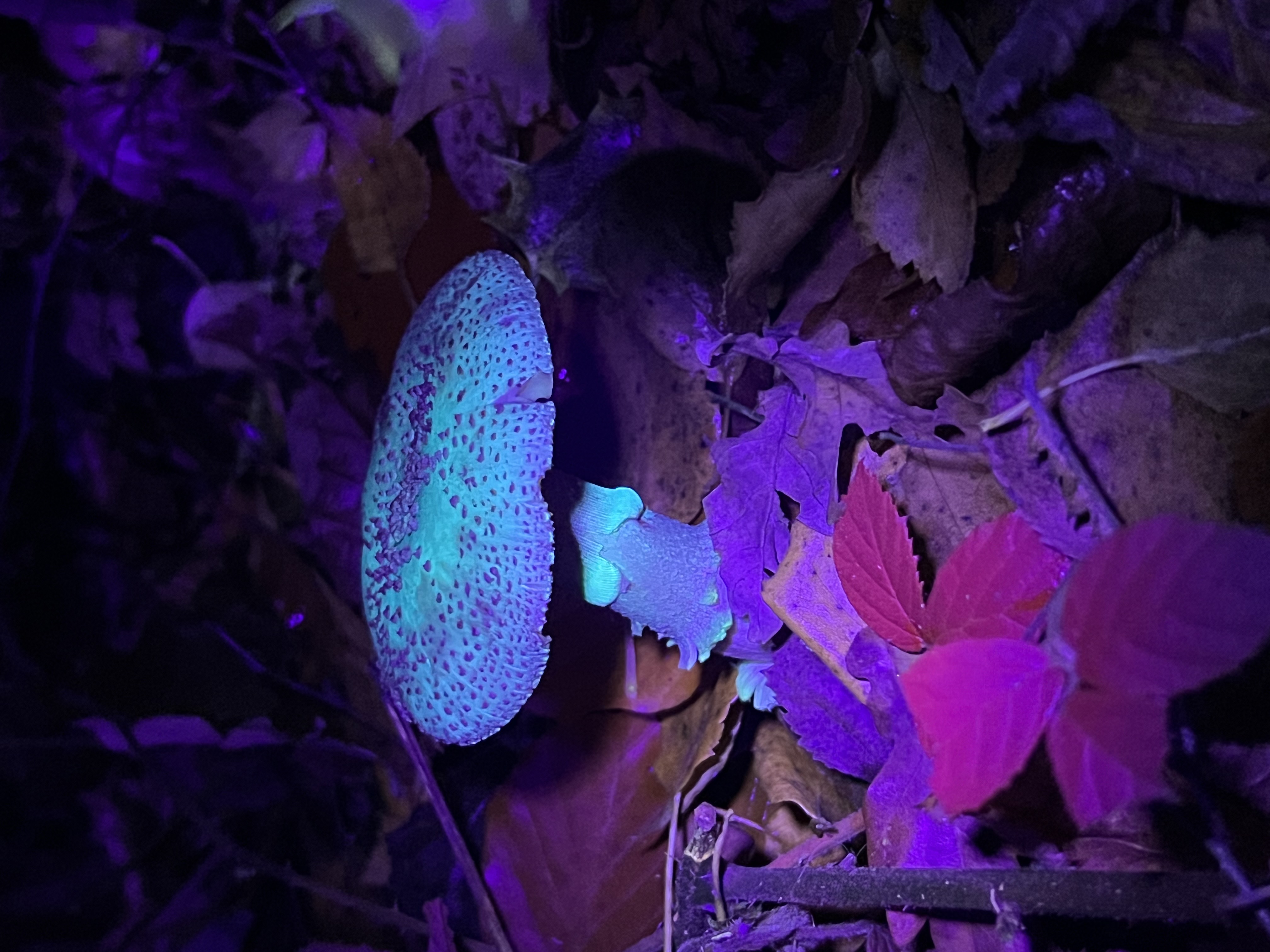
At Danby Lodge in the North York Moors, a walk led by Lucy Cuzzocrea of Wild Roots Foraging will explore a world of fungi, mosses, lichens and insects whose colours become visible beneath ultraviolet light. Beginning as daylight fades in Crow Wood, the evening moves from a wild-spiced mushroom hot chocolate to an encounter with nature through UV torches.
The walk, on Saturday 24 October, is already listed as sold out. But its place in the Dark Skies Fringe Festival offers a compelling introduction to the wider programme: here's an invitation to pay attention to a landscape at the hour when many of us might stop looking.
Running from 23 October to 1 November 2026, the Fringe brings together the North York Moors and Yorkshire Dales, with the organisers also identifying Nidderdale and the Howardian Hills National Landscapes as part of its reach. The two national parks are International Dark Sky Reserves. Their night skies belong among the qualities that make these places distinctive, alongside the stone walls, wooded valleys and expanses of moor.
Darkness, though, can be a difficult thing to celebrate. We tend to associate it with inconvenience or danger; autumn’s shortening days can feel like a narrowing of our opportunities to be outside. A festival built around the night asks us to reconsider that familiar retreat.
The fungi walk makes the proposition wonderfully tangible. Its subject is biofluorescence: organisms absorb incoming light and re-emit it at a different wavelength, allowing colours normally hidden from us to appear under UV. This differs from bioluminescence, in which a living organism produces light through a chemical reaction. The torch is part of the discovery.
The distinction does nothing to diminish the fascination. A familiar wood can hold visual surprises we would otherwise pass without noticing. For a child encountering them, or an adult whose knowledge of fungi extends little beyond the supermarket shelf, it offers a reason to linger and ask questions.
The wider festival carries that curiosity into music, storytelling and movement.
At Sutton Bank on 25 October, The Long Dead Stars will perform their new album, Dark Core, outside the Nature & Star Hub, in a silent disco setting. The work draws on the night sky and the cosmos. At Danby Lodge on 28 October, Tales at Twilight brings families together as day gives way to evening, with local actor Bidi Iredale providing the storytelling. A dusking session at Sutton Bank on 29 October offers a quieter encounter with the transition into night.
Together, these events suggest how many different routes there are into an interest in the natural world. You might come for the music and leave with a question about the sky. A story can give a family a reason to venture outdoors at an unfamiliar hour. Curiosity doesn't need a telescope.
For those of us keen to learn our way around the heavens, the programme includes stargazing at Danby, Sutton Bank and Ampleforth Abbey. Guided night walks offer opportunities to practise navigation using the stars, with routes including Goathland and the Hole of Horcum. There's also a 65km gravel bike ride from Sutton Bank: a considerably more energetic way to watch the daylight disappear.
Across in the Dales, the listings include a family alien-making activity on 28 October and an astronomy evening in Swaledale on 30 October. Halloween brings its own strands of folklore and performance, including ghost walks at Robin Hood’s Bay and Mad Alice’s Ghost Train on the North Yorkshire Moors Railway.
“There’s a perception that nature goes to sleep as soon as darkness falls,” says Vicky Burton, marketing officer at the North York Moors National Park.
The programme challenges that assumption. It also raises a question that lasts beyond half term: how much of the night are we prepared to protect?
Artificial light can alter the behaviour of wildlife, disrupting feeding, reproduction and navigation. Insects attracted to lights and birds drawn off course are among the consequences described by DarkSky International. Darkness is a condition within which other lives unfold; treating it as empty space overlooks an important part of the environment.
The North York Moors’ own explanation of reserve status places considerable emphasis on appropriate lighting. Protecting the night involves choices about where light falls, how much is needed and when it should be used. Those choices connect the view through a telescope to the decisions made around homes, businesses and public spaces.
There's a cultural question here too. A night sky can be a shared source of curiosity, but enjoying it depends on confidence, opportunity and access. Guided events can help people take a first step. Cost, transport, terrain and the timing of an evening outing still shape who can join in. The Danby fungi walk, for example, is explicitly listed as unsuitable for wheelchair access.
That makes a varied programme valuable. Families, walkers, music lovers and would-be astronomers need different ways in. The strongest invitation allows people to begin with something that interests them, then discover what else the landscape holds.
The October Fringe is also a foretaste of the next main Dark Skies Festival, confirmed for 5–21 February 2027. There will be another season in which to explore Yorkshire after sunset.
For now, the appeal is close at hand: a story at twilight, a woodland seen differently, a chance to learn the sky with someone who knows where to look.
The night is part of the North’s landscape. This half term offers a reason to spend some time in it.
Visitor information: The Dark Skies Fringe Festival runs from 23 October to 1 November 2026.
The 24 October UV fungi walk at Danby Lodge is listed as sold out.
Check individual events for current availability, prices, age limits, access arrangements and weather plans at darkskiesnationalparks.org.uk.
Header image: Milky Way arc over the lone tree at Egton. Credit - Steve Bell





