



Awards shortlists usually arrive as collections of individual names: the institution, the emerging artist, the established figure whose contribution has accumulated across a lifetime.
Look more closely at this year’s Parliamentary Jazz Awards, however, and three of its nominations appear to form something closer to a musical family tree.
Leeds Conservatoire’s Jazz department has been shortlisted for the 2026 Jazz Education Award. Olivia Cuttill, who graduated from its Jazz degree in 2023, is in contention for Jazz Newcomer of the Year. Nikki Iles, the pianist, composer and educator whose influence runs through the institution’s musical history, has been nominated for the Services to Jazz Award.
Taken together, they offer more than a moment of institutional celebration. They reveal how culture grows: not through isolated flashes of talent, but through places capable of nurturing it over years - and sometimes generations.
The Parliamentary Jazz Awards are organised by the All-Party Parliamentary Jazz Group and are now in their 21st year. Intended to recognise the breadth and vitality of jazz across the UK, the awards will be presented at World Heart Beat in London on October 13.
Yet the Leeds presence on the shortlist has roots stretching considerably further back.
The institution was founded as Leeds Music Centre in 1965. Within two years, it had introduced a diploma in Jazz and Light Music - at a time when jazz was still fighting for full recognition within formal music education.
In 1993, by then operating as Leeds College of Music, it introduced what it describes as the first Jazz degree in Europe.
That matters. Institutions do not merely teach technique; at their best, they legitimise forms of artistic expression, create communities around them and give musicians permission to regard their creativity as a life’s work.
Jazz, with its reliance upon listening, collaboration, experimentation and improvisation, cannot be sustained by a curriculum alone. It requires ensembles, rehearsal rooms, committed teachers, fellow players, live audiences and somewhere young musicians can take risks without every imperfect note becoming a professional failure.
Leeds has spent six decades assembling that environment.
“Our Jazz department, one of our graduates and a hugely influential figure in our jazz community making the Parliamentary Jazz Awards shortlist is a wonderful reflection of our pioneering legacy,” says Jamil Sheriff, Head of the School of Music and Education at Leeds Conservatoire.
“From the diploma we launched in the 1960s to the bold and performance-led Jazz degree we offer today, our commitment has always been to give artists the space, skills and confidence to develop their own voices. We are incredibly proud to see our efforts acknowledged in this way.”
Sheriff’s own connection to Nikki Iles helps explain why the three nominations feel less like a coincidence than a demonstration of continuity. Iles taught him as a teenager, when the institution was still Leeds College of Music. He went on to become a pianist, composer, bandleader and educator - and now helps lead the school in which another generation is being trained.
Iles has spent much of her career moving between performance, composition and education. Her nomination for Services to Jazz recognises that larger contribution: not simply the music she has created, but the knowledge, encouragement and artistic confidence transmitted to other musicians.
That is the less visible work behind any thriving cultural scene. Audiences encounter the concert, record or festival performance. Beneath it lies an infrastructure of teaching and mentoring, the passing on of standards and traditions, and the equally important encouragement to depart from them.
At the other end of that generational line is Olivia Cuttill.
Since graduating from Leeds Conservatoire in 2023, the trumpeter, composer and bandleader has been developing a musical identity of her own. Her work brings together contemporary British jazz, composition and lyricism; she performs with her own quintet and has also worked with the National Youth Jazz Orchestra’s emerging-professional programme.
Her Newcomer of the Year nomination is significant precisely because it represents movement beyond education. It marks the difficult transition from being a promising student to becoming a working artist with a recognisable voice.
That passage should not be romanticised. The first UK Musicians’ Census, drawing responses from almost 6,000 professional musicians, found that nearly half earned less than £14,000 a year from music. Seventy per cent possessed a degree or higher qualification, while many were sustaining several different roles simply to remain in the profession.
Education, in other words, cannot guarantee security. But it can provide ability, relationships, confidence and entry into the networks through which a precarious creative career becomes possible.
This is why the Leeds shortlist matters beyond the conservatoire itself.
The economic language surrounding the creative industries often concentrates upon outputs: jobs generated, audiences attracted, tickets sold and money added to regional economies. Those outcomes are important, but they begin much earlier—in classrooms, rehearsal rooms, youth ensembles and encounters with teachers who recognise potential before the wider world does.
Northern cultural success is sometimes presented as though it arrives unexpectedly: an artist emerges, a band breaks through, an award travels north. The infrastructure that helped produce the achievement can disappear from view.
Leeds offers a different account. Its musical identity has been built through the interaction of formal education and an independent city culture: conservatoire students and graduates moving through local ensembles, promoters, studios, small venues and festivals, learning as much from one another as from any prospectus.
That ecosystem is capable of renewing itself. Teachers shape students who become performers, composers and teachers in their own right. Graduates form bands, create work, organise nights and introduce new audiences to the music. Some remain in the region; others carry something of its collaborative culture elsewhere.
The Parliamentary Jazz Awards ceremony will take place in London, but the story represented by these three nominations belongs firmly to Leeds.
One nomination recognises what has been built over six decades. Another recognises an artist beginning to turn education into a distinctive career. The third honours a musician whose influence demonstrates how knowledge and artistic possibility travel between generations.
That is the long game of cultural investment.
You create a place in which people can learn to find their own sound - and, years later, hear its influence returning from every direction.
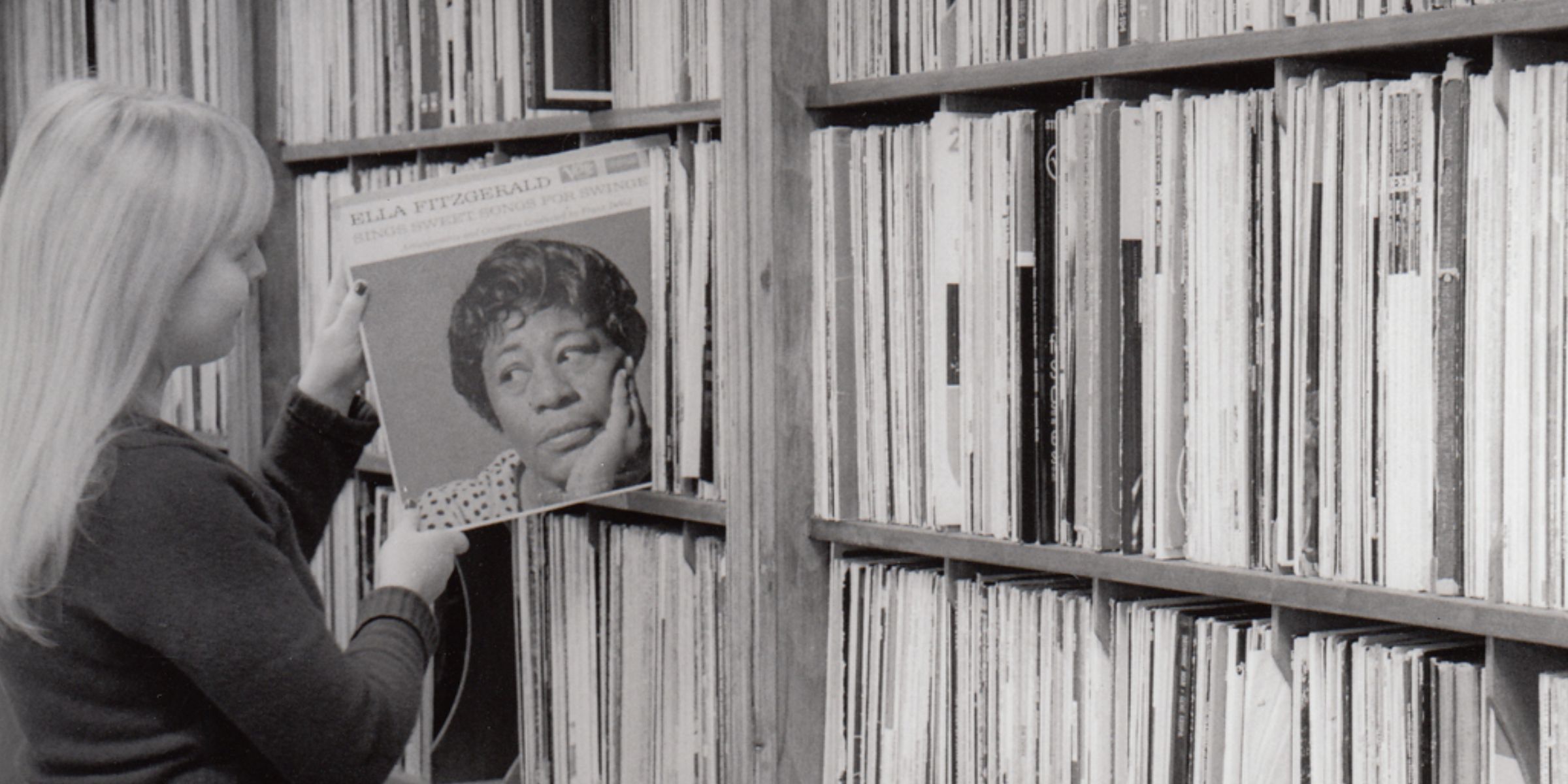
Header image: Browsing records including Ella Fitzgerald. (Leeds Conservatoire Archive)





