



.jpg)
On a Friday afternoon in late March, something quietly radical happened in Blackpool.
Inside the Grundy Art Gallery, a room filled with local leaders, cultural figures, volunteers, and residents gathered not just to see a painting - but to witness a shift in what feels possible.
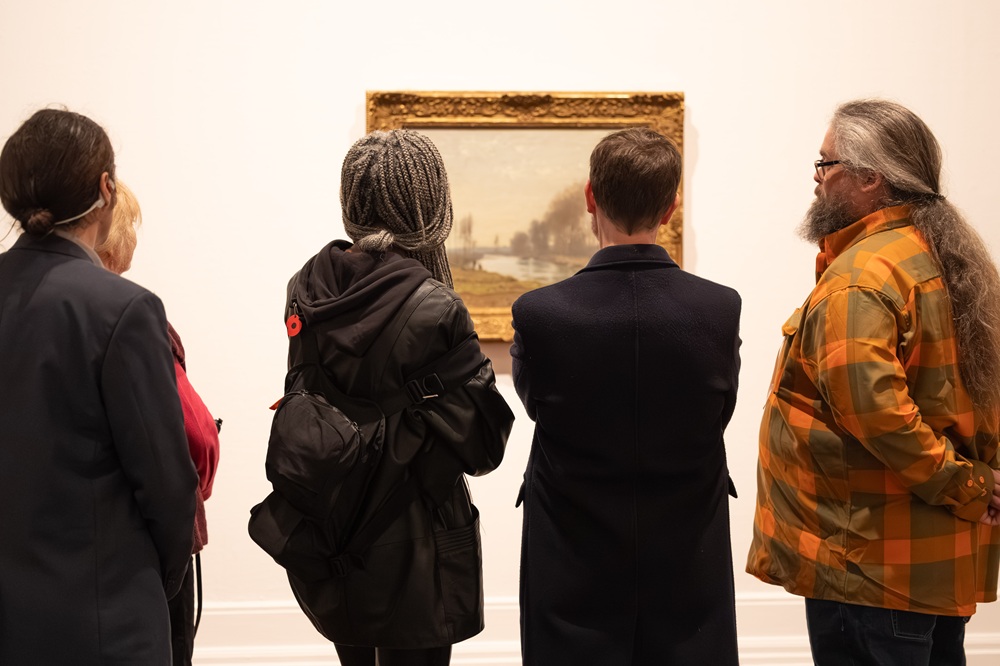
Claude Monet’s The Petit Bras of the Seine at Argenteuil (1872) now hangs on the walls of a seaside town more commonly associated with rollercoasters and illuminations than Impressionism.
And yet, listening to the people in that room, it quickly became clear: this wasn’t an anomaly.
It was a culmination.
As curator Paulette Brien put it, this was “a landmark moment for Blackpool” - but also something more personal. A moment of ambition realised.

There’s an easy version of this story.
A National Gallery loan. One of only four venues in the UK. A painting that hasn’t toured in decades.
But if you stop there, you miss the point entirely.
Because the Grundy team aren’t interested in prestige. They’re interested in redistribution.
For Brien, the real significance lies in what happens around the painting. “It’s not just one painting on the wall,” she said. “It’s what it will do for people.”
That idea - impact over object - runs through everything here.
Before the exhibition even opened, young people had already been engaging with the work. Not passively, but actively - questioning it, interpreting it, responding to it through sound, movement, and conversation.
“They told me things about it that I didn’t know,” Brien reflected.
That’s the quiet provocation at the heart of this project: What happens when cultural authority is no longer one-directional?
“Art speaks differently in different places.”
Jacob Rothschild Head of the Curatorial Department at the National Gallery Per Rumberg’s line might sound polite, diplomatic - even obvious. But in Blackpool, it lands differently.
Because here, the painting isn’t surrounded by the usual context. It’s not one masterpiece among many. It’s not buffered by institutional familiarity.
It’s exposed - to a different kind of attention.
Young people from the Magic Club - a youth group based in one of the most deprived parts of the country - were invited to respond to the painting before even seeing it in person.
Their starting point wasn’t art history. It was curiosity.
What does this painting sound like?
What followed took them from Blackpool beach to the National Gallery, from first-time gallery visits to creating a new sound work rooted in their own environment.
“They’ve claimed Blackpool, they’ve claimed Monet, they’ve claimed the Grundy,” said Learning and Engagement Officer Holly Kilner.
And that word - claimed - matters.
Because for once, the flow of culture isn’t extractive. It’s reciprocal.
.jpg)
If the gallery offers one lens, the civic leadership offers another.
For Councillor Lynn Williams, this moment sits squarely inside a bigger fight: who gets to define Blackpool? “Too often Blackpool is seen through a narrow lens,” she said. “And while we are rightly proud of that history, it is only part of our story.”
The arrival of a Monet doesn’t transform the town. It challenges how the town is perceived.
“Hosting a Monet here does not create culture - it shines a spotlight on what is already happening.”
And that distinction is everything. Because this isn’t about cultural charity from London. It’s about cultural recognition.
Spend five minutes in this conversation and one word keeps resurfacing: access.
Not in the abstract, policy-document sense - but in lived, practical terms.
Who gets to see great art? Who feels it belongs to them? Who even thinks to walk through the door?
“You might not think to go to Manchester or Liverpool,” Williams said. “But this is on your doorstep. This is truly accessible.”
That proximity changes things. Children who have never stepped inside a gallery are now responding to Monet. Young people are gaining qualifications through creative work.
Visitors arrive for a weekend break - and leave with something unexpected.
“There’s something quite special…someone might come for the Pleasure Beach…and leave having seen a Monet.”
That’s not just access. That’s cultural ambush - in the best possible sense.
Talk to enough people here and a pattern emerges: quiet frustration. Not with what Blackpool lacks - but with what gets overlooked.
“There is so much good stuff happening here,” Brien said. “We just need to celebrate it more.”
This isn’t a town waiting to be “levelled up.” It’s a town that’s been culturally active all along - just rarely centred in the national narrative.
The Grundy knows this. The volunteers know this. The artists know this. And increasingly, the town itself knows it too.
All of this feeds into something bigger. Blackpool’s UK City of Culture bid sits in the background - not as a distant ambition, but as a logical next step.
For Williams, the stakes are clear. “It’s about opportunities…particularly for our young people.”
But beyond funding, beyond status, there’s something less tangible - and arguably more important: Confidence. A shift from could we? to why shouldn’t we?
It would be easy - lazy, even - to frame this as a moment.
A coup. A milestone. A headline.
But that flattens what’s actually happening. Because this isn’t just about hosting a masterpiece. It’s about redistributing cultural gravity.
“The National Gallery’s collection belongs to everyone,” Rumberg said.
In Blackpool, that idea is being stress-tested - and expanded.
Not just everyone as audience. Everyone as participant. Everyone as author of meaning.
And once that shift happens - even briefly - it’s hard to reverse.
Which is why this feels bigger than a painting.
Monet x The Magic Club is at the Grundy Art Gallery until 13 June
Header Image: Guests viewing Claude Monet’s The Petit Bras of the Seine at Argenteuil (1872) at The Grundy Art Gallery, Blackpool





