



Something is shifting on the Northwest coast - and we're not referring to Longshore Drift.
In Happy Mount Park, a place long woven into the social fabric of Morecambe, a basketball court has become something else entirely: a canvas, a meeting point, a signal.
“HA HA HAPPY”, the new large-scale public artwork by artist Lakwena Maciver, is not just decoration. It’s infrastructure for joy.
Commissioned by Deco Publique and partners as part of the Morecambe Bay Coastal Commissioning Programme, the work transforms over 1,000 square metres into a technicolour landscape of repeated laughter - “ha ha ha” - culminating in the word “HAPPY” rising around the court.
But this isn’t just about colour. It’s about what happens on it.
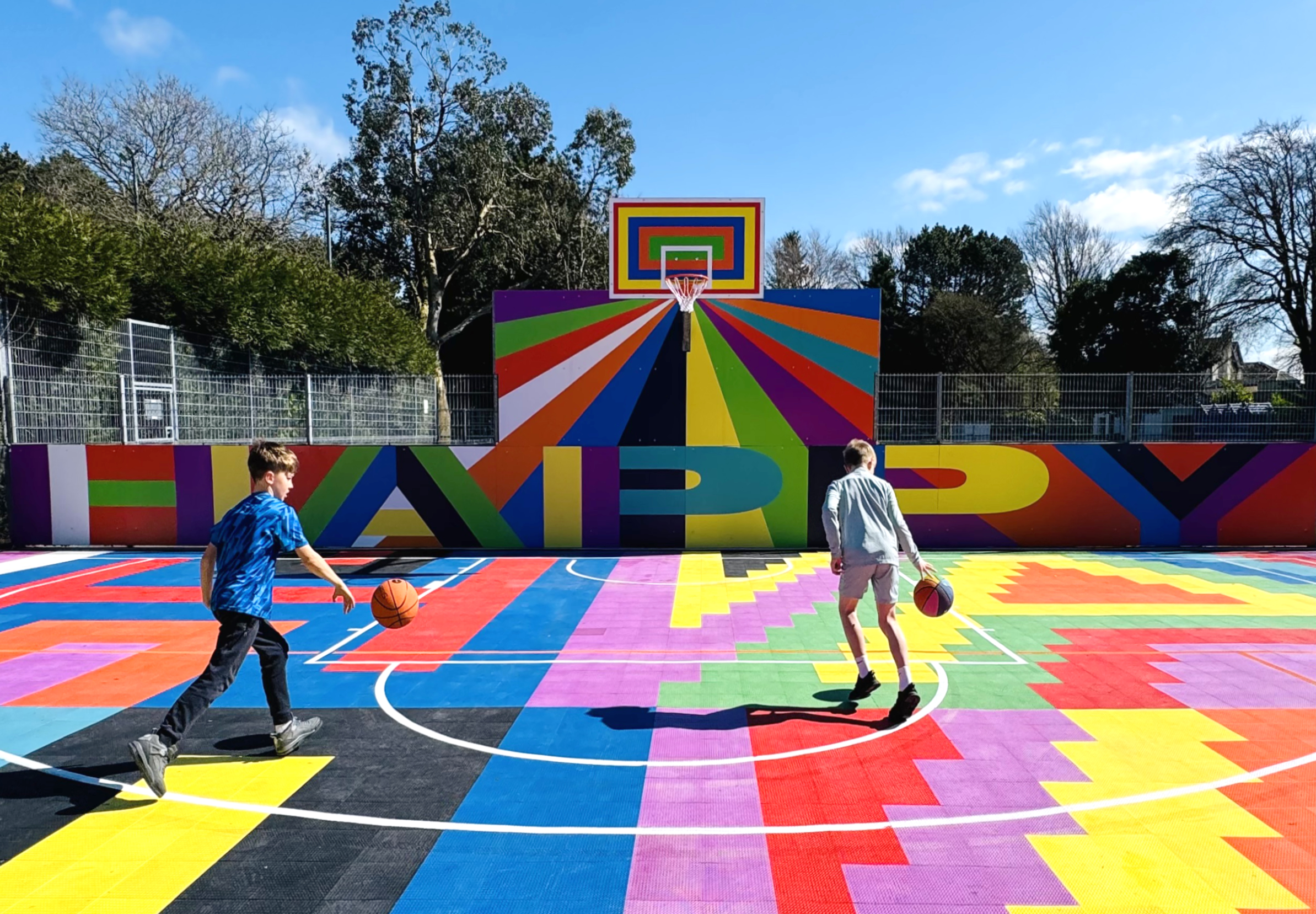
The court is fully playable - basketball, netball, five-a-side - but it also functions as something more subtle: a social condenser.
Maciver’s work explores laughter as a shared human signal - “a fundamental sign of openness, safety and humanity.”
That matters in a town like Morecambe, where public space has historically been both an asset and a challenge. The intervention reframes a “tired” facility into a destination - one that invites movement, gathering, and interaction across generations. It’s not art you look at. It’s art you use.
To understand why this is important, we have to zoom out.
Deco Publique isn’t parachuting artworks into places. It’s building a long-term cultural ecology around Morecambe Bay.
Through the Coastal Commissioning Programme, artists are invited to spend time in the area, responding to its social, environmental and cultural landscape - creating work that is “locally rooted and internationally resonant.”
This is slow, embedded cultural production. Not a one-off installation, but a sequence of interventions that accumulate meaning.
Recent commissions - alongside artists like Daisy Collingridge and Elizabeth Clough - point to a pattern:
And crucially, permanence.
“HA HA HAPPY” itself is partially constructed from reused materials from a previous London installation, signalling not just sustainability but continuity - a literal transfer of cultural capital into Morecambe.

This project doesn’t sit in isolation. Across Morecambe, there’s a growing sense of cultural and civic reactivation:
Even official commentary frames projects like this as adding “a new permanent landmark…that brings people together.”
And that word - permanent - is key. Because Morecambe’s story isn’t about temporary spectacle. It’s about rebuilding confidence in place.
What’s striking about “HA HA HAPPY” is its tone.
It doesn’t lean on nostalgia. It doesn’t aestheticise decline. It doesn’t try to be “gritty”.
Instead, it chooses joy - deliberately, insistently, almost provocatively.
And that might be the most radical move of all.
In a coastal town often framed through deprivation statistics or faded seaside tropes, this is something quite different:
A public artwork that says: this is a place to gather, to play, to laugh.
Morecambe’s renaissance isn't being defined by a single mega-project.
It's being built through layers:
What Deco Publique is doing - and what “HA HA HAPPY” embodies - is helping to write a new grammar for the town: one where public space is active, expressive, and shared.
Not just somewhere you pass through. Somewhere you belong.
Header Image: Lawkena, HA HA HAPPY at Happy Mount Park (2026) Image courtesy Deco Publique and theCOLAB





