



.jpg)
Some public artworks are made to be looked at. At MagNorth, we think the best ones make people look again at the places around them.
In Chapeltown, the joyous Reflections of Carnival mural has already done that. Painted in 2023 by artist Rhian Kempadoo-Millar and commissioned by East Street Arts, the large, colourful mural celebrates the history and spirit of Leeds West Indian Carnival, standing as a landmark at the end of Savile Mount, LS7. Now, the land beneath it is set to become something more than the space in front of an artwork. It is going to be a garden.
The Chapeltown Carnival Mural Garden has been awarded £27,250 from the Veolia Environmental Trust, through the Landfill Communities Fund, to transform what the organisers describe as a small but significant piece of land into a community garden and welcoming public green space.
It might be a modest amount of land, perhaps. But in cities, modest spaces are important. They're where people pass each other, stop for a moment, talk, wait, remember, breathe. They're also where neglect can take hold, and where a neighbourhood’s sense of itself can either be eroded or strengthened.
The project is being delivered by a local planning group made up of Leeds West Indian Carnival, Leeds City Council, East Street Arts and The Ginnel Project, part of Chapeltown Arts Ltd. Together, they're going to develop the site with new planting, landscaping, environmental improvements, community-led activity and a bespoke bench designed by The Ginnel Project, inspired by themes from the mural itself.
The idea isn't about “tidying up” a forgotten corner. It's to create a place that belongs to the people who live around it, walk through it, and understand its cultural significance.
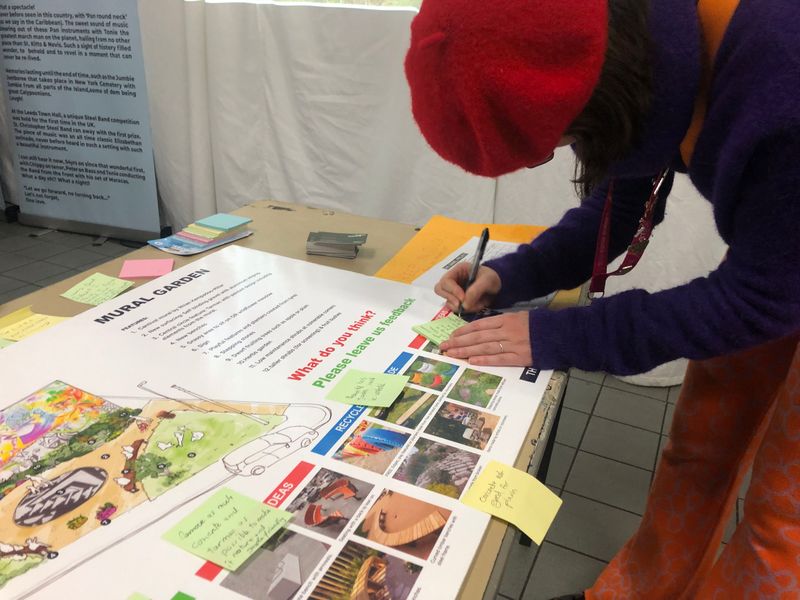
Community consultations have shown strong support for the garden, with residents welcoming the opportunity to transform a neglected part of Chapeltown into a nurtured, usable space that discourages dumping, improves the local environment and reflects the area’s community heritage.
That connection between environment and heritage is key. This isn't placemaking as a branding exercise. It's placemaking as memory work. The site sits close to Carnival House, and the partners describe it as a space that reflects and celebrates the contribution of Leeds’ Caribbean community to the fabric of the city.
Leeds West Indian Carnival, founded in 1967, is recognised as Europe’s first authentic Caribbean Carnival and the largest of its kind outside London, attracting around 150,000 spectators each August Bank Holiday. But Carnival isn't only a spectacular annual event. It's a living cultural tradition, supported by lots of amazing year-round work in costume design, Carnival arts training, youth residencies, cultural exchange and community partnership.
This new garden understands that. It treats Carnival not as a parade that appears once a year and then disappears, but as a cultural force that's embedded in Chapeltown’s streets, institutions, families and public imagination.
Stuart Bailey, Trustee for Leeds West Indian Carnival, said the award marks “an exciting new chapter” for the legacy of the Reflections of Carnival mural. What began as a public artwork celebrating more than 50 years of Carnival in Leeds, he said, has evolved into a “community-led vision for the neighbourhood”.
Community-led vision - as a phrase - does a lot of leg-work. Because sometimes murals, like gardens, can be imposed badly. They can appear in places without much listening, become civic decoration, then fade. This project seems to be moving in the opposite direction: from artwork to conversation, from conversation to plan, from plan to shared space.
The bench is going to be central to that. Sandra Whyles, who leads The Ginnel Project, said it will reflect “both the spirit of carnival and the need for a strong, welcoming place to sit and take in the mural and cityscape.” Its design has drawn on artistic, architectural and landscape expertise, with an Adinkra symbol from Ghana chosen to represent freedom and emancipation after becoming the clear favourite in community consultations.
A bench might sound like a small thing. But it's not. A bench says: you are allowed to be here. You can stop. You do not have to be moving, buying, working, waiting for permission. In a city where too many public spaces are either hostile, over-managed or quietly privatised, somewhere to sit beneath a mural celebrating Carnival is a political and cultural gesture as well as a practical one.
For East Street Arts, that's part of the point. Melody Walker said the project shows how artists and communities can shape the future of neighbourhoods, adding that public art should do more than transform walls: it should “spark conversations, build relationships and inspire long-term change.”
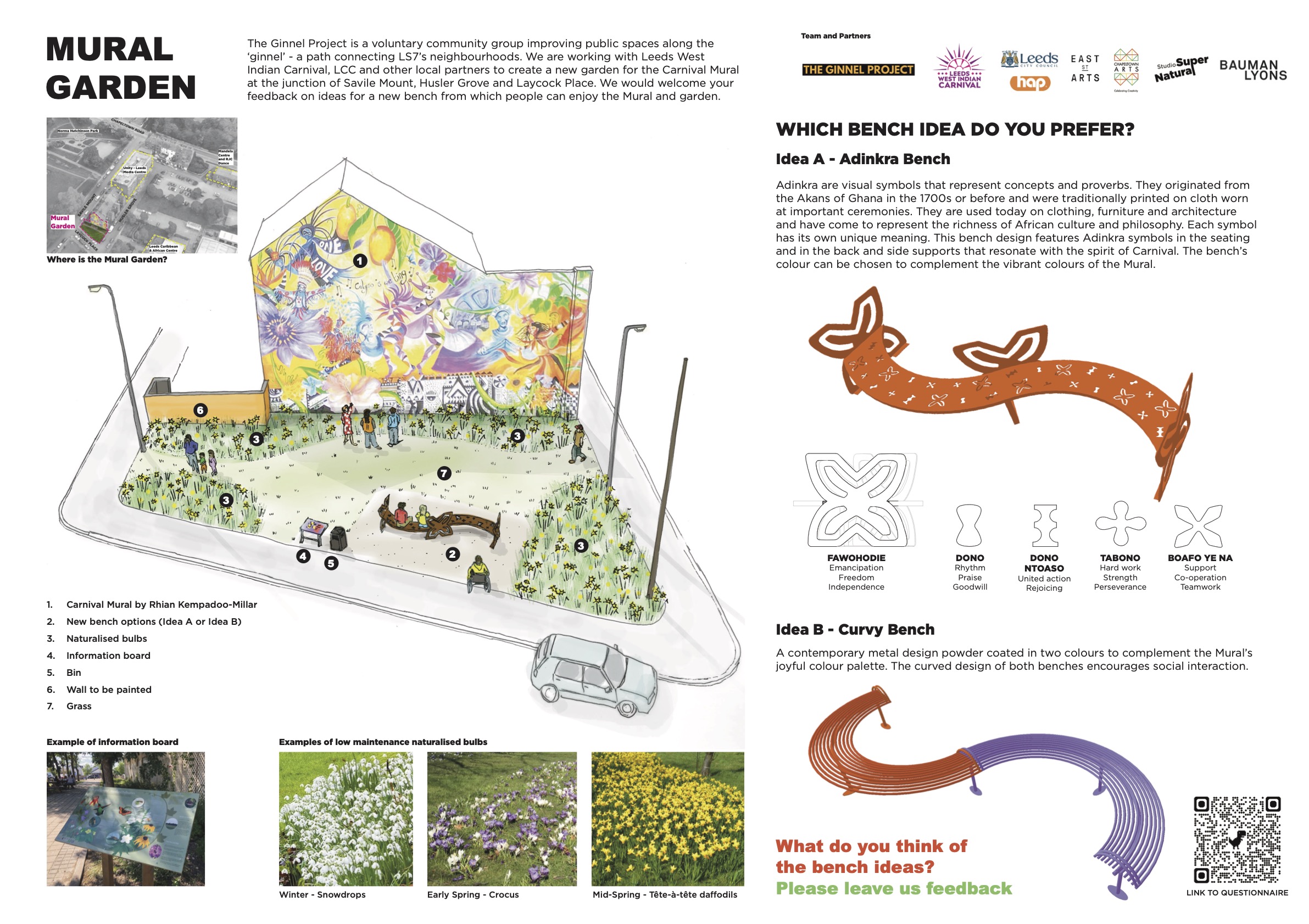
The Mural Garden will also sit at one end of the Chapeltown ginnel between Sheepscar and Potternewton Lane, giving it a role as either a starting point or destination for people moving through the neighbourhood. The Ginnel Project has long worked to improve and maintain that route through planting, design, clearing and community activity, relying heavily on local volunteers.
In that sense, this is also a story about the overlooked infrastructure of everyday life: ginnels, corners, benches, planting, walls, shortcuts, gathering points. The things cities often fail to notice until communities insist that they do matter.
Work funded by the grant is due to begin over the next few weeks, with opportunities for residents and young people to take part in planting, maintenance sessions and creative activities.
And perhaps that's the loveliest part of it. The mural won't simply be something finished and fixed. Its setting will keep growing. People will tend it, use it, pass through it, sit within it, and make it part of ordinary days.
In Chapeltown, a public artwork is becoming a public place. And that feels exactly as it should be.
The Chapeltown Carnival Mural Garden is being developed by Leeds West Indian Carnival, The Ginnel Project, Leeds City Council and East Street Arts, with support from the Veolia Environmental Trust through the Landfill Communities Fund.
Header image: The Reflections of Carnival mural in Chapeltown, Leeds





