



Too often, the history of classical music is told as a localised fairy tale of Vienna, Leipzig, or Paris. We are taught to look to the sun-drenched valleys of the Rhine or the manicured salons of Austria to find the roots of nineteenth-century musical genius.
But I tell you, as a proud Yorkshireman, that one of the most vital, intoxicating, and revolutionary currents of modern composition was forged not in the shadow of the Alps, but amidst the towering, smoke-kissed grit of Victorian West Yorkshire.
This is the story of the incomparable Frederick Delius. And I speak of the crucible that birthed his unique artistic vision: an architectural marvel nestled in the manufacturing heart of Bradford, known to the world as Little Germany.
To understand Delius is to understand a musical alchemist who dissolved the rigid, clinical boundaries of traditional form into a fluid celebration of classical. But this revolutionary voice did not emerge from a vacuum. It was the direct product of a cultural bridge between the industrial might of northern England and the intellectual landscapes of continental Europe. And that portal was built, stone by stone, in the grand merchant palaces of Bradford.
Just imagine the scene: it is the late nineteenth century. Bradford is the undisputed, roaring "Wool Capital of the World." The air hums with the clatter of looms and the fierce vitality of an empire built on textiles.
Yet, just a stone's throw from the soot-blackened factories, there arises an architectural marvel that feels entirely alien to the standard industrial landscape. This is Little Germany. A dense, concentrated quarter of grand, neoclassical warehouses, built with an opulence that rivaled the finest Italianate palazzos of Florence or Venice. But it was not just the stone that made Little Germany so important.
This quarter was populated by a brilliant, highly educated diaspora of European merchants - predominantly German textile traders who brought with them an unquenchable, fiery passion for the arts, philosophy, and above all, music.
Here, in the industrial north, was a thriving cosmopolitan ecosystem. In the grand drawing rooms of Little Germany, the hard-nosed realities of Victorian commerce melted away, replaced by the fierce debates of European romanticism, the poetry of Heine and Goethe, and the revolutionary scores of Richard Wagner and Johannes Brahms. It was a golden, creative conduit linking the manufacturing muscle of Yorkshire directly to the avant-garde cultural movements of Europe. And it was into the very heart of this intoxicating, binary world that Fritz Theodor Albert Delius was born in 1862.

Listen to the counterpoint of Delius’s early life. His father, Julius Delius, was a fiercely proud German wool merchant who had settled in Bradford to seize the immense fortunes of the textile boom. Julius expected his son to follow the family ledger, to master the utilitarian mechanics of the trade, to be a man of commerce.
But the young man’s soul had already been captured by music. Fritz was raised in a household where the finest European musicians, visiting Leeds or Bradford, would routinely stay and perform chamber music. He breathed in the rich, heavy atmosphere of Little Germany’s elite right here in Bradford.
He saw that the very wealth generated by the Yorkshire wool trade was being used to fund an insatiable appetite for European high culture. Yet, the young composer felt trapped between two worlds. The stark, uncompromising machinery of the Yorkshire wool trade pressed against him on one side, while the seductive, chromatic harmonic languages of Europe beckoned from the other.
When his father sent him abroad to manage business interests, Fritz completely abandoned the ledgers. Instead, whether exploring the orange groves of Florida - where the improvisational, sorrowful, and beautiful singing of African-American plantation workers forever altered his harmonic sensibilities - or studying at the Leipzig Conservatoire. Delius was running away from the ledger toward the light.
But make no mistake: you can take the boy out of Yorkshire, but you cannot take Yorkshire out of the boy. The tension between the gritty, industrial driving force of Bradford and the romantic, untamed dreamscape of his ancestral Europe created the volatile, creative spark that defined his entire career.
So, what was it about Delius’s music that made him so fundamentally important? Delius was the bridge between the old world and the new. He rejected the academic, rigorous, paint-by-numbers structures of the late-Victorian classical establishment. He did not care for strict sonata forms or mathematical fugues. Instead, Delius sought to capture the fleeting textures of nature, memory, and human emotion.
When you listen to his masterworks - such as On Hearing the First Cuckoo in Spring, In a Summer Garden, or the magnificent, sprawling North Country Sketches - you are listening to a completely unique form of musical Impressionism. It is a sonic tapestry where chords shift and bleed into one another like colors at sunset.
This entirely original style was born directly from the cultural cross-pollination of Little Germany. The cosmopolitan tolerance, the exposure to radical continental harmonies, and the deep, underlying nostalgia for the rugged landscape of the North all coalesced in his mind.
Delius took the raw, untamed beauty of the West Yorkshire landscape, the bleak, majestic sweeps of the moors, the sudden, brilliant bursts of northern springtime, and filtered them through the sophisticated, harmonic lenses he discovered through his family’s European connections.
Little Germany and Bradford gave him the tools, the vocabulary, and the worldly perspective to turn regional English poetry into universal, symphonic art. He proved to the world that the industrial North was not a cultural wasteland, but a fertile greenhouse capable of producing world-class avant-garde genius.
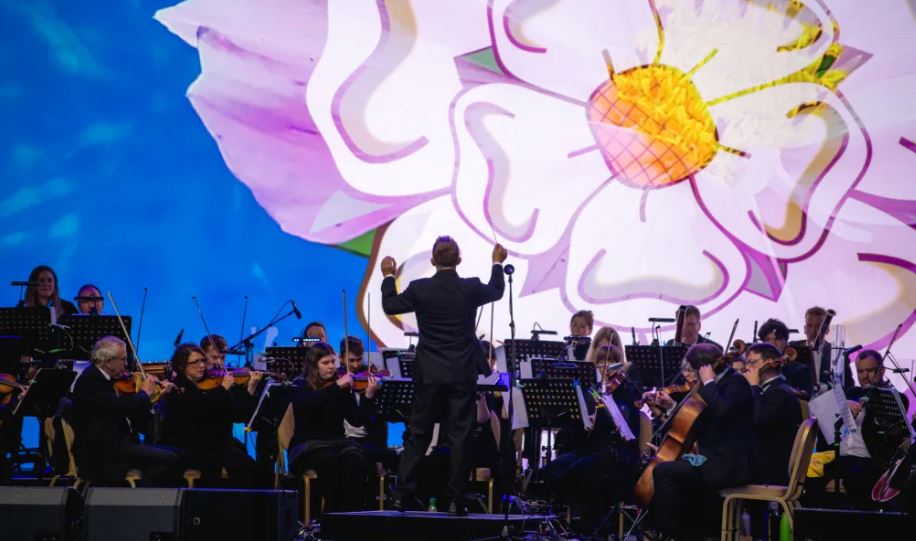
Today, Delius stands as one of the North of England‘s most important composers. That’s why to celebrate Yorkshire Day on Saturday August 1st we are performing his music as part of the inaugural Yorkshire Proms. This event will burst into glorious life at the iconic St George’s Hall in Bradford.
The conert won’t be a passive, elitist spectacle to be watched in polite, muted silence. It’ll be a roaring, passionate, inclusionary engine of massed local voices. The evening will feature a stunning programme celebrating our rich cultural tapestry. Alongside Delius, audeinces will experience the cinematic genius of John Barry, works by Jarrod Royles Atkins and Ernest Farrar, and a beautiful medley of traditional Yorkshire folk songs.
But remember the golden rule of the Proms: you are part of the music! Bring your Yorkshire flags, wave them high, and prepare to lift the roof off St George’s Hall as the entire auditorium unites for a passionate sing-along of Land of Hope and Glory, Jerusalem, and the ultimate northern anthem, On Ilkla Moor Baht 'at!
Tickets and Info Here
Header image: Former Mill buildings in Bradford's Little Germany (Derek Oldfield)





