



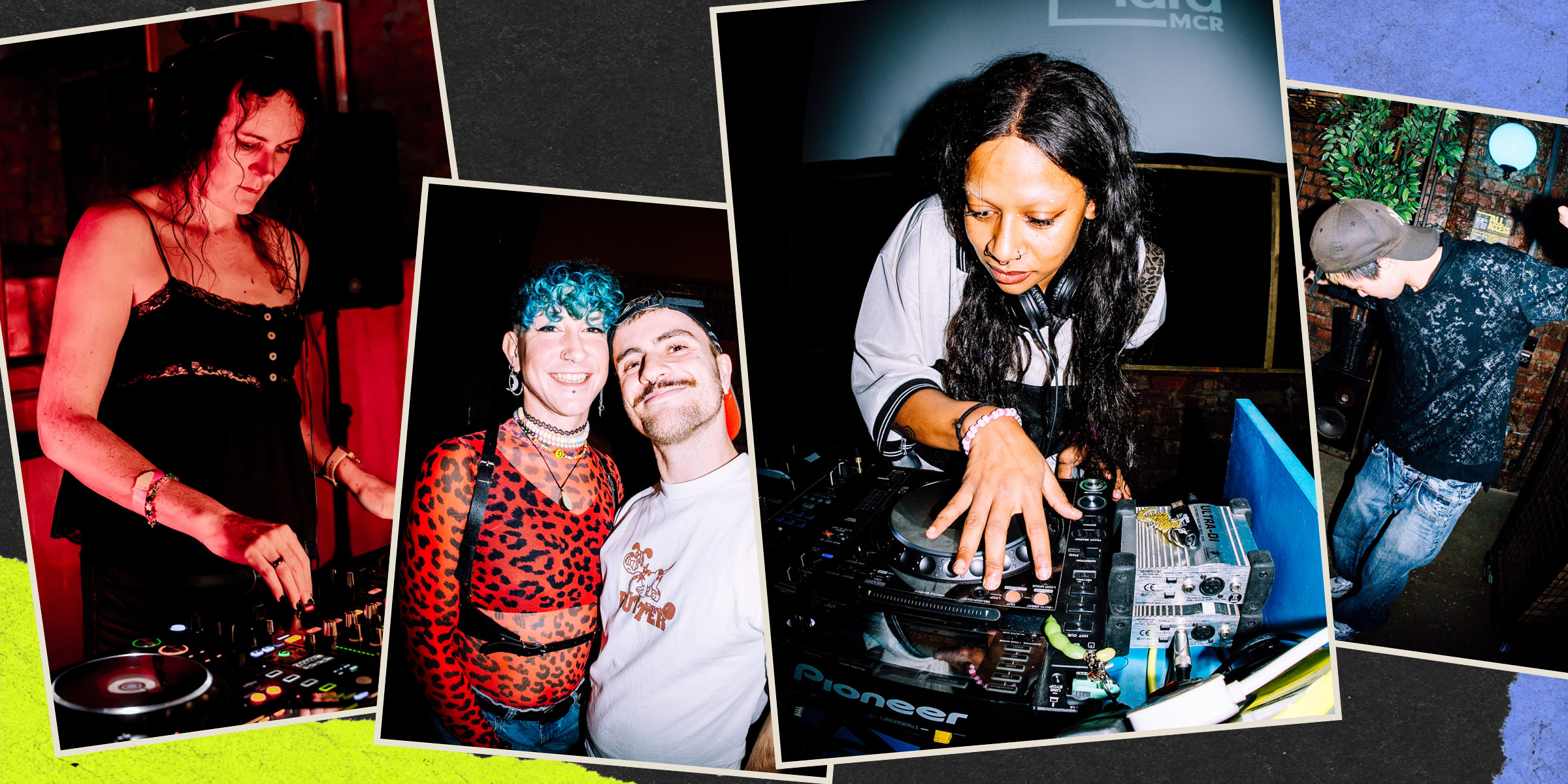
As Storm Boelo batters the streets outside with howling wind and rain, inside The Yard, DJ Xanda is tearing through a thunderous set highlighted by pummelling remixes of The Prodigy.
It’s a Saturday afternoon in October and I’m at All Access, an accessible day rave at The Yard, an arts hub and creative space in Manchester’s Cheetham Hill. The event is a collaboration between online accessibility information and advocacy platform, Discability, and DJ Club, a DJ collective that runs free, inclusive electronic music events. All Access is part of a cluster of events in Manchester, alongside United By The Groove and Under One Roof bringing ravers together to raise awareness and build a blueprint for what accessible clubbing can and should look like.
“Discability started two years ago when I first started DJing and realised that there wasn't any discussion around access,” says Pip, DJ and founder of Discability.
Both Pip’s experiences as a neurodivergent DJ and attending events with her dad, who has Parkinson’s, led to the creation of Discability. She says that venues and promoters often use the term ‘accessible’ and a come as you are tagline, but the reality is often a box ticking exercise void of consultation. In contrast, an intentional, receptive and dialogue-driven approach puts accessibility at the forefront of All Access.
Everyone in attendance, including myself, and the full line-up of disabled and neurodivergent artists, was invited to fill out an ‘access rider’ in the weeks prior to the event, making organisers aware of accessibility needs and opening a clear channel of communication with the venue well in advance. It’s similar to being asked about allergies when you book a restaurant table.

The Yard is significant in that it has a ramp and an accessible toilet but other adjustments have been made too. The DJ booth is step-free with the decks on one level. A separate, private green room for artists allows for a calm space to prepare and warm down from their set. The main space features a lowered bar. There’s no strobing and additional seating has been provided around the dancefloor. A clearly marked welfare team is present throughout the night.
A second chill out room, soundtracked by Leeds Ambient Trance Community, provides ambient music and calming lighting for those feeling overstimulated or in need of a breather. Pip tells me that even the poster has been carefully considered. An engaging design with clear and dictation software-friendly font. Crop Radio is livestreaming for those unable to attend.
“You don’t need to spend thousands of pounds,” Pip says, acknowledging the difficult financial circumstances that many grassroots venues operate in. “It's about doing what you can to make your event the most accessible it can be.” For at least one person in attendance, this consideration and clear communication has inspired their first ever visit to a rave.
“I think that this should be news. It’s extraordinary. Three different events [in Manchester] going on simultaneously trying to highlight this stuff. I’ve never seen that before in my life,” says Finley Allen, 24, an electronic music producer and DJ who lives in Cardiff and travels to Manchester regularly for events. He is full of praise for All Access.
“More venues need to realise that the reason they don’t get more disabled people at their events is, if [disabled people] can’t go to places, why are you going to see them?" Finley likens it to a chicken and egg scenario. Visibility is key in giving others the confidence to attend. It highlights demand. But that confidence must be met with transparency and communication from venues.
Finley, a wheelchair user with cerebral palsy, says that’s why something as simple as an access rider is so important. It helps to reduce the fear and anxiety before an event. He compares it to adjustments venues will happily make. “If an artist asks for only blue M&M’S, two bottles of Grey Goose vodka and a peeled apple, you know [a venue] will give it to them,” he says. In contrast, reasonable adjustment is often met with barriers or reluctance.
In the 2026 State of Access Report by music accessibility charity, Attitude is Everything, 94% of respondents reported that attending events exposed them to additional personal risk. 67% described provisions as either ‘inconsistent’ or ‘very inconsistent’, with 13% saying access provisions cannot be relied upon at all. This inconsistency carries a measurable disability tax: approximately £99 per audience visit, £138 per artist performance and £184 per professional engagement.
Under One Roof and United By The Groove are two other clubnights platforming accessibility in Manchester. The former, founded by DJ and promoter Alice Woods, which works closely with self-advocacy organisation Manchester People First, will next year celebrate a decade of putting on four accessible nights per year at Manchester music venue, YES, creating safe rave environments for adults with disabilities and learning difficulties. Alice tells me that DJ Seinfeld and Ben Pearce played early events, with lineups now platforming disabled artists.

“Everyone says ‘That was the best night I've ever played’ because of the crowd reaction,” Alice says. “There is such freedom on the dance floor. People are so in the moment.”
When Claire Louise, the accessibility content creator behind Raveable, tells me about attending the first United By The Groove event, she describes it as a defining moment. “I actually felt like me again for the first time since I'd been in a wheelchair and that was incredible,” she says.
“I hadn't got that much into the scene then, and I was raving on access platforms, not really mixing with people. [United By The Groove] was the first event that I went to, and I was surrounded by people that were there because they knew it was about disability. So nobody was judging me for being disabled.”
United By The Groove was founded in 2025, by Joe Skinner and his close friends Lee and Gabe. Joe, who works in disability sport at Burnley FC and also creates content for his social media platform, Wheeltalklife, tells me that growing up, he was surrounded by the stories and sounds of his mum’s experiences in the early acid house scene.
“Whenever we had people round the house, dance music was always on, and I saw how people in the room reacted to that sound and that feeling. I've always wanted a piece of that,” says Joe.
United By The Groove is rooted in that same sense of community. The accessible clubnight, which also takes place at The Yard in Manchester, is just two events old but has already built strong bonds. The first event in September 2025 saw 70 people attend, with Creamfields lineup alumni Jake Smith headlining and money raised for the disability charity, Sense UK. Finley has played the event and he, Joe and Claire have become close friends through attending.
People travel too. Joe, who has cerebral palsy and uses a wheelchair, mentions a lad travelling all the way from London with his mum for his first ever rave. “Someone else travelled from Plymouth. He told me he has the same condition as me. He is a teacher and has kids. Music is at the forefront [of the event], but the byproduct is other conversations that take place,” says Joe.
“I also think it’s important to mention that it shouldn’t be down to three working class lads with full-time jobs from the North of England with virtually no resources,” says Joe. At times he refers to United By The Groove as an “uprising” and it’s a sentiment shared across the people I speak to running these events. Many of whom are either small teams or one person in the case of Alice at Under One Roof.
“It would be good if it wasn't just left to people who didn't have any financial backing behind them. Because I'll be honest, without financial backing or support from the wider industry, we don't know how far we can take it. It's a very physically and emotionally exhausting process to put these events on yourself. I guess that's a message to anyone reading the article. If you want to get on board, come and help us, because we'd love to do it more.”
In a city internationally celebrated for its dance music culture, the volume is gradually being turned up on the next chapter of inclusive clubbing. It doesn’t cost anything to listen to the voices involved in this fledgling movement and dancefloors will be all the better for doing so.
All images: Murren Watson aka @diva_shoots


